

 登录
登录
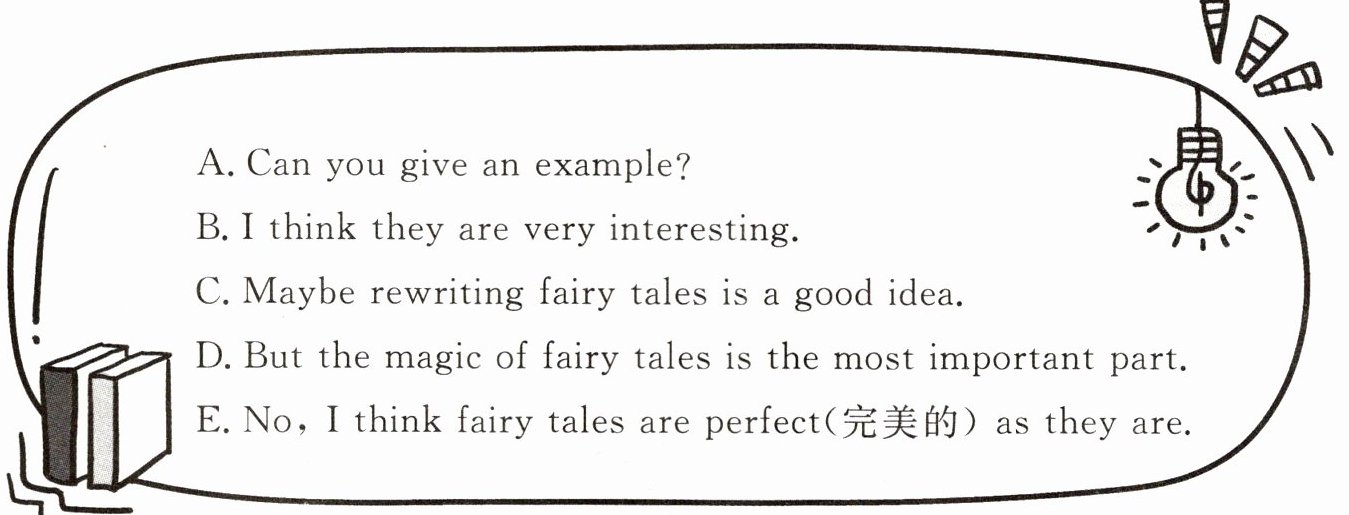
八、玲玲和大明正在讨论是否应该改写童话故事。读一读,选择合适的句子补全对话。
Lingling: Do you like reading fairy tales?
Daming: Yes, I like them very much. 1.
Lingling: Do you think we should rewrite fairy tales?
Daming: 2.
Lingling: I don't agree with(赞同) you. Some parts of them are not realistic.
Daming: 3.
Lingling: Why do you think so? We can keep the magic and add some good ideas.
Daming: 4.
Lingling: Of course. Let me show you one. For example, Goldilocks can help the bears clean the house after making a mess.
Daming: That sounds good! 5.
Lingling: Do you like reading fairy tales?
Daming: Yes, I like them very much. 1.
B
Lingling: Do you think we should rewrite fairy tales?
Daming: 2.
E
Lingling: I don't agree with(赞同) you. Some parts of them are not realistic.
Daming: 3.
D
Rewriting them will make them lose their magic.Lingling: Why do you think so? We can keep the magic and add some good ideas.
Daming: 4.
A
Lingling: Of course. Let me show you one. For example, Goldilocks can help the bears clean the house after making a mess.
Daming: That sounds good! 5.
C
答案
1. B
2. E
3. D
4. A
5. C
2. E
3. D
4. A
5. C
解析
【分析】
本题为英语补全对话题,围绕“是否应该改写童话故事”的话题展开,需结合上下文语境及日常交际用语的逻辑衔接选择合适选项。解题时先通读对话把握主题,再逐个分析每个空前后的语句:1. 大明表达喜欢童话后,需补充对童话的正面评价;2. 玲玲问是否改写童话,大明需给出明确态度;3. 玲玲提出改写的理由,大明需反驳并说明核心观点;4. 玲玲说可保留魔力加点子,大明需进一步询问具体例子;5. 玲玲举例后,大明需给出最终看法。
【解析】
1. 第一空:大明前一句说“非常喜欢童话”,选项B“我觉得它们很有趣”是对童话的正面评价,符合语境;
2. 第二空:玲玲问“是否应该改写童话”,选项E“不,我觉得童话本身就很完美”是否定改写的态度,衔接自然;
3. 第三空:玲玲说“不同意,因为有些部分不现实”,选项D“但童话的魔力是最重要的部分”承接大明反对改写的理由,说明改写会失去核心;
4. 第四空:玲玲说“可以保留魔力加好点子”,选项A“你能举个例子吗?”符合大明想验证的逻辑,引出下文玲玲的举例;
5. 第五空:玲玲举了Goldilocks的例子,大明觉得好,选项C“也许改写童话是个好主意”是大明听完例子后的最终看法,符合语境。
【答案】
1. B 2. E 3. D 4. A 5. C
【知识点】
英语补全对话、日常交际用语
【点评】
本题围绕日常话题考查英语交际用语的运用,逻辑清晰,选项贴合语境,是基础的补全对话题型,适合初中阶段学生练习。
【难度系数】
0.6
本题为英语补全对话题,围绕“是否应该改写童话故事”的话题展开,需结合上下文语境及日常交际用语的逻辑衔接选择合适选项。解题时先通读对话把握主题,再逐个分析每个空前后的语句:1. 大明表达喜欢童话后,需补充对童话的正面评价;2. 玲玲问是否改写童话,大明需给出明确态度;3. 玲玲提出改写的理由,大明需反驳并说明核心观点;4. 玲玲说可保留魔力加点子,大明需进一步询问具体例子;5. 玲玲举例后,大明需给出最终看法。
【解析】
1. 第一空:大明前一句说“非常喜欢童话”,选项B“我觉得它们很有趣”是对童话的正面评价,符合语境;
2. 第二空:玲玲问“是否应该改写童话”,选项E“不,我觉得童话本身就很完美”是否定改写的态度,衔接自然;
3. 第三空:玲玲说“不同意,因为有些部分不现实”,选项D“但童话的魔力是最重要的部分”承接大明反对改写的理由,说明改写会失去核心;
4. 第四空:玲玲说“可以保留魔力加好点子”,选项A“你能举个例子吗?”符合大明想验证的逻辑,引出下文玲玲的举例;
5. 第五空:玲玲举了Goldilocks的例子,大明觉得好,选项C“也许改写童话是个好主意”是大明听完例子后的最终看法,符合语境。
【答案】
1. B 2. E 3. D 4. A 5. C
【知识点】
英语补全对话、日常交际用语
【点评】
本题围绕日常话题考查英语交际用语的运用,逻辑清晰,选项贴合语境,是基础的补全对话题型,适合初中阶段学生练习。
【难度系数】
0.6
九、每个人都有自己的观点,我们要学会表达自己,也要学会尊重他人。阅读短文,完成下列任务。
Everyone has their own opinions. Your opinion can be very different from others'. For example, “I think reading is more interesting than playing computer games.” It's an opinion. Facts are different from opinions. Facts are true things, and they never change. For example, “The earth goes around the sun.”
When you have different opinions, you can talk about them with others. You can also have a debate to share your ideas. When you have a talk with others, you should respect(尊重) them. It's important to listen to others' opinions. Maybe you don't agree with others, but you can still learn something from them.
任务一:判断下列句子的正误,正确的写“T”,错误的写“F”。
(
(
(
(
(
任务二:提升题根据短文内容回答问题。
1. What is the difference between facts and opinions?
2. What can we do when we have different opinions?
3. What should we do when we have a talk with others?
Everyone has their own opinions. Your opinion can be very different from others'. For example, “I think reading is more interesting than playing computer games.” It's an opinion. Facts are different from opinions. Facts are true things, and they never change. For example, “The earth goes around the sun.”
When you have different opinions, you can talk about them with others. You can also have a debate to share your ideas. When you have a talk with others, you should respect(尊重) them. It's important to listen to others' opinions. Maybe you don't agree with others, but you can still learn something from them.
任务一:判断下列句子的正误,正确的写“T”,错误的写“F”。
(
F
)1. Everyone has a similar opinion.(
T
)2. We can have a debate to share different ideas.(
T
)3. We should respect others' opinions.(
F
)4. When you don't agree with others, you can't learn from them.(
T
)5. Facts are different from opinions, because facts never change.任务二:提升题根据短文内容回答问题。
1. What is the difference between facts and opinions?
Everyone has their own opinions, and their opinions can be different. Facts are true things, and they never change.
2. What can we do when we have different opinions?
We can talk about them with others and have a debate to share our ideas.
3. What should we do when we have a talk with others?
We should respect them and listen to their opinions.
答案
任务一:
1. F
2. T
3. T
4. F
5. T
任务二:
1. Everyone has their own opinions, and their opinions can be different. Facts are true things, and they never change.
2. We can talk about them with others and have a debate to share our ideas.
3. We should respect them and listen to their opinions.
1. F
2. T
3. T
4. F
5. T
任务二:
1. Everyone has their own opinions, and their opinions can be different. Facts are true things, and they never change.
2. We can talk about them with others and have a debate to share our ideas.
3. We should respect them and listen to their opinions.
解析
【分析】
首先通读短文,理解短文围绕观点与事实的区别、不同观点的处理方式展开的主旨。任务一的判断正误需将题目句子与原文逐一比对,判断是否一致;任务二的回答问题需根据问题关键词定位原文对应语句,提取并整理信息作答。
【解析】
任务一:1. 原文提到“Everyone has their own opinions. Your opinion can be very different from others'”,说明每个人观点不同,并非相似,故判断为错误;2. 原文明确表述“You can also have a debate to share your ideas”,故判断为正确;3. 原文指出“When you have a talk with others, you should respect(尊重) them”,故判断为正确;4. 原文说明“Maybe you don't agree with others, but you can still learn something from them”,即不同意他人也能学到东西,故判断为错误;5. 原文提到“Facts are different from opinions. Facts are true things, and they never change”,故判断为正确。
任务二:1. 定位短文第一段,提取观点与事实的区别相关语句整理为答案;2. 定位短文第二段第一句,提取不同观点时的做法;3. 定位短文第二段关于谈话要求的语句整理为答案。
【答案】
任务一:1.F 2.T 3.T 4.F 5.T
任务二:1.Everyone has their own opinions, and their opinions can be different. Facts are true things, and they never change.
2.We can talk about them with others and have a debate to share our ideas.
3.We should respect them and listen to their opinions.
【知识点】
英语阅读理解、细节理解、任务型阅读
【点评】
本题为英语任务型阅读理解题,侧重考查学生对短文细节信息的提取与判断能力,题目均基于原文内容设置,难度适中,学生只要认真阅读短文、准确定位对应语句即可完成作答,有助于巩固基础阅读技能。
【难度系数】
0.7
首先通读短文,理解短文围绕观点与事实的区别、不同观点的处理方式展开的主旨。任务一的判断正误需将题目句子与原文逐一比对,判断是否一致;任务二的回答问题需根据问题关键词定位原文对应语句,提取并整理信息作答。
【解析】
任务一:1. 原文提到“Everyone has their own opinions. Your opinion can be very different from others'”,说明每个人观点不同,并非相似,故判断为错误;2. 原文明确表述“You can also have a debate to share your ideas”,故判断为正确;3. 原文指出“When you have a talk with others, you should respect(尊重) them”,故判断为正确;4. 原文说明“Maybe you don't agree with others, but you can still learn something from them”,即不同意他人也能学到东西,故判断为错误;5. 原文提到“Facts are different from opinions. Facts are true things, and they never change”,故判断为正确。
任务二:1. 定位短文第一段,提取观点与事实的区别相关语句整理为答案;2. 定位短文第二段第一句,提取不同观点时的做法;3. 定位短文第二段关于谈话要求的语句整理为答案。
【答案】
任务一:1.F 2.T 3.T 4.F 5.T
任务二:1.Everyone has their own opinions, and their opinions can be different. Facts are true things, and they never change.
2.We can talk about them with others and have a debate to share our ideas.
3.We should respect them and listen to their opinions.
【知识点】
英语阅读理解、细节理解、任务型阅读
【点评】
本题为英语任务型阅读理解题,侧重考查学生对短文细节信息的提取与判断能力,题目均基于原文内容设置,难度适中,学生只要认真阅读短文、准确定位对应语句即可完成作答,有助于巩固基础阅读技能。
【难度系数】
0.7
