

 登录
登录
Ⅰ. Read and complete the tasks.
A. Complete the posters with proper words according to the Chinese or the phonetic symbols given.
Lily
1.(回收利用)
It turns waste into new products. It helps
2. (/rɪˈdjuːs/) the amount of rubbish sent to the trash bin. For example, a clear bottle might return as a brand-new glass bowl. And used paper, 3. (/ɪˌlekˈtrɒnɪk/) devices can also be sent to the factory.
Tom
4.(升级改造)
It gives old items a new purpose with higher value in a 5.(有创造力) way. A common example is turning an old glass bottle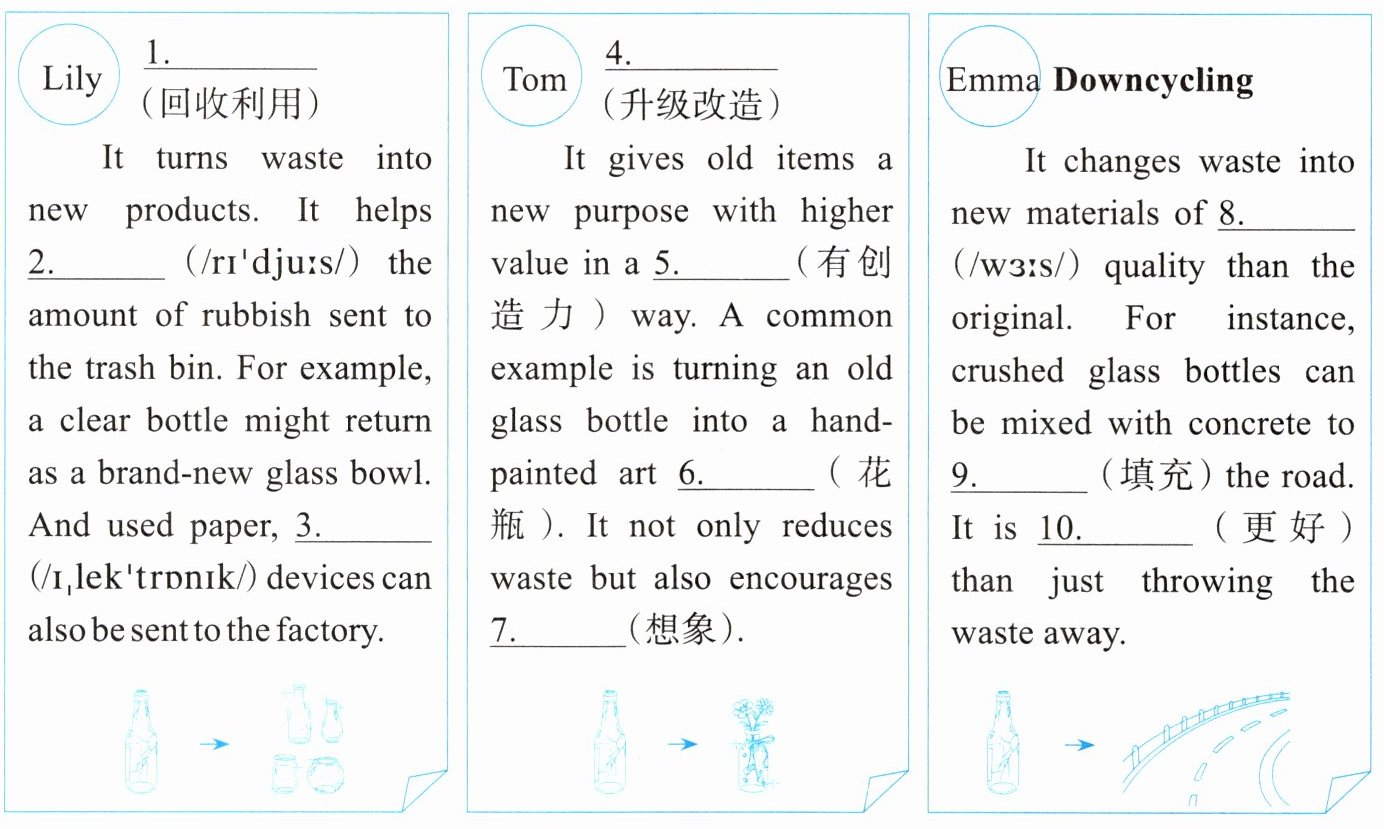 into a hand-painted art 6.(花瓶). It not only reduces waste but also encourages 7.(想象).
Emma Downcycling
It changes waste into new materials of 8. (/wɜːs/) quality than the original. For instance, crushed glass bottles can be mixed with concrete to 9.(填充)the road. It is 10.(更好)than just throwing the waste away.
A. Complete the posters with proper words according to the Chinese or the phonetic symbols given.
Lily
1.(回收利用)
It turns waste into new products. It helps
2. (/rɪˈdjuːs/) the amount of rubbish sent to the trash bin. For example, a clear bottle might return as a brand-new glass bowl. And used paper, 3. (/ɪˌlekˈtrɒnɪk/) devices can also be sent to the factory.
Tom
4.(升级改造)
It gives old items a new purpose with higher value in a 5.(有创造力) way. A common example is turning an old glass bottle
into a hand-painted art 6.(花瓶). It not only reduces waste but also encourages 7.(想象).Emma Downcycling
It changes waste into new materials of 8. (/wɜːs/) quality than the original. For instance, crushed glass bottles can be mixed with concrete to 9.(填充)the road. It is 10.(更好)than just throwing the waste away.
答案
1. Recycling 2. reduce 3. electronic 4. Upcycling 5. creative 6. vase 7. imagination 8. worse 9. fill 10. better
解析
【分析】
本题是根据中文提示、音标及语境完成单词填空的题目,解题思路为:先明确每个空的提示类型(中文意思、音标),再结合句子结构、词性要求,匹配对应的正确英文单词,同时注意单词的形式(如比较级、词性转换等)。
【解析】
1. 中文提示“回收利用”,对应名词形式,Lily的主题是回收,故填Recycling;
2. 音标为/rɪˈdjuːs/,对应动词reduce,help后接动词原形,故填reduce;
3. 音标为/ɪˌlekˈtrɒnɪk/,需形容词修饰名词devices,故填electronic;
4. 中文提示“升级改造”,对应名词形式,Tom的主题是升级改造,故填Upcycling;
5. 中文提示“有创造力”,需形容词修饰名词way,故填creative;
6. 中文提示“花瓶”,对应名词vase,故填vase;
7. 中文提示“想象”,需名词作encourages的宾语,故填imagination;
8. 音标为/wɜːs/,且有than表示比较,故填worse;
9. 中文提示“填充”,to后接动词原形,故填fill;
10. 中文提示“更好”,且有than表示比较,故填better。
【答案】
1. Recycling 2. reduce 3. electronic 4. Upcycling 5. creative 6. vase 7. imagination 8. worse 9. fill 10. better
【知识点】
单词拼写、词性辨析、比较级用法
【点评】
本题考查基础词汇的拼写与运用,结合中文提示、音标及语境即可完成,难度较低,适合巩固基础词汇。
【难度系数】
0.8
本题是根据中文提示、音标及语境完成单词填空的题目,解题思路为:先明确每个空的提示类型(中文意思、音标),再结合句子结构、词性要求,匹配对应的正确英文单词,同时注意单词的形式(如比较级、词性转换等)。
【解析】
1. 中文提示“回收利用”,对应名词形式,Lily的主题是回收,故填Recycling;
2. 音标为/rɪˈdjuːs/,对应动词reduce,help后接动词原形,故填reduce;
3. 音标为/ɪˌlekˈtrɒnɪk/,需形容词修饰名词devices,故填electronic;
4. 中文提示“升级改造”,对应名词形式,Tom的主题是升级改造,故填Upcycling;
5. 中文提示“有创造力”,需形容词修饰名词way,故填creative;
6. 中文提示“花瓶”,对应名词vase,故填vase;
7. 中文提示“想象”,需名词作encourages的宾语,故填imagination;
8. 音标为/wɜːs/,且有than表示比较,故填worse;
9. 中文提示“填充”,to后接动词原形,故填fill;
10. 中文提示“更好”,且有than表示比较,故填better。
【答案】
1. Recycling 2. reduce 3. electronic 4. Upcycling 5. creative 6. vase 7. imagination 8. worse 9. fill 10. better
【知识点】
单词拼写、词性辨析、比较级用法
【点评】
本题考查基础词汇的拼写与运用,结合中文提示、音标及语境即可完成,难度较低,适合巩固基础词汇。
【难度系数】
0.8
B. Let’s classify! Write RECYCLE, UPCYCLE or DOWNCYCLE in each blank.
1. An old glass bottle is painted and turned into an art vase.
2. Old glass bottles are crushed into small pieces to fill the road.
3. An old glass bottle is melted and remade into a new glass bowl.
1. An old glass bottle is painted and turned into an art vase.
UPCYCLE
2. Old glass bottles are crushed into small pieces to fill the road.
DOWNCYCLE
3. An old glass bottle is melted and remade into a new glass bowl.
RECYCLE
答案
1. UPCYCLE 2. DOWNCYCLE 3. RECYCLE
解析
【分析】首先明确三个环保术语的核心含义:RECYCLE指将废弃物回收后加工成同类或类似的新产品;UPCYCLE指将旧物改造为价值更高、功能更新的物品(升级利用);DOWNCYCLE指将旧物转化为价值更低、用途更基础的物品(降级利用)。再结合每个句子的场景匹配对应术语:1.旧玻璃瓶变艺术花瓶属于升级改造,对应UPCYCLE;2.旧玻璃瓶打碎填路属于降级利用,对应DOWNCYCLE;3.旧玻璃瓶融化重制新玻璃碗属于回收再制同类产品,对应RECYCLE。
【解析】先解释三个术语定义:①RECYCLE:回收废弃物后重新加工成同类产品;②UPCYCLE:旧物升级改造为高价值新物品;③DOWNCYCLE:旧物降级利用为低价值物品。再逐一分析题目:1.旧玻璃瓶改造为艺术花瓶,是升级利用,填UPCYCLE;2.旧玻璃瓶打碎后用于填路,是降级利用,填DOWNCYCLE;3.旧玻璃瓶融化后重制为新玻璃碗,是回收再制同类产品,填RECYCLE。
【答案】1. UPCYCLE 2. DOWNCYCLE 3. RECYCLE
【知识点】环保术语辨析 废弃物处理分类
【点评】本题考察三种循环利用类型的概念理解,结合实际场景即可判断,属于基础环保常识题,难度较低。
【难度系数】0.3
【解析】先解释三个术语定义:①RECYCLE:回收废弃物后重新加工成同类产品;②UPCYCLE:旧物升级改造为高价值新物品;③DOWNCYCLE:旧物降级利用为低价值物品。再逐一分析题目:1.旧玻璃瓶改造为艺术花瓶,是升级利用,填UPCYCLE;2.旧玻璃瓶打碎后用于填路,是降级利用,填DOWNCYCLE;3.旧玻璃瓶融化后重制为新玻璃碗,是回收再制同类产品,填RECYCLE。
【答案】1. UPCYCLE 2. DOWNCYCLE 3. RECYCLE
【知识点】环保术语辨析 废弃物处理分类
【点评】本题考察三种循环利用类型的概念理解,结合实际场景即可判断,属于基础环保常识题,难度较低。
【难度系数】0.3
Ⅱ. Read Jason’s interview and complete the tasks.
A. Complete the interview with proper sentences in the box. There is one extra option.
After reporting the stands, Jason is interviewing students about precycling on campus.
Jason: Welcome to our programme! We’re talking about a green lifestyle called precycling. Let’s start with the basic concept first. What is precycling about?
Student 1: Oh, I know this! It means we stop waste before it is created. 1.
Jason: Exactly! It focuses on reducing waste at the very start. How is it different from recycling?
Student 2: Well, recycling is for things we’ve already used. But precycling happens much earlier—when we’re still shopping.
Jason: Perfect! The timing is the biggest difference. 2.
Student 3: Yeah! When we recycle, we have to use energy to process old materials. 3.
Jason: What a great point! Do you have any precycling tips?
Student 2: I can give an example! My mum always brings her own cloth bag when she goes shopping, so we never use plastic bags.
Jason: 4.
Student 1: I bring my own water bottle and reusable chopsticks to school every day, so I don’t need to buy a new one.
Jason: Wow, those ideas are truly remarkable! We only need to make a few little changes to our daily habits. Thank you all for sharing!
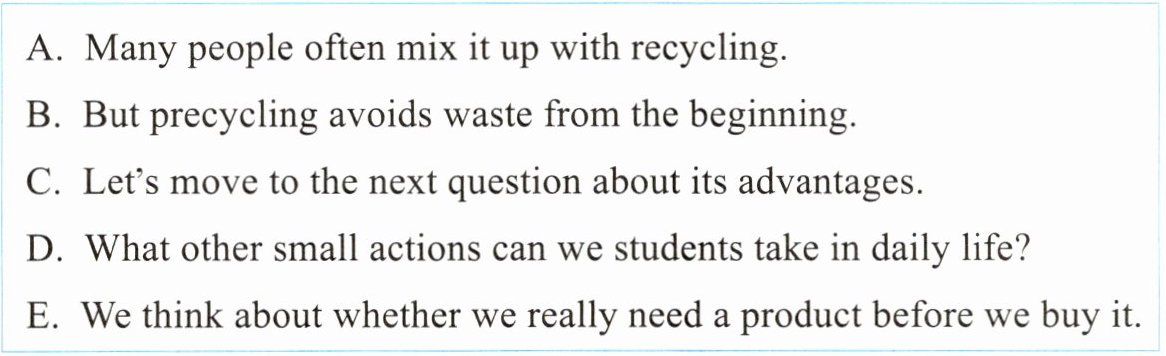
A. Many people often mix it up with recycling.
B. But precycling avoids waste from the beginning.
C. Let’s move to the next question about its advantages.
D. What other small actions can we students take in daily life?
E. We think about whether we really need a product before we buy it.
A. Complete the interview with proper sentences in the box. There is one extra option.
After reporting the stands, Jason is interviewing students about precycling on campus.
Jason: Welcome to our programme! We’re talking about a green lifestyle called precycling. Let’s start with the basic concept first. What is precycling about?
Student 1: Oh, I know this! It means we stop waste before it is created. 1.
E
Jason: Exactly! It focuses on reducing waste at the very start. How is it different from recycling?
Student 2: Well, recycling is for things we’ve already used. But precycling happens much earlier—when we’re still shopping.
Jason: Perfect! The timing is the biggest difference. 2.
C
Does precycling have more advantages besides cutting waste?Student 3: Yeah! When we recycle, we have to use energy to process old materials. 3.
B
That’s the reason why it saves lots of energy.Jason: What a great point! Do you have any precycling tips?
Student 2: I can give an example! My mum always brings her own cloth bag when she goes shopping, so we never use plastic bags.
Jason: 4.
D
Student 1: I bring my own water bottle and reusable chopsticks to school every day, so I don’t need to buy a new one.
Jason: Wow, those ideas are truly remarkable! We only need to make a few little changes to our daily habits. Thank you all for sharing!
A. Many people often mix it up with recycling.
B. But precycling avoids waste from the beginning.
C. Let’s move to the next question about its advantages.
D. What other small actions can we students take in daily life?
E. We think about whether we really need a product before we buy it.
答案
1. E 2. C 3. B 4. D
解析
【分析】
本题为补全对话题型,需结合对话上下文的话题、逻辑衔接来选择合适的句子。第1空需承接预回收的概念说明具体做法,第2空需在讨论完区别后过渡到优点话题,第3空需对比回收说明预回收的优势,第4空需对应学生分享的行动询问相关问题。
【解析】
1. 第1空:前文学生1解释预回收是“在废物产生前阻止”,选项E“我们在买产品前考虑是否真的需要一个产品”是预回收的具体做法,承接上文,故选E;
2. 第2空:Jason刚讨论完预回收与回收的区别,接下来要转向预回收的优点,选项C“让我们转到下一个关于它优点的问题”起到过渡作用,故选C;
3. 第3空:学生3提到回收需要耗能处理旧材料,选项B“但预回收从一开始就避免浪费”对比出预回收的好处,对应后文“节省能源”,故选B;
4. 第4空:学生分享了自带水杯、购物带布袋等预回收行动,Jason需询问学生日常的其他小行动,选项D“我们学生在日常生活中还能采取什么其他小行动?”符合语境,故选D。
【答案】1.E 2.C 3.B 4.D
【知识点】补全对话、语境逻辑、话题衔接
【点评】本题考查学生对英语对话上下文逻辑的理解,需结合话题转换和内容衔接选择合适句子,是常见的英语补全对话题型,难度适中。
【难度系数】0.5
本题为补全对话题型,需结合对话上下文的话题、逻辑衔接来选择合适的句子。第1空需承接预回收的概念说明具体做法,第2空需在讨论完区别后过渡到优点话题,第3空需对比回收说明预回收的优势,第4空需对应学生分享的行动询问相关问题。
【解析】
1. 第1空:前文学生1解释预回收是“在废物产生前阻止”,选项E“我们在买产品前考虑是否真的需要一个产品”是预回收的具体做法,承接上文,故选E;
2. 第2空:Jason刚讨论完预回收与回收的区别,接下来要转向预回收的优点,选项C“让我们转到下一个关于它优点的问题”起到过渡作用,故选C;
3. 第3空:学生3提到回收需要耗能处理旧材料,选项B“但预回收从一开始就避免浪费”对比出预回收的好处,对应后文“节省能源”,故选B;
4. 第4空:学生分享了自带水杯、购物带布袋等预回收行动,Jason需询问学生日常的其他小行动,选项D“我们学生在日常生活中还能采取什么其他小行动?”符合语境,故选D。
【答案】1.E 2.C 3.B 4.D
【知识点】补全对话、语境逻辑、话题衔接
【点评】本题考查学生对英语对话上下文逻辑的理解,需结合话题转换和内容衔接选择合适句子,是常见的英语补全对话题型,难度适中。
【难度系数】0.5
