

 登录
Ⅲ.阅读理解(每题2分,满分20分)
A
文化意识 文化鉴赏 The Hakka people, a Han Chinese subgroup(分支), have an unusual history, language, and culture. Hundreds of years ago, they moved from their homeland in central China to Southeast China. In Chinese, Hakka means "guest families" as if these people were guests on the land.
Clearly, Hakka earth buildings are different from any other traditional architectural(建筑的) form. The buildings are not only huge in size, but also quite strong. To build them, the Hakka people mix earth, sand, bamboo, and other things together, and then tamp the mixture into nearly 2-metre-thick walls that stand in a close circle. The heavy walls can not only keep the earth buildings warm in winter and cool in summer, but also protect people against danger.
If danger comes, the only door will be closed. People can stay safely in the building for a long time as there's enough space for food and water in it.
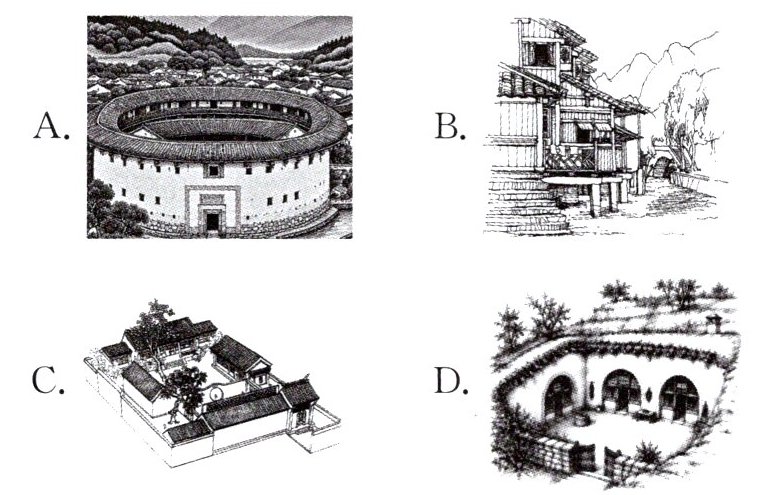
Some of the oldest earth buildings date back to the 12th century, and the latest examples were built in the last century. Sometimes people call them roundhouses. But actually, not all earth buildings are round. Square ones can be found as well.
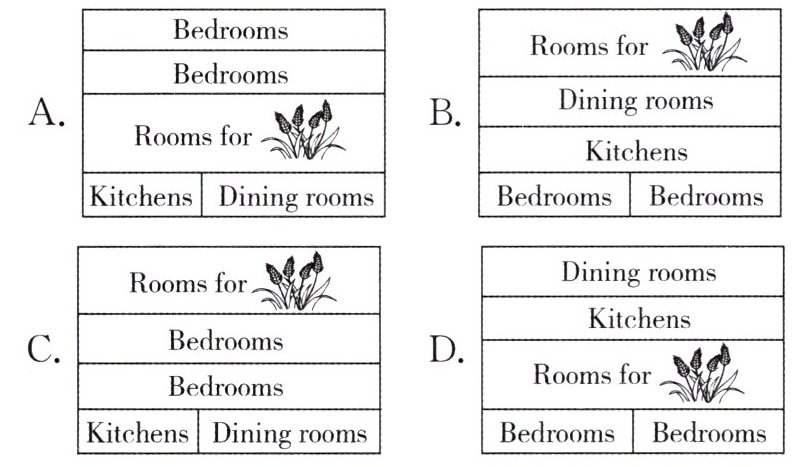
Most of these buildings have three or four floors, and each one can hold hundreds of people —all sharing the same last name. The first floor is used for kitchens and dining rooms; the second floor is for keeping grain; and the third and fourth floors are used for bedrooms.
We Chinese always say, "A nearby neighbour is better than a distant relative." The earth-building-living Hakka people have the best of both worlds, as neighbours are also relatives. However, these buildings are facing a problem: fewer and fewer people would like to live in them.
1. 新考法 图示理解 Which may be the picture of the Hakka earth building?
2. What does the writer mention about the Hakka earth building in Paragraph 2?
①Its advantages(优点). ②Its history.
③The building process.
④The building materials.
⑤Specific types of danger.
A. ①②④ B. ②③⑤
C. ①③④ D. ①②③
3. 新考法 图示理解 Which is the structure of the Hakka earth building?
4. 语言能力 推断能力 What can we infer from this passage?
A. All the buildings are in the same shape.
B. People who live in a Hakka earth building are family.
C. Hakka earth buildings are more popular than before.
D. The Hakka people like to live in earth buildings better than in tall buildings.
5. What will the writer probably talk about next?
A. How do the Hakka people get along with each other?
B. Why are the Hakka people leaving the earth buildings?
C. Who don't the Hakka people want to share the buildings with?
D. How will the government protect the Hakka earth buildings?
A
文化意识 文化鉴赏 The Hakka people, a Han Chinese subgroup(分支), have an unusual history, language, and culture. Hundreds of years ago, they moved from their homeland in central China to Southeast China. In Chinese, Hakka means "guest families" as if these people were guests on the land.
Clearly, Hakka earth buildings are different from any other traditional architectural(建筑的) form. The buildings are not only huge in size, but also quite strong. To build them, the Hakka people mix earth, sand, bamboo, and other things together, and then tamp the mixture into nearly 2-metre-thick walls that stand in a close circle. The heavy walls can not only keep the earth buildings warm in winter and cool in summer, but also protect people against danger.
If danger comes, the only door will be closed. People can stay safely in the building for a long time as there's enough space for food and water in it.
Some of the oldest earth buildings date back to the 12th century, and the latest examples were built in the last century. Sometimes people call them roundhouses. But actually, not all earth buildings are round. Square ones can be found as well.
Most of these buildings have three or four floors, and each one can hold hundreds of people —all sharing the same last name. The first floor is used for kitchens and dining rooms; the second floor is for keeping grain; and the third and fourth floors are used for bedrooms.
We Chinese always say, "A nearby neighbour is better than a distant relative." The earth-building-living Hakka people have the best of both worlds, as neighbours are also relatives. However, these buildings are facing a problem: fewer and fewer people would like to live in them.
1. 新考法 图示理解 Which may be the picture of the Hakka earth building?
2. What does the writer mention about the Hakka earth building in Paragraph 2?
①Its advantages(优点). ②Its history.
③The building process.
④The building materials.
⑤Specific types of danger.
A. ①②④ B. ②③⑤
C. ①③④ D. ①②③
3. 新考法 图示理解 Which is the structure of the Hakka earth building?
4. 语言能力 推断能力 What can we infer from this passage?
A. All the buildings are in the same shape.
B. People who live in a Hakka earth building are family.
C. Hakka earth buildings are more popular than before.
D. The Hakka people like to live in earth buildings better than in tall buildings.
5. What will the writer probably talk about next?
A. How do the Hakka people get along with each other?
B. Why are the Hakka people leaving the earth buildings?
C. Who don't the Hakka people want to share the buildings with?
D. How will the government protect the Hakka earth buildings?
答案
1.A 2.C 3.A 4.B 5.B
A
【语篇解读】本文是一篇说明文,主要介绍客家土楼的建筑材料、结构功能、安全优势及其面临的居住人口减少问题。
1. A 解析:图示理解题。根据“not all earth buildings are round. Square ones can be found as well.”可知,土楼有圆形也有方形,通常是围合式结构,选项A的围合式建筑符合客家土楼特征,故选A。
2. C 解析:细节理解题。根据第二段“mix earth, sand, bamboo ...”和“tamp the mixture ...”可知,该段介绍了建筑材料和建造过程;根据“keep ... warm ... cool”和“protect people against danger”可知,该段还介绍了建筑的优点;文中没有说明具体危险种类,故选C。
3. A 解析:图示理解题。根据“The first floor is used for kitchens and dining rooms; the second floor is for keeping grain; and the third and fourth floors are used for bedrooms”可知,土楼结构是“一楼厨房和餐厅→二楼存放粮食→三楼及以上卧室”,对应选项A,故选A。
4. B 解析:推理判断题。根据“each one can hold hundreds of people—all sharing the same last name”及“neighbours are also relatives”可推知,同一座土楼中的居民多为同一家族成员,B项正确。A项与“Square ones can be found as well.”矛盾;C项、D项与“fewer and fewer people would like to live in them”不符,故选B。
5. B 解析:推理判断题。末句提出“越来越少的人愿意住在土楼里”这一问题,后文最可能接着解释其原因。B项承接最自然,故选B。
