

 登录
登录
Ⅶ.Reorder the sentences to form a dialogue.将下列句子重新排序,组成一段完整、通顺的对话。
(
( 1 )Hi, Amy! Why are you shopping alone today?
(
(
(
(
3
)Good girl! What do you often do on the weekend?( 1 )Hi, Amy! Why are you shopping alone today?
(
5
)That sounds like a lot of fun.(
4
)I often clean my room. Sometimes I play ping-pong with my father.(
2
)Because my mother is not at home today.答案
3 1 5 4 2
解析
【分析】
做这类对话排序题,首先先定位题目已经给出的首句,再顺着对话的问答逻辑逐步推导:首先首句是用Why提问的特殊疑问句,询问独自购物的原因,我们首先要找到以Because开头的原因答句,确定它是第2句。接下来,对方解释完原因后,对话会自然延伸到新的话题,也就是夸赞对方后询问周末的日常活动,对应"Good girl! What do you often do on the weekend?" 排在第3位。接着针对周末活动的提问,要给出对应的活动内容回答,也就是"I often clean my room. Sometimes I play ping-pong with my father." 排在第4位。最后听完对方的活动描述后,给出评价"That sounds like a lot of fun." 作为对话收尾,排在第5位,最后把所有句子连起来通读验证逻辑通顺即可。
【解析】
1. 题目已给定首句为:(1)Hi, Amy! Why are you shopping alone today? 该句用Why引导特殊疑问句,询问独自购物的原因,对应的应答句为"Because my mother is not at home today.",因此该句排序为第2位。
2. 解释完独自购物的原因后,对话自然推进到新话题,夸赞对方后询问周末的常规活动,对应句子"Good girl! What do you often do on the weekend?",该句排序为第3位。
3. 针对"What do you often do on the weekend?"的提问,需要回答周末的具体活动内容,对应句子"I often clean my room. Sometimes I play ping-pong with my father.",该句排序为第4位。
4. 听完对方描述的周末活动后,给出正面评价收尾对话,对应句子"That sounds like a lot of fun.",该句排序为第5位。
最终对应题干括号的顺序,填入的数字依次为3、1、5、4、2,整段对话逻辑连贯通顺。
【答案】
3 1 5 4 2
【知识点】
情景对话排序,日常交际用语,特殊疑问句应答
【点评】
本题是小学英语基础的情景对话排序题,核心解题技巧是抓住问答对应关系,顺着对话的话题推进逻辑推导,做完后通读整段对话验证逻辑连贯性即可,能够帮助学生巩固日常交际用语的使用规则。
【难度系数】
0.8
做这类对话排序题,首先先定位题目已经给出的首句,再顺着对话的问答逻辑逐步推导:首先首句是用Why提问的特殊疑问句,询问独自购物的原因,我们首先要找到以Because开头的原因答句,确定它是第2句。接下来,对方解释完原因后,对话会自然延伸到新的话题,也就是夸赞对方后询问周末的日常活动,对应"Good girl! What do you often do on the weekend?" 排在第3位。接着针对周末活动的提问,要给出对应的活动内容回答,也就是"I often clean my room. Sometimes I play ping-pong with my father." 排在第4位。最后听完对方的活动描述后,给出评价"That sounds like a lot of fun." 作为对话收尾,排在第5位,最后把所有句子连起来通读验证逻辑通顺即可。
【解析】
1. 题目已给定首句为:(1)Hi, Amy! Why are you shopping alone today? 该句用Why引导特殊疑问句,询问独自购物的原因,对应的应答句为"Because my mother is not at home today.",因此该句排序为第2位。
2. 解释完独自购物的原因后,对话自然推进到新话题,夸赞对方后询问周末的常规活动,对应句子"Good girl! What do you often do on the weekend?",该句排序为第3位。
3. 针对"What do you often do on the weekend?"的提问,需要回答周末的具体活动内容,对应句子"I often clean my room. Sometimes I play ping-pong with my father.",该句排序为第4位。
4. 听完对方描述的周末活动后,给出正面评价收尾对话,对应句子"That sounds like a lot of fun.",该句排序为第5位。
最终对应题干括号的顺序,填入的数字依次为3、1、5、4、2,整段对话逻辑连贯通顺。
【答案】
3 1 5 4 2
【知识点】
情景对话排序,日常交际用语,特殊疑问句应答
【点评】
本题是小学英语基础的情景对话排序题,核心解题技巧是抓住问答对应关系,顺着对话的话题推进逻辑推导,做完后通读整段对话验证逻辑连贯性即可,能够帮助学生巩固日常交际用语的使用规则。
【难度系数】
0.8
Ⅷ.Choose and write.选择恰当的句子完成对话。
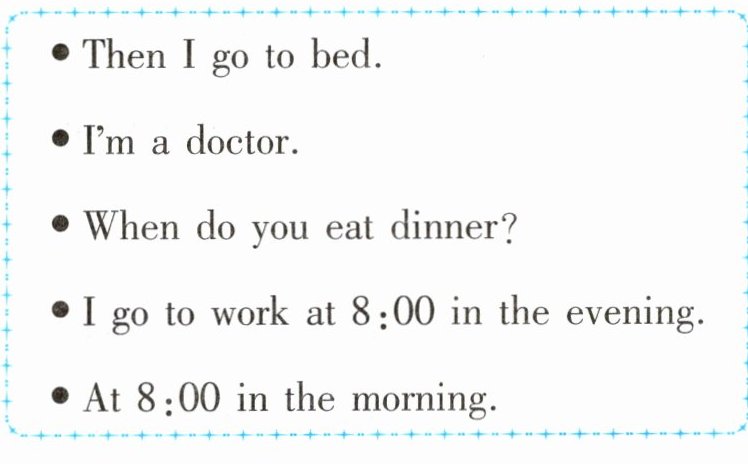
A:Excuse me,can I ask you some questions,please?
B:Sure.
A:What do you do?
B:1.
A:When do you go to work?
B:2.
A:3.
B:I eat dinner at 6:00 p. m.
A:When do you go home?
B:4.
I eat breakfast at 8:30 a. m.
5.
A:Wow! You are different from others.
A:Excuse me,can I ask you some questions,please?
B:Sure.
A:What do you do?
B:1.
A:When do you go to work?
B:2.
A:3.
B:I eat dinner at 6:00 p. m.
A:When do you go home?
B:4.
I eat breakfast at 8:30 a. m.
5.
A:Wow! You are different from others.
答案
1. I'm a doctor.
2. I go to work at 8:00 in the evening.
3. When do you eat dinner?
4. At 8:00 in the morning.
5. Then I go to bed.
2. I go to work at 8:00 in the evening.
3. When do you eat dinner?
4. At 8:00 in the morning.
5. Then I go to bed.
解析
本题考查根据对话情境选择合适的句子补全对话。
1. 问句“What do you do?”用于询问职业,对应的回答是“I'm a doctor.”;
2. 问句“When do you go to work?”询问上班时间,对应的回答是“I go to work at 8:00 in the evening.”;
3. 根据答语“I eat dinner at 6:00 p. m.”,可知上一句的问句是“When do you eat dinner?”;
4. 问句“When do you go home?”询问回家时间,结合后文“I eat breakfast at 8:30 a. m.”,对应的回答是“At 8:00 in the morning.”;
5. 前文提到早上吃完早餐,结合语境,接下来的动作是“Then I go to bed.”,符合该角色的作息逻辑。
1. 问句“What do you do?”用于询问职业,对应的回答是“I'm a doctor.”;
2. 问句“When do you go to work?”询问上班时间,对应的回答是“I go to work at 8:00 in the evening.”;
3. 根据答语“I eat dinner at 6:00 p. m.”,可知上一句的问句是“When do you eat dinner?”;
4. 问句“When do you go home?”询问回家时间,结合后文“I eat breakfast at 8:30 a. m.”,对应的回答是“At 8:00 in the morning.”;
5. 前文提到早上吃完早餐,结合语境,接下来的动作是“Then I go to bed.”,符合该角色的作息逻辑。
Ⅸ.Read and judge.阅读短文,判断句子正(√)误(×)。
Zoom and Zip are good friends. They are planning a trip in January. Zip's favourite season is summer. He likes swimming. He will visit his grandparents in Australia. It's hot there. He can swim all day. He has a new bathing suit and sunglasses. But Zoom doesn't like swimming. His favourite season is winter. He likes skating. So he will go to Canada. It's winter there now. He can skate all day. He has winter coats and some new ice skates.
(
(
(
(
(
Zoom and Zip are good friends. They are planning a trip in January. Zip's favourite season is summer. He likes swimming. He will visit his grandparents in Australia. It's hot there. He can swim all day. He has a new bathing suit and sunglasses. But Zoom doesn't like swimming. His favourite season is winter. He likes skating. So he will go to Canada. It's winter there now. He can skate all day. He has winter coats and some new ice skates.
(
×
)1. Seasons in Australia and Canada are the same.(
×
)2. Zoom and Zip are going to Canada.(
×
)3. Zoom likes swimming.(
√
)4. Zip has a new bathing suit and sunglasses.(
√
)5. It's hot in January in Australia.答案
1.× 2.× 3.× 4.√ 5.√
解析
【分析】
做这类阅读判断正误题时,首先先通读全文梳理核心信息:两个好朋友Zoom和Zip在一月计划旅行,Zip喜欢夏天要去处于夏季的澳大利亚,Zoom喜欢冬天要去处于冬季的加拿大。之后我们逐个对照题干,带着题干的关键词回到原文定位对应内容,比对题干描述和原文信息是否完全匹配,就能得出正误判断结果。
【解析】
1. 原文提到一月时澳大利亚天气炎热是夏季,加拿大此时是冬季,两地季节完全不同,因此该句表述错误。
2. 原文明确说明Zip要去澳大利亚拜访祖父母,只有Zoom会前往加拿大,并非两人都去加拿大,因此该句表述错误。
3. 原文明确写明“But Zoom doesn't like swimming. His favourite season is winter. He likes skating.”,可知Zoom并不喜欢游泳,因此该句表述错误。
4. 原文提到Zip出行的装备是“He has a new bathing suit and sunglasses.”,和题干描述完全一致,因此该句表述正确。
5. 两人计划一月出行,Zip前往澳大利亚,原文明确说明澳大利亚此时“It's hot there.”,因此一月的澳大利亚天气炎热,该句表述正确。
【答案】
1.× 2.× 3.× 4.√ 5.√
【知识点】
阅读理解细节定位,代词指代辨析,南北半球季节差异
【点评】
本题属于小学英语基础阅读题型,绝大多数题目都可以直接在原文找到对应线索,仅需要注意区分两个主角的不同喜好、不同出行目的地,稍加留意细节就可以轻松完成,同时还能顺带巩固南北半球季节相反的地理小常识。
【难度系数】
0.9
做这类阅读判断正误题时,首先先通读全文梳理核心信息:两个好朋友Zoom和Zip在一月计划旅行,Zip喜欢夏天要去处于夏季的澳大利亚,Zoom喜欢冬天要去处于冬季的加拿大。之后我们逐个对照题干,带着题干的关键词回到原文定位对应内容,比对题干描述和原文信息是否完全匹配,就能得出正误判断结果。
【解析】
1. 原文提到一月时澳大利亚天气炎热是夏季,加拿大此时是冬季,两地季节完全不同,因此该句表述错误。
2. 原文明确说明Zip要去澳大利亚拜访祖父母,只有Zoom会前往加拿大,并非两人都去加拿大,因此该句表述错误。
3. 原文明确写明“But Zoom doesn't like swimming. His favourite season is winter. He likes skating.”,可知Zoom并不喜欢游泳,因此该句表述错误。
4. 原文提到Zip出行的装备是“He has a new bathing suit and sunglasses.”,和题干描述完全一致,因此该句表述正确。
5. 两人计划一月出行,Zip前往澳大利亚,原文明确说明澳大利亚此时“It's hot there.”,因此一月的澳大利亚天气炎热,该句表述正确。
【答案】
1.× 2.× 3.× 4.√ 5.√
【知识点】
阅读理解细节定位,代词指代辨析,南北半球季节差异
【点评】
本题属于小学英语基础阅读题型,绝大多数题目都可以直接在原文找到对应线索,仅需要注意区分两个主角的不同喜好、不同出行目的地,稍加留意细节就可以轻松完成,同时还能顺带巩固南北半球季节相反的地理小常识。
【难度系数】
0.9
