

 登录
登录
范畴:人与自然 主题:生态治理 体裁:说明文 难度:★★★★ 建议用时:9分钟 评价:/10
KEY→P40
The Taklimakan Desert(塔克拉玛干沙漠) is the biggest desert in China. It is about 337,600 square kilometers.
The sand here is light and soft. When strong winds blow, the sand flies, and the desert moves! It moves forward every year. The desert can cover roads, farms and even people's homes.
But now, we are working hard to stop it. In 2024, China finished a 3,046-kilometer green belt(带)around the Taklimakan Desert.
How do we stop the sand?
Straw squares
We stick straws(插稻草) into the sand to make big squares. These squares help keep the sand in place. Trees and flower seeds can grow safely inside.
Sand barriers(沙障)
We build 1-meter-tall walls with straws and wires. These walls are like silent guardians(卫士) standing in the desert. When the strong desert wind blows, hitting these walls, its speed is gradually reduced. The wind slows down, so it can't carry and spread the sand as heavily as before. In this way, they play a key role in preventing sand from moving.
Deep roots
Trees and flowers grow roots deep into the ground as if they decide to hold the earth hard. As they grow deeper and thicker, they grow together, forming a strong underground system. Little by little, the roots hold the sand even harder, silently working to keep the land in place.
Energy from the sun
In the Taklimakan Desert, where sunshine is rich, we make good use of this natural treasure. We turn energy into power. Then, machines can take water from underground to water plants, helping them survive in this dry land. In this way, energy from the sun gives life to plants and brings hope to the desert.
Through hard work, the Taklimakan Desert is not as "terrible" as before. Stopping the desert from becoming larger will take a long period of time. But as long as we keep working hard and never give up, we can make more parts of the desert turn green. Let's take action to make our country more beautiful.
根据短文内容,完成表格。(每空一词)
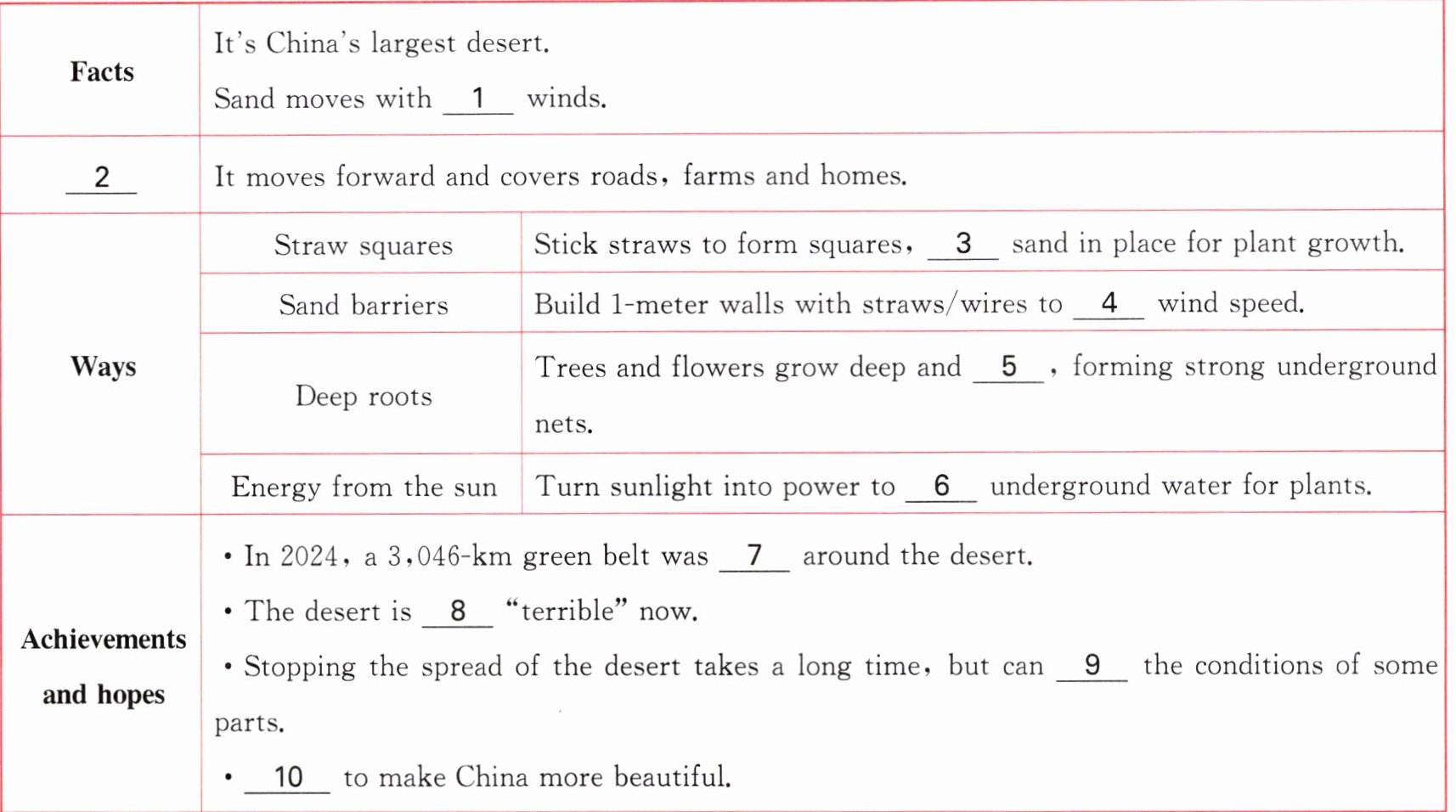
| Facts | It's China's largest desert.
Sand moves with 1 winds. |
| --- | --- |
| 2 | It moves forward and covers roads, farms and homes. |
| Ways | Straw squares | Stick straws to form squares, 3 sand in place for plant growth. |
| | Sand barriers | Build 1-meter walls with straws/wires to 4 wind speed. |
| | Deep roots | Trees and flowers grow deep and 5, forming strong underground nets. |
| | Energy from the sun | Turn sunlight into power to 6 underground water for plants. |
| Achievements and hopes | • In 2024, a 3,046-km green belt was 7 around the desert.
• The desert is 8 "terrible" now.
• Stopping the spread of the desert takes a long time, but can 9 the conditions of some parts.
• 10 to make China more beautiful. |
1.
2.
3.
4.
5.
6.
7.
8.
9.
10.
英语嗨吧
KEY→P40
The Taklimakan Desert(塔克拉玛干沙漠) is the biggest desert in China. It is about 337,600 square kilometers.
The sand here is light and soft. When strong winds blow, the sand flies, and the desert moves! It moves forward every year. The desert can cover roads, farms and even people's homes.
But now, we are working hard to stop it. In 2024, China finished a 3,046-kilometer green belt(带)around the Taklimakan Desert.
How do we stop the sand?
Straw squares
We stick straws(插稻草) into the sand to make big squares. These squares help keep the sand in place. Trees and flower seeds can grow safely inside.
Sand barriers(沙障)
We build 1-meter-tall walls with straws and wires. These walls are like silent guardians(卫士) standing in the desert. When the strong desert wind blows, hitting these walls, its speed is gradually reduced. The wind slows down, so it can't carry and spread the sand as heavily as before. In this way, they play a key role in preventing sand from moving.
Deep roots
Trees and flowers grow roots deep into the ground as if they decide to hold the earth hard. As they grow deeper and thicker, they grow together, forming a strong underground system. Little by little, the roots hold the sand even harder, silently working to keep the land in place.
Energy from the sun
In the Taklimakan Desert, where sunshine is rich, we make good use of this natural treasure. We turn energy into power. Then, machines can take water from underground to water plants, helping them survive in this dry land. In this way, energy from the sun gives life to plants and brings hope to the desert.
Through hard work, the Taklimakan Desert is not as "terrible" as before. Stopping the desert from becoming larger will take a long period of time. But as long as we keep working hard and never give up, we can make more parts of the desert turn green. Let's take action to make our country more beautiful.
根据短文内容,完成表格。(每空一词)
| Facts | It's China's largest desert.
Sand moves with 1 winds. |
| --- | --- |
| 2 | It moves forward and covers roads, farms and homes. |
| Ways | Straw squares | Stick straws to form squares, 3 sand in place for plant growth. |
| | Sand barriers | Build 1-meter walls with straws/wires to 4 wind speed. |
| | Deep roots | Trees and flowers grow deep and 5, forming strong underground nets. |
| | Energy from the sun | Turn sunlight into power to 6 underground water for plants. |
| Achievements and hopes | • In 2024, a 3,046-km green belt was 7 around the desert.
• The desert is 8 "terrible" now.
• Stopping the spread of the desert takes a long time, but can 9 the conditions of some parts.
• 10 to make China more beautiful. |
1.
strong
2.
Problem/Problems
3.
keeping
4.
reduce/slow/lower
5.
thick
6.
provide
7.
finished/completed/built
8.
less
9.
improve
10.
Act
英语嗨吧
答案
本文介绍了塔克拉玛干沙漠的规模及危害,并讲述了通过稻草方格、沙障、植物深根和利用太阳能等方式治理沙漠的成果与希望。
1. strong 2. Problem/Problems 3. keeping
4. reduce/slow/lower 5. thick 6. provide
7. finished/completed/built 8. less 9. improve
10. Act
1. strong 2. Problem/Problems 3. keeping
4. reduce/slow/lower 5. thick 6. provide
7. finished/completed/built 8. less 9. improve
10. Act
解析
【分析】
本题为任务型阅读,需根据短文内容完成表格填空。解题思路:1. 先明确每个空所在的表格模块(如Facts、Problem等);2. 定位原文对应段落或句子,找到与空格语境匹配的信息;3. 结合语法规则(如非谓语动词、被动语态、形容词比较级等)确定单词的正确形式,确保每空一词。
【解析】
1. 定位原文“When strong winds blow, the sand flies”,可知沙漠移动伴随强风,故填strong;
2. 该模块描述沙漠移动带来的负面影响,属于“问题”,故填Problem/Problems;
3. 原文Straw squares部分提到“These squares help keep the sand in place”,此处用现在分词作伴随状语,故填keeping;
4. 原文Sand barriers部分提到“its speed is gradually reduced”,即降低风速,故填reduce/slow/lower;
5. 原文Deep roots部分提到“As they grow deeper and thicker”,故填thick;
6. 原文Energy from the sun部分提到“machines can take water from underground to water plants”,即给植物提供地下水,故填provide;
7. 原文“In 2024, China finished a 3,046-kilometer green belt”,此处为被动语态,故填finished/completed/built;
8. 原文“the Taklimakan Desert is not as 'terrible' as before”,即现在没那么可怕,故填less;
9. 原文提到治理后沙漠变绿,即改善部分地区的状况,故填improve;
10. 原文“Let's take action to make our country more beautiful”,故填Act。
【答案】
1. strong 2. Problem/Problems 3. keeping 4. reduce/slow/lower 5. thick 6. provide 7. finished/completed/built 8. less 9. improve 10. Act
【知识点】
任务型阅读、词汇运用、语境理解
【点评】
本题围绕生态治理主题,考查学生快速定位原文信息及运用词汇的能力,需注意单词形式变化,整体难度适中。
【难度系数】
0.6
本题为任务型阅读,需根据短文内容完成表格填空。解题思路:1. 先明确每个空所在的表格模块(如Facts、Problem等);2. 定位原文对应段落或句子,找到与空格语境匹配的信息;3. 结合语法规则(如非谓语动词、被动语态、形容词比较级等)确定单词的正确形式,确保每空一词。
【解析】
1. 定位原文“When strong winds blow, the sand flies”,可知沙漠移动伴随强风,故填strong;
2. 该模块描述沙漠移动带来的负面影响,属于“问题”,故填Problem/Problems;
3. 原文Straw squares部分提到“These squares help keep the sand in place”,此处用现在分词作伴随状语,故填keeping;
4. 原文Sand barriers部分提到“its speed is gradually reduced”,即降低风速,故填reduce/slow/lower;
5. 原文Deep roots部分提到“As they grow deeper and thicker”,故填thick;
6. 原文Energy from the sun部分提到“machines can take water from underground to water plants”,即给植物提供地下水,故填provide;
7. 原文“In 2024, China finished a 3,046-kilometer green belt”,此处为被动语态,故填finished/completed/built;
8. 原文“the Taklimakan Desert is not as 'terrible' as before”,即现在没那么可怕,故填less;
9. 原文提到治理后沙漠变绿,即改善部分地区的状况,故填improve;
10. 原文“Let's take action to make our country more beautiful”,故填Act。
【答案】
1. strong 2. Problem/Problems 3. keeping 4. reduce/slow/lower 5. thick 6. provide 7. finished/completed/built 8. less 9. improve 10. Act
【知识点】
任务型阅读、词汇运用、语境理解
【点评】
本题围绕生态治理主题,考查学生快速定位原文信息及运用词汇的能力,需注意单词形式变化,整体难度适中。
【难度系数】
0.6
