

 登录
Ⅲ. 书面表达。
11. 学校英语俱乐部发布了一项关于未来职业探索的项目任务 (My dream job project)。
要求:
(1)描述你的职业选择、原因以及未来规划。
(2)通过创意展示你的项目成果。
11. 学校英语俱乐部发布了一项关于未来职业探索的项目任务 (My dream job project)。
要求:
(1)描述你的职业选择、原因以及未来规划。
(2)通过创意展示你的项目成果。
答案
11.(合理即可)
Ⅰ. 根据所给提示完成句子。
1. We share a common journey of
2. Each face
3. David is very clever; he can always find ways
4. These differences make our school fun and
5. He is
1. We share a common journey of
learning
(learn).2. Each face
tells
(tell) a unique story.3. David is very clever; he can always find ways
to help
(help) us if necessary.4. These differences make our school fun and
exciting
(excite).5. He is
our
(we) walking library.答案
1. learning 2. tells 3. to help 4. exciting 5. our
Ⅱ. 补全对话。
(After the first day of the new term, Bob came back home. Now he is talking with his mother.)
Mother: How was your first day of Grade 8?
Bob: 6.
It’s exciting to go to school. We have a new subject this term.
Mother: 7.
Bob: Physics.
Mother: 8.
Bob: It seems interesting.
Mother: 9.
Bob: Yes. I have a new classmate. His name is David. He likes reading, just like me. I’d like to make friends with him.
Mother: Good luck to you.
Bob: 10.
(After the first day of the new term, Bob came back home. Now he is talking with his mother.)
Mother: How was your first day of Grade 8?
Bob: 6.
It's going well./Great.
It’s exciting to go to school. We have a new subject this term.
Mother: 7.
What's your new subject?
Bob: Physics.
Mother: 8.
What do you think of it?/How do you like it?
Bob: It seems interesting.
Mother: 9.
Do you have any new classmates?
Bob: Yes. I have a new classmate. His name is David. He likes reading, just like me. I’d like to make friends with him.
Mother: Good luck to you.
Bob: 10.
Thank you
, mum. I hope to make more friends this term.答案
6. It's going well./Great. 7. What's your new subject? 8. What do you think of it?/How do you like it? 9. Do you have any new classmates? 10. Thank you(合理即可)
Ⅲ. 阅读表达。
A
In Class 3, students from different cultural backgrounds study and grow together. Li Mei, a Chinese girl, practices calligraphy (书法) every morning. She is also talented in maths. She often helps classmates solve complex equations (方程). Taro, a Japanese boy, is skilled at origami (折纸) and soccer. His paper cranes (鹤) decorate the classroom walls. Priya from India enjoys classical dance and science experiments. She once built
a mini volcano (火山) that amazed everyone! Tom, an American boy, plays basketball and writes songs during breaks. His cheerful tunes make lunchtime lively.
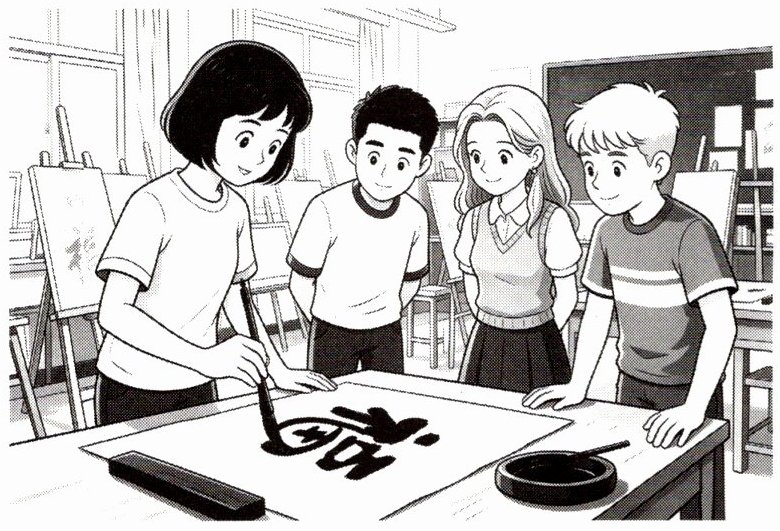
Though they have different hobbies and talents, the class feels like a big family. During festivals, they share traditions: Li Mei teaches how to write “福” (fortune), Taro performs tea art, Priya shows dance steps, and Tom organizes a Halloween costume contest. They even start a “Culture Day” every month to learn about each other’s cultures. Arguments? Seldom! When disagreements happen, they talk openly. “Differences make us stronger,” says Priya. “We’re like puzzle pieces — unique but connected,” adds Tom. Their teacher, Ms Green, says, “Respect and curiosity (好奇心) build bridges.”
11. What subject is Li Mei good at?
12. Where does Taro’s origami artwork hang in the classroom?
13. How do the students solve arguments?
14. Why did they start a “Culture Day” every month?
15. Which unique tradition or hobby would you like to share on “Culture Day”?
A
In Class 3, students from different cultural backgrounds study and grow together. Li Mei, a Chinese girl, practices calligraphy (书法) every morning. She is also talented in maths. She often helps classmates solve complex equations (方程). Taro, a Japanese boy, is skilled at origami (折纸) and soccer. His paper cranes (鹤) decorate the classroom walls. Priya from India enjoys classical dance and science experiments. She once built
a mini volcano (火山) that amazed everyone! Tom, an American boy, plays basketball and writes songs during breaks. His cheerful tunes make lunchtime lively.
Though they have different hobbies and talents, the class feels like a big family. During festivals, they share traditions: Li Mei teaches how to write “福” (fortune), Taro performs tea art, Priya shows dance steps, and Tom organizes a Halloween costume contest. They even start a “Culture Day” every month to learn about each other’s cultures. Arguments? Seldom! When disagreements happen, they talk openly. “Differences make us stronger,” says Priya. “We’re like puzzle pieces — unique but connected,” adds Tom. Their teacher, Ms Green, says, “Respect and curiosity (好奇心) build bridges.”
11. What subject is Li Mei good at?
Maths.
12. Where does Taro’s origami artwork hang in the classroom?
On the classroom walls.
13. How do the students solve arguments?
They talk openly.
14. Why did they start a “Culture Day” every month?
To learn about each other's cultures.
15. Which unique tradition or hobby would you like to share on “Culture Day”?
(合理即可)
答案
11. Maths. 12. On the classroom walls. 13. They talk openly. 14. To learn about each other's cultures. 15.(合理即可)
