

 登录
登录
- Look, read and choose.读一读,给句子选择合适的图片。

A.
B.
C.
D.
(
(
(
(
A.
B.
C.
D.
(
D
)1. He studies Chinese every day.(
C
)2. She goes hiking every weekend.(
B
)3. My friend doesn't do homework. He does word puzzles.(
A
)4. My mother often cooks Chinese food!答案
1. D
2. C
3. B
4. A
2. C
3. B
4. A
解析
1. 句子“He studies Chinese every day.”描述的是学习语文的场景,与图片D中男孩读语文书相符。
2. 句子“She goes hiking every weekend.”描述的是去远足的场景,与图片C中女孩拿着水壶去远足相符。
3. 句子“My friend doesn't do homework. He does word puzzles.”描述的是做字谜的场景,与图片B中的字谜游戏相符。
4. 句子“My mother often cooks Chinese food!”描述的是做中国菜的场景,与图片A中女性在做饭相符。
2. 句子“She goes hiking every weekend.”描述的是去远足的场景,与图片C中女孩拿着水壶去远足相符。
3. 句子“My friend doesn't do homework. He does word puzzles.”描述的是做字谜的场景,与图片B中的字谜游戏相符。
4. 句子“My mother often cooks Chinese food!”描述的是做中国菜的场景,与图片A中女性在做饭相符。
- Read and write.用所给单词的适当形式填空。
1. My father often goes
2. Mike
3. Mary likes
4. My brother
5. Chen Jie often
1. My father often goes
hiking
(hike) on Sundays.2. Mike
watches
(watch) TV every day.3. Mary likes
swimming
(swim).4. My brother
studies
(study) English well.5. Chen Jie often
does
(do) word puzzles on the weekend.答案
1. hiking
2. watches
3. swimming
4. studies
5. does
2. watches
3. swimming
4. studies
5. does
解析
1. “go hiking”是固定短语,意为“去远足”,所以这里填hiking。
2. “every day”表明句子是一般现在时,主语Mike是第三人称单数,动词要用第三人称单数形式watches。
3. “like doing sth.”表示喜欢做某事,swim的动名词形式是swimming。
4. 句子是一般现在时,主语My brother是第三人称单数,动词study要用第三人称单数形式studies。
5. “often”表明句子是一般现在时,主语Chen Jie是第三人称单数,动词do要用第三人称单数形式does。
2. “every day”表明句子是一般现在时,主语Mike是第三人称单数,动词要用第三人称单数形式watches。
3. “like doing sth.”表示喜欢做某事,swim的动名词形式是swimming。
4. 句子是一般现在时,主语My brother是第三人称单数,动词study要用第三人称单数形式studies。
5. “often”表明句子是一般现在时,主语Chen Jie是第三人称单数,动词do要用第三人称单数形式does。
- Look, read and write.看图片,仿照例句写对话。("√"表示肯定,"×"表示否定)
例: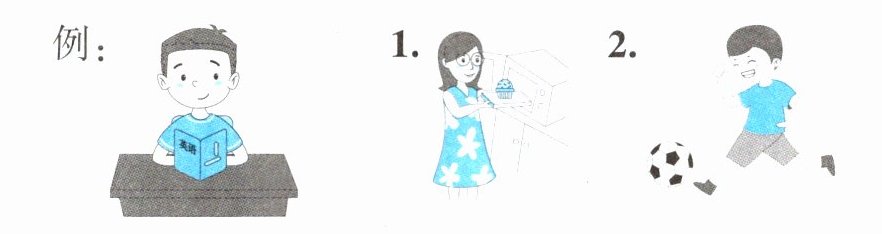 study Chinese (×)
A: Does he study Chinese on the weekend?
B: No, he doesn't.
1. cook Chinese food (×)
A:
B:
2. play football (√)
A:
B:
例:
study Chinese (×)A: Does he study Chinese on the weekend?
B: No, he doesn't.
1. cook Chinese food (×)
A:
Does she cook Chinese food on the weekend?
B:
No, she doesn't.
2. play football (√)
A:
Does he play football on the weekend?
B:
Yes, he does.
答案
1. A: Does she cook Chinese food on the weekend?
B: No, she doesn't.
2. A: Does he play football on the weekend?
B: Yes, he does.
B: No, she doesn't.
2. A: Does he play football on the weekend?
B: Yes, he does.
