

 登录
4.如图,在△ABC中,∠C=90°,D是BC上一点,DE⊥AB于点E,AE=AC,连结AD,若BC=8,求BD+DE. 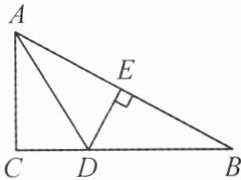
答案
解:$\because DE⊥ AB$,$\therefore∠ AED=90°$.$\because∠ C=90°$,
$\therefore∠ C=∠ AED$.
在$\mathrm{Rt}△ACD$和$\mathrm{Rt}△AED$中,$\because AE=AC$,$AD=AD$,
$\therefore\mathrm{Rt}△ACD≌\mathrm{Rt}△AED(\mathrm{HL})$,
$\therefore CD=ED$.
$\because BC=8$,$\therefore BD+CD=8$,$\therefore BD+DE=8$.
$\therefore∠ C=∠ AED$.
在$\mathrm{Rt}△ACD$和$\mathrm{Rt}△AED$中,$\because AE=AC$,$AD=AD$,
$\therefore\mathrm{Rt}△ACD≌\mathrm{Rt}△AED(\mathrm{HL})$,
$\therefore CD=ED$.
$\because BC=8$,$\therefore BD+CD=8$,$\therefore BD+DE=8$.
5.如图,$AB ⊥ CD$,垂足为点O.添加下列一组条件后,不能判定$\mathrm{Rt}△ AOC ≌ \mathrm{Rt}△ BOD$的是(
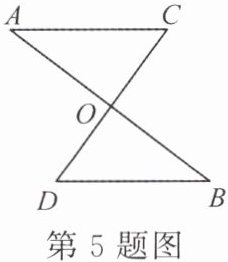
A.$AC=BD$,$OA=OB$
B.$OA=OD$,$∠ A=∠ B$
C.$AC=BD$,$OC=OD$
D.$AC=BD$,$AC // BD$
B
)A.$AC=BD$,$OA=OB$
B.$OA=OD$,$∠ A=∠ B$
C.$AC=BD$,$OC=OD$
D.$AC=BD$,$AC // BD$
答案
5. B
6.如图,D为$\mathrm{Rt}△ ABC$中斜边BC上的一点,且$BD=AB$,过点D作BC的垂线,交AC于点E.若$AE=12\ \mathrm{cm}$,则DE的长为
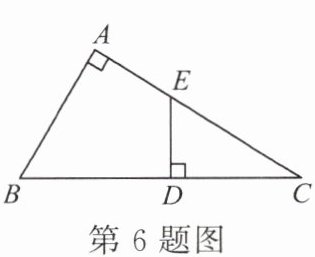
12
cm.答案
6. 12
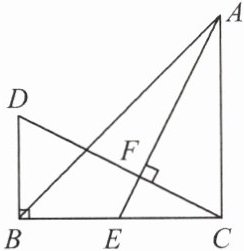
7.如图,在$△ ABC$中,$∠ ACB=90°,AC=BC$,
AE是边BC上的中线,过点C作$CF⊥ AE$,
垂足为F,过点B作$BD⊥ BC$交CF的延长
线于点D.
(1)求证:$AE=CD$;
(2)若$AC=12\ \mathrm{cm}$,求BD的长.
AE是边BC上的中线,过点C作$CF⊥ AE$,
垂足为F,过点B作$BD⊥ BC$交CF的延长
线于点D.
(1)求证:$AE=CD$;
(2)若$AC=12\ \mathrm{cm}$,求BD的长.
答案
7. (1)证明:$\because DB⊥ BC,CF⊥ AE$,
$\therefore∠ DCB+∠ D=∠ DCB+∠ AEC=90°$,
$\therefore∠ D=∠ AEC$.
在$△ DBC$和$△ ECA$中,
$\because∠ D=∠ AEC$,
$∠ DBC=∠ ECA=90°$,
$BC=CA$,
$\therefore△ DBC≌△ ECA(\mathrm{AAS})$,
$\therefore AE=CD$.
(2)解:由(1)知$△ DBC≌△ ECA$,
$\therefore BD=CE$.
$\because AE$是边$BC$上的中线,
$\therefore BD=CE=\frac{1}{2}BC=\frac{1}{2}AC$.
又$\because AC=12\ \mathrm{cm}$,
$\therefore BD=6\ \mathrm{cm}$.
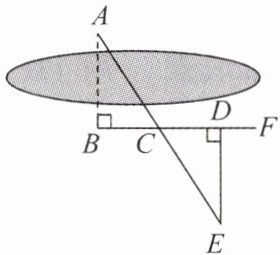
8.如图,要测量池塘两岸相对的两点A,B间的距离,可以在池塘外取AB的垂线BF上的两点C,D,使BC=CD.再画出BF的垂线DE,使点E与A,C在同一条直线上,这时测得DE的长就是AB的长.判断以上方法是否可行.如果可行,请证明;如果不可行,请说明理由.
答案
8. 解:可行,$AB=DE$.理由如下:
$\because AB⊥ BF,DE⊥ BF$,
$\therefore∠ B=∠ EDC=90°$.
在$△ ABC$和$△ EDC$中,
$\because∠ B=∠ EDC,BC=DC,∠ ACB=∠ ECD$,
$\therefore△ ABC≌△ EDC(\mathrm{ASA})$,
$\therefore AB=ED$.
$\because AB⊥ BF,DE⊥ BF$,
$\therefore∠ B=∠ EDC=90°$.
在$△ ABC$和$△ EDC$中,
$\because∠ B=∠ EDC,BC=DC,∠ ACB=∠ ECD$,
$\therefore△ ABC≌△ EDC(\mathrm{ASA})$,
$\therefore AB=ED$.
