

 登录
1. 老师在黑板上留下了一道思考题:
如图,在$△ ABC$中,$AD$是边$BC$上的高,当$AB=7,BC=6,AC=5$时,求$CD$的长.
某学习小组经过交流讨论,给出了如下解题思路:
第一步:设$CD=x$,用含$x$的代数式表示$BD$;
第二步:$\because AD ⊥ BC,\therefore$可利用勾股定理,以$AD$为“桥梁”建立方程;
第三步:解出$CD$的长.
请你按他们的方法进行解答.
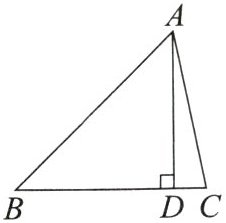
如图,在$△ ABC$中,$AD$是边$BC$上的高,当$AB=7,BC=6,AC=5$时,求$CD$的长.
某学习小组经过交流讨论,给出了如下解题思路:
第一步:设$CD=x$,用含$x$的代数式表示$BD$;
第二步:$\because AD ⊥ BC,\therefore$可利用勾股定理,以$AD$为“桥梁”建立方程;
第三步:解出$CD$的长.
请你按他们的方法进行解答.
答案
1. 解:$CD=1.$
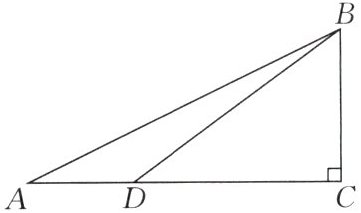
2. 如图,在$Rt△ ABC$中,$∠ C=90°$,$D$是边$AC$上一点,$\tan∠ DBC=\dfrac{4}{3}$,且$BC=6$,$AD=4$.求$\cos A$的值.
答案
2. 解:在$Rt△DBC$中, $∠C=90°,BC=6$,
$\tan∠ DBC=\dfrac{CD}{BC}=\dfrac{4}{3},$
$\therefore CD=8.$
$\therefore AC=AD+CD=12.$
在$Rt△ABC$中,由勾股定理,得
$AB=\sqrt{AC^2+BC^2}=\sqrt{12^2+6^2}=6\sqrt{5},$
$\therefore \cos A=\dfrac{AC}{AB}=\dfrac{12}{6\sqrt{5}}=\dfrac{2}{5}\sqrt{5}.$
$\tan∠ DBC=\dfrac{CD}{BC}=\dfrac{4}{3},$
$\therefore CD=8.$
$\therefore AC=AD+CD=12.$
在$Rt△ABC$中,由勾股定理,得
$AB=\sqrt{AC^2+BC^2}=\sqrt{12^2+6^2}=6\sqrt{5},$
$\therefore \cos A=\dfrac{AC}{AB}=\dfrac{12}{6\sqrt{5}}=\dfrac{2}{5}\sqrt{5}.$
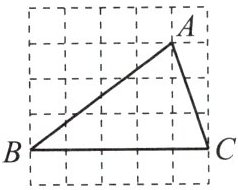
1. 如图,在边长为1的小正方形组成的网格中,△ABC的三个顶点均在格点上,则tan∠ABC的值为 (
A.$\frac{3}{5}$
B.$\frac{3}{4}$
C.$\frac{\sqrt{10}}{5}$
D.1
B
)A.$\frac{3}{5}$
B.$\frac{3}{4}$
C.$\frac{\sqrt{10}}{5}$
D.1
答案
1. B
