

 登录
登录
一、补全对话。
从方框中选择合适的句子补全对话(其中有一项多余)。
A:Hi, Mike. You look worried. What's wrong?
B:1
A:Don't worry. Let's make some preparations.
B:2
A:First, we should check the windows and doors to make sure they are closed tightly.
B:Okay. 3
A:We need to prepare a flashlight and some batteries in case the power goes out.
B:What about food and water?
A:4
B:You're right. 5
A:Also, we should stay off the streets and stay indoors when the storm comes.
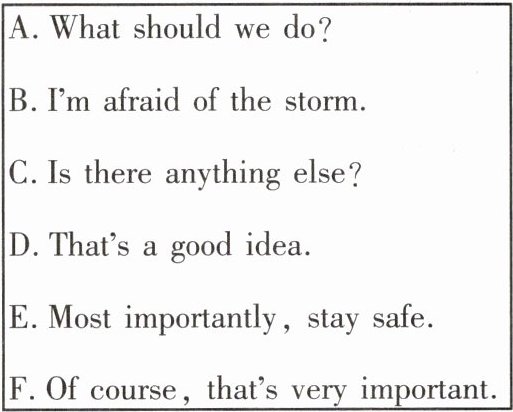
从方框中选择合适的句子补全对话(其中有一项多余)。
A:Hi, Mike. You look worried. What's wrong?
B:1
B
I heard there might be a heavy rainstorm tonight.A:Don't worry. Let's make some preparations.
B:2
A
A:First, we should check the windows and doors to make sure they are closed tightly.
B:Okay. 3
D
A:We need to prepare a flashlight and some batteries in case the power goes out.
B:What about food and water?
A:4
F
We should have some cooked food and clean water ready.B:You're right. 5
C
A:Also, we should stay off the streets and stay indoors when the storm comes.
答案
1. B 2. A 3. D 4. F 5. C
二、阅读理解。
A tsunami is one of the most powerful and dangerous natural disasters. It is a series of huge ocean waves caused mainly by underwater earthquakes. When the ocean floor suddenly moves during a quake, it pushes a large amount of water upward, creating waves that travel across the ocean at very high speeds, as fast as a jet plane.
Unlike normal waves, a tsunami wave is very long and low in the deep ocean, so ships might not even notice it passing underneath. However, as it approaches the coast and enters shallower water, the wave slows down but grows much taller, sometimes as high as a tall building. The word “tsunami” comes from Japanese, meaning “harbor wave”.
Warning signs of a tsunami can include a strong or long-lasting earthquake near the coast, the ocean pulling back far from the shore very quickly (like a very low tide), or a loud roar from the ocean. If you see any of these signs, you must move to higher ground immediately. Do not wait for an official warning. Remember, the first wave may not be the largest, and tsunamis can last for hours.
根据短文内容,选择最佳答案。
(
A. Strong winds over the ocean.
B. Underwater earthquakes.
C. Heavy rainfall on the sea.
D. The high tide.
(
A. It travels faster.
B. It becomes longer and lower.
C. It grows much taller.
D. It disappears.
(
A. Deeper.
B. Not deep.
C. Warmer.
D. Colder.
(
A. A strong earthquake near the coast.
B. The ocean water pulling back quickly.
C. A loud sound coming from the ocean.
D. Dark clouds gathering in the sky.
(
A. Go to the beach to watch.
B. Wait for an official warning on TV.
C. Move to higher ground at once.
D. Get on a ship in the harbor.
A tsunami is one of the most powerful and dangerous natural disasters. It is a series of huge ocean waves caused mainly by underwater earthquakes. When the ocean floor suddenly moves during a quake, it pushes a large amount of water upward, creating waves that travel across the ocean at very high speeds, as fast as a jet plane.
Unlike normal waves, a tsunami wave is very long and low in the deep ocean, so ships might not even notice it passing underneath. However, as it approaches the coast and enters shallower water, the wave slows down but grows much taller, sometimes as high as a tall building. The word “tsunami” comes from Japanese, meaning “harbor wave”.
Warning signs of a tsunami can include a strong or long-lasting earthquake near the coast, the ocean pulling back far from the shore very quickly (like a very low tide), or a loud roar from the ocean. If you see any of these signs, you must move to higher ground immediately. Do not wait for an official warning. Remember, the first wave may not be the largest, and tsunamis can last for hours.
根据短文内容,选择最佳答案。
(
B
)1. What is the main cause of a tsunami?A. Strong winds over the ocean.
B. Underwater earthquakes.
C. Heavy rainfall on the sea.
D. The high tide.
(
C
)2. What happens to a tsunami wave as it gets close to the coast?A. It travels faster.
B. It becomes longer and lower.
C. It grows much taller.
D. It disappears.
(
B
)3. What does the underlined word “shallower” in Paragraph 2 mean?A. Deeper.
B. Not deep.
C. Warmer.
D. Colder.
(
D
)4. Which of the following is NOT mentioned as a warning sign of a tsunami?A. A strong earthquake near the coast.
B. The ocean water pulling back quickly.
C. A loud sound coming from the ocean.
D. Dark clouds gathering in the sky.
(
C
)5. What should you do if you see a possible tsunami warning sign?A. Go to the beach to watch.
B. Wait for an official warning on TV.
C. Move to higher ground at once.
D. Get on a ship in the harbor.
答案
1. B 2. C 3. B 4. D 5. C
