

 登录
登录
(
—Yes. And she said
bring some traditional snacks to
the party.
A.that she will
B.if she would
C.that she would
C
)10.—Will Linda come to the party?—Yes. And she said
that she would
bring some traditional snacks to
the party.
A.that she will
B.if she would
C.that she would
答案
10. C said后面是一个宾语从句。从
句中不缺少句子成分,语意完
整,因此宾语从句引导词用
that;主句谓语动词为一般过去
时态,从句也应使用相应的过
去时态,故选C。
句中不缺少句子成分,语意完
整,因此宾语从句引导词用
that;主句谓语动词为一般过去
时态,从句也应使用相应的过
去时态,故选C。
二、完形填空
In the Ancient Street of Foshan, Guangdong, the sound of drums fills the
air every morning. Wang Xiaohu was born
without a 11. He watches lion dancers with
bright eyes. He often stands for hours in the
rain, moving his fingers on wooden desks to
copy the lions' dance. One day, Master Li, a
lion dance teacher, 12 his hard work.
"Real lions speak with their eyes," the master
says, surprising everyone that voice isn't
the key.
Lion dancing is a 13 with centuries of
history. It takes two 14 to make a lion:
one controls the head, and the other controls
the body and the tail. The training is hard.
Some people wanted to 15 when their arms
hurt badly. However, Wang practiced until
midnight, tried hard to let the lion blink to the drums perfectly. "You need 16
and teamwork," Master Li explains.
During the Spring Festival show, the
ground was 17 from the rain. When
another team fell, Wang's group was brave.
Their lion danced smoothly like a brush on
paper. The crowd cheered 18. Now, Wang
teaches people to dance lions, showing them
19 to bring the tradition to life.
It says that, during the Han dynasty, a
few lions were taken to China 20 the Silk
Road. People learned their movements, and
lion dancing was born. Today, it's not just an
art — it's a way for everyone to feel strong and
united.
(
(
(
(
C. students
(
C. fall asleep
(
C. time
(
(
C. carefully
(
(
In the Ancient Street of Foshan, Guangdong, the sound of drums fills the
air every morning. Wang Xiaohu was born
without a 11. He watches lion dancers with
bright eyes. He often stands for hours in the
rain, moving his fingers on wooden desks to
copy the lions' dance. One day, Master Li, a
lion dance teacher, 12 his hard work.
"Real lions speak with their eyes," the master
says, surprising everyone that voice isn't
the key.
Lion dancing is a 13 with centuries of
history. It takes two 14 to make a lion:
one controls the head, and the other controls
the body and the tail. The training is hard.
Some people wanted to 15 when their arms
hurt badly. However, Wang practiced until
midnight, tried hard to let the lion blink to the drums perfectly. "You need 16
and teamwork," Master Li explains.
During the Spring Festival show, the
ground was 17 from the rain. When
another team fell, Wang's group was brave.
Their lion danced smoothly like a brush on
paper. The crowd cheered 18. Now, Wang
teaches people to dance lions, showing them
19 to bring the tradition to life.
It says that, during the Han dynasty, a
few lions were taken to China 20 the Silk
Road. People learned their movements, and
lion dancing was born. Today, it's not just an
art — it's a way for everyone to feel strong and
united.
(
A
)11. A. voice B. hope C. family(
C
)12. A. believed B. forgot C. noticed(
C
)13. A. sport B. game C. tradition(
B
)14. A. teachers B. dancersC. students
(
B
)15. A. look back B. give upC. fall asleep
(
B
)16. A. money B. confidenceC. time
(
C
)17. A. dry B. hard C. wet(
B
)18. A. politely B. loudlyC. carefully
(
B
)19. A. when B. how C. why(
A
)20. A. along B. from C. for答案
11. A 根据上下文可知,王小虎天生
失声,voice符合文义。
12. C notice意为“注意到”,师傅注
意到他的努力,符合语境。
13. C
14. B dancer意为“舞者”。舞狮需要
两名舞者配合:一人控制狮头,
一人控制身体和尾巴,故选B。
15. B
16. B confidence意为“信心”,师傅
解释,这项活动需要信心和团
队合作,故选B。
17. C 由后面的rain可知应选wet(湿
的)。
18. B cheer loudly意为“大声欢呼”,
符合表演成功的场景,故选B。
19. B how意为“如何”,此句是说王
小虎教人们如何让传统焕发生
机,故选B。
20. A along意为“沿着”,句意为:
“汉朝时几只狮子沿丝绸之路被
带入中国。”故选A。
失声,voice符合文义。
12. C notice意为“注意到”,师傅注
意到他的努力,符合语境。
13. C
14. B dancer意为“舞者”。舞狮需要
两名舞者配合:一人控制狮头,
一人控制身体和尾巴,故选B。
15. B
16. B confidence意为“信心”,师傅
解释,这项活动需要信心和团
队合作,故选B。
17. C 由后面的rain可知应选wet(湿
的)。
18. B cheer loudly意为“大声欢呼”,
符合表演成功的场景,故选B。
19. B how意为“如何”,此句是说王
小虎教人们如何让传统焕发生
机,故选B。
20. A along意为“沿着”,句意为:
“汉朝时几只狮子沿丝绸之路被
带入中国。”故选A。
三、阅读理解
第一节 阅读下面短文,根据短文内
容,从题中所给的A、B、C、D四个选项
中,选出最佳答案。
The Laba Festival is a special traditional
Chinese festival. It falls on the 8th day of the
twelfth lunar month, usually in January. At this
festival, one of the most important traditions is
making Laba congee.
Laba congee is a warm and delicious kind
of food. It is made of rice, beans, dried fruit
and other grains. People boil these
ingredients together until the congee becomes
thick. In the past, there was a famous story
about how it started. Zhu Yuanzhang was very
poor before becoming the first emperor of the
Ming dynasty. Once he found some leftover food
when he was hungry,
and cooked them into congee. Because that day
was the eighth of the lunar twelfth month, he
named it "Laba congee".
Besides congee, people in northern China
also make Laba garlic at this time. It's
easy to make: just put clean garlic into vinegar.
After a few days, the garlic turns green and
tastes great with dumplings.
Today, Laba congee is still popular. It
brings family together to share happiness. Eight
foreign college students once made Laba congee
to thank their teachers. They bought grains
online and cooked the congee to show their
thanks and their love for China.
Laba congee is more than just food. It
carries good wishes for health and a happy new
year, and shows the importance of tradition and
sharing. Do you want to try making it?
(
congee?
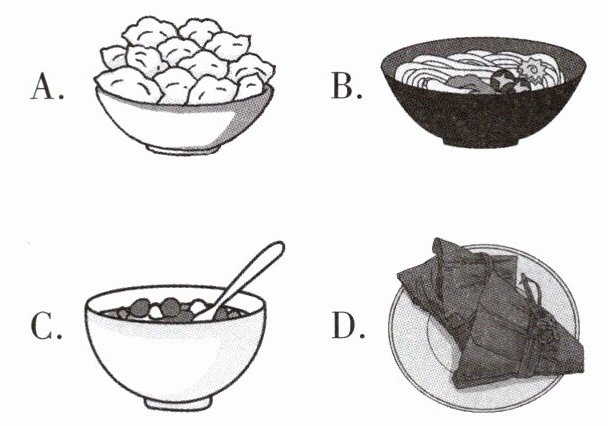
(
story about Zhu Yuanzhang?
① He was hungry.
② He named the congee "Laba
congee".
③ He found rice and beans.
④ He cooked the food.
A. ①→③→④→②
B. ③→①→④→②
C. ①→②→③→④
D. ④→③→①→②
(
" ingredients " in paragraph 2
probably mean?
A. Tool. B. Materials.
C. Sugar. D. Pot.
(
best describe the foreign college
students in paragraph 4?
A. Thankful. B. Careless.
C. Shy. D. Lazy.
(
main idea of paragraph 4?
A. By listing numbers.
B. By comparing facts.
C. By giving an example.
D. By reporting a result.
第二节 根据短文内容,从短文后所给
的选项中选出能填入空白处的最佳选项。
Once upon a time, a father and his son
ran a small tea-house. 26.
for tea always boiled well, and the house
opened early and closed late. 27.
A local official, Mr. Bai, often came to
drink tea for free. He took a table alone,
sometimes asked for peanuts or tofu,
and left without paying. 28.
Soon, the father fell ill. The son had to
run the tea-house. 29.
frowned and said, "The water isn't hot, and
the tea tastes bad."
After that, Mr. Bai came less and less.
Later, he never came. When the father got
well, the tea-house became busy again. He
asked, "Why doesn't Mr. Bai come?" The son
smiled, "30.
This story made the saying "Pick the
kettle that is not boiling" popular.
A. The father and son felt bad but didn't
dare to say anything.
B. When Mr. Bai came, the son served him
tea with water that wasn't boiled.
C. So the tea-house did well.
D. I carried the pot that wasn't boiled when
making tea for him.
E. Though it was small, they were warm to
customers and kept everything
clean.
第一节 阅读下面短文,根据短文内
容,从题中所给的A、B、C、D四个选项
中,选出最佳答案。
The Laba Festival is a special traditional
Chinese festival. It falls on the 8th day of the
twelfth lunar month, usually in January. At this
festival, one of the most important traditions is
making Laba congee.
Laba congee is a warm and delicious kind
of food. It is made of rice, beans, dried fruit
and other grains. People boil these
ingredients together until the congee becomes
thick. In the past, there was a famous story
about how it started. Zhu Yuanzhang was very
poor before becoming the first emperor of the
Ming dynasty. Once he found some leftover food
when he was hungry,
and cooked them into congee. Because that day
was the eighth of the lunar twelfth month, he
named it "Laba congee".
Besides congee, people in northern China
also make Laba garlic at this time. It's
easy to make: just put clean garlic into vinegar.
After a few days, the garlic turns green and
tastes great with dumplings.
Today, Laba congee is still popular. It
brings family together to share happiness. Eight
foreign college students once made Laba congee
to thank their teachers. They bought grains
online and cooked the congee to show their
thanks and their love for China.
Laba congee is more than just food. It
carries good wishes for health and a happy new
year, and shows the importance of tradition and
sharing. Do you want to try making it?
(
C
)21. In which picture can we see Labacongee?
(
A
)22. What is the correct order of thestory about Zhu Yuanzhang?
① He was hungry.
② He named the congee "Laba
congee".
③ He found rice and beans.
④ He cooked the food.
A. ①→③→④→②
B. ③→①→④→②
C. ①→②→③→④
D. ④→③→①→②
(
B
)23. What does the underlined word" ingredients " in paragraph 2
probably mean?
A. Tool. B. Materials.
C. Sugar. D. Pot.
(
A
)24. Which of the following words canbest describe the foreign college
students in paragraph 4?
A. Thankful. B. Careless.
C. Shy. D. Lazy.
(
C
)25. How does the writer support themain idea of paragraph 4?
A. By listing numbers.
B. By comparing facts.
C. By giving an example.
D. By reporting a result.
第二节 根据短文内容,从短文后所给
的选项中选出能填入空白处的最佳选项。
Once upon a time, a father and his son
ran a small tea-house. 26.
E
The waterfor tea always boiled well, and the house
opened early and closed late. 27.
C
A local official, Mr. Bai, often came to
drink tea for free. He took a table alone,
sometimes asked for peanuts or tofu,
and left without paying. 28.
A
Soon, the father fell ill. The son had to
run the tea-house. 29.
B
Mr. Baifrowned and said, "The water isn't hot, and
the tea tastes bad."
After that, Mr. Bai came less and less.
Later, he never came. When the father got
well, the tea-house became busy again. He
asked, "Why doesn't Mr. Bai come?" The son
smiled, "30.
D
"This story made the saying "Pick the
kettle that is not boiling" popular.
A. The father and son felt bad but didn't
dare to say anything.
B. When Mr. Bai came, the son served him
tea with water that wasn't boiled.
C. So the tea-house did well.
D. I carried the pot that wasn't boiled when
making tea for him.
E. Though it was small, they were warm to
customers and kept everything
clean.
答案
三、第一节
21. C 文章多次提到腊八粥由米、豆、
干果等制成,故选C。
22. A 故事顺序:饥饿(①) → 找到
食材(③) → 煮粥(④) →
命名(②),故选A。
23. B 第二段提到rice, beans, dried
fruit and other grains是制作腊八
粥的材料,故ingredients指食
材,选B。
24. A 文中提到外国学生制作腊八粥
来向老师致谢,体现了他们的
感恩之情,故选A。
25. C 文章第四段以“Eight foreign
college students once made Laba
congee ...”为例,说明腊八粥
仍受欢迎,属于举例支持观点,
故选C。
第二节
26. E 27. C 28. A 29. B 30. D
21. C 文章多次提到腊八粥由米、豆、
干果等制成,故选C。
22. A 故事顺序:饥饿(①) → 找到
食材(③) → 煮粥(④) →
命名(②),故选A。
23. B 第二段提到rice, beans, dried
fruit and other grains是制作腊八
粥的材料,故ingredients指食
材,选B。
24. A 文中提到外国学生制作腊八粥
来向老师致谢,体现了他们的
感恩之情,故选A。
25. C 文章第四段以“Eight foreign
college students once made Laba
congee ...”为例,说明腊八粥
仍受欢迎,属于举例支持观点,
故选C。
第二节
26. E 27. C 28. A 29. B 30. D
