

 登录
登录
二、根据要求完成下列各题,每空一词。
1. I usually spend about an hour on the internet every day. (对画线部分提问)
you usually on the internet every day?
2. Sometimes earthquakes are just too small, so people can’t feel them. (改为同义句)
Sometimes earthquakes are just for people feel.
3. More and more people will use e-money. They won’t use cash. (合并为一句)
More and more people will use e-money cash.
4. Jack often uses the internet to search for information. (对画线部分提问)
Jack often the internet to ?
5. The first electronic computer came into being in 1946 in America. (改为一般疑问句并作肯定回答)
— the first electronic computer in 1946 in America?
—Yes, .
1. I usually spend about an hour on the internet every day. (对画线部分提问)
you usually on the internet every day?
2. Sometimes earthquakes are just too small, so people can’t feel them. (改为同义句)
Sometimes earthquakes are just for people feel.
3. More and more people will use e-money. They won’t use cash. (合并为一句)
More and more people will use e-money cash.
4. Jack often uses the internet to search for information. (对画线部分提问)
Jack often the internet to ?
5. The first electronic computer came into being in 1946 in America. (改为一般疑问句并作肯定回答)
— the first electronic computer in 1946 in America?
—Yes, .
答案
【解析】:
1. 画线部分about an hour表示上网花费的时长,对其提问要用疑问词组How much time;原句为一般现在时,主语从第一人称I变为第二人称you,需要借助助动词do构成疑问句,谓语动词保持原形spend。
2. 原句语义为“地震太小,因此人们无法感知到它们”,使用固定结构too...to...(太……而不能)改写,符合“地震太小了,以至于人们无法感觉到”的含义。
3. 合并两句时,用固定短语instead of(而不是)衔接,表达“用电子货币而不是现金”的含义。
4. 画线部分search for information是动作内容,对动作内容提问要用疑问词What;原句是一般现在时,主语Jack是第三人称单数,需要借助助动词does构成疑问句,谓语动词用原形use,最后一空填do指代原画线部分的动作。
5. 原句是一般过去时,谓语动词came是实义动词come的过去式,改为一般疑问句需要借助助动词Did,后面谓语动词还原为原形come,固定搭配come into being保持原形;肯定回答用it指代the first electronic computer,后接助动词did。
【答案】:
1. How much time do; spend
2. too small
3. instead of
4. What does; use; do
5. Did; come into being; it did
1. 画线部分about an hour表示上网花费的时长,对其提问要用疑问词组How much time;原句为一般现在时,主语从第一人称I变为第二人称you,需要借助助动词do构成疑问句,谓语动词保持原形spend。
2. 原句语义为“地震太小,因此人们无法感知到它们”,使用固定结构too...to...(太……而不能)改写,符合“地震太小了,以至于人们无法感觉到”的含义。
3. 合并两句时,用固定短语instead of(而不是)衔接,表达“用电子货币而不是现金”的含义。
4. 画线部分search for information是动作内容,对动作内容提问要用疑问词What;原句是一般现在时,主语Jack是第三人称单数,需要借助助动词does构成疑问句,谓语动词用原形use,最后一空填do指代原画线部分的动作。
5. 原句是一般过去时,谓语动词came是实义动词come的过去式,改为一般疑问句需要借助助动词Did,后面谓语动词还原为原形come,固定搭配come into being保持原形;肯定回答用it指代the first electronic computer,后接助动词did。
【答案】:
1. How much time do; spend
2. too small
3. instead of
4. What does; use; do
5. Did; come into being; it did
阅读短文,从方框中选择适当的词并用其正确形式填空,使短文通顺、意思完整。每空限填一词,每词限用一次。
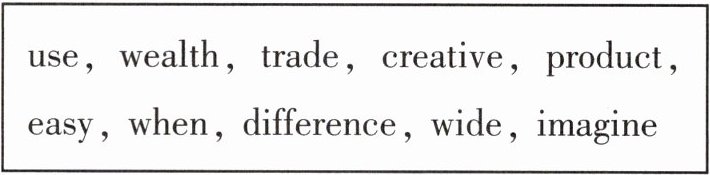
What types of money do you know? You may say coins and banknotes. If you visit a currency museum, you will see many 1. types of money used in ancient times.
In the beginning, people exchanged goods directly. For example, someone with a chicken might 2. ______ it with a neighbour for some salt. They traded many 3. ______ such as shells, feathers, and animals. On a small island in Micronesia, people once 4. ______ large stones as money. Similarly, shell money was first used in ancient China. This was because shells were durable (持久的) and 5. ______ to carry.
With the development of our society, people began to use other common goods like salt, grains, and cloth for trade. Can you 6. a type of money you can eat? Yes — it's cheese! In northern Italy, people once used cheese as collateral (抵押物) 7. they took out money from banks.
Later, to make trade easier, people began to use metals, such as gold and silver as currency. Gold, in particular, was 8. used. In ancient China, gold was not only a form of 9. but also a symbol of power.
The exciting journey of money shows how 10. people have been!
What types of money do you know? You may say coins and banknotes. If you visit a currency museum, you will see many 1. types of money used in ancient times.
In the beginning, people exchanged goods directly. For example, someone with a chicken might 2. ______ it with a neighbour for some salt. They traded many 3. ______ such as shells, feathers, and animals. On a small island in Micronesia, people once 4. ______ large stones as money. Similarly, shell money was first used in ancient China. This was because shells were durable (持久的) and 5. ______ to carry.
With the development of our society, people began to use other common goods like salt, grains, and cloth for trade. Can you 6. a type of money you can eat? Yes — it's cheese! In northern Italy, people once used cheese as collateral (抵押物) 7. they took out money from banks.
Later, to make trade easier, people began to use metals, such as gold and silver as currency. Gold, in particular, was 8. used. In ancient China, gold was not only a form of 9. but also a symbol of power.
The exciting journey of money shows how 10. people have been!
答案
1. different
2. trade
3. products
4. used
5. easy
6. imagine
7. when
8. widely
9. wealth
10. creative
2. trade
3. products
4. used
5. easy
6. imagine
7. when
8. widely
9. wealth
10. creative
解析
1. 此处修饰名词types,需将名词difference变为形容词different,different types表示“不同种类”,符合语境:你会看到很多古代使用的不同种类的钱币。
2. 情态动词might后接动词原形,固定搭配trade sth. with sb. for sth. 表示“用某物和某人交换某物”,符合早期物物交换的语境,填trade。
3. many后接可数名词复数,将product变为复数products,表示“物品”,符合句意:他们交易很多物品,比如贝壳、羽毛和动物。
4. 时间标志once(曾经)提示句子用一般过去时,use的过去式为used,固定搭配use sth. as sth. 表示“把某物用作某物”,符合当地把大石头当钱的语境。
5. and连接并列形容词,和durable(持久的)并列,easy to carry表示“容易携带”,符合贝壳作为钱币的优势,填easy。
6. 情态动词can后接动词原形,imagine表示“想象”,符合句意:你能想象一种可以吃的钱币吗?
7. 此处引导时间状语从句,when表示“当……的时候”,符合语境:当人们从银行取钱时,会用奶酪作为抵押物。
8. 此处修饰动词used,需将形容词wide变为副词widely,widely used表示“被广泛使用”,符合黄金作为货币的使用情况。
9. 介词of后接名词,wealth表示“财富”,a form of wealth表示“一种财富形式”,符合句意。
10. how引导感叹句,后接形容词,creative表示“有创造力的”,符合语境:钱币的发展历程展现了人们是多么有创造力。
2. 情态动词might后接动词原形,固定搭配trade sth. with sb. for sth. 表示“用某物和某人交换某物”,符合早期物物交换的语境,填trade。
3. many后接可数名词复数,将product变为复数products,表示“物品”,符合句意:他们交易很多物品,比如贝壳、羽毛和动物。
4. 时间标志once(曾经)提示句子用一般过去时,use的过去式为used,固定搭配use sth. as sth. 表示“把某物用作某物”,符合当地把大石头当钱的语境。
5. and连接并列形容词,和durable(持久的)并列,easy to carry表示“容易携带”,符合贝壳作为钱币的优势,填easy。
6. 情态动词can后接动词原形,imagine表示“想象”,符合句意:你能想象一种可以吃的钱币吗?
7. 此处引导时间状语从句,when表示“当……的时候”,符合语境:当人们从银行取钱时,会用奶酪作为抵押物。
8. 此处修饰动词used,需将形容词wide变为副词widely,widely used表示“被广泛使用”,符合黄金作为货币的使用情况。
9. 介词of后接名词,wealth表示“财富”,a form of wealth表示“一种财富形式”,符合句意。
10. how引导感叹句,后接形容词,creative表示“有创造力的”,符合语境:钱币的发展历程展现了人们是多么有创造力。
