

 登录
登录
一、根据画线部分的发音将下列单词正确归类。
pure, dry, study, yellow, worker, city,
fly, bird, pity,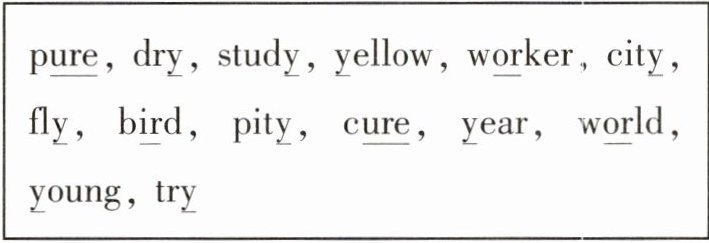 ure, year, world,
young, try
1. /j/
2. /ɪ/
3. /aɪ/
4. /ɜː/
5. /jʊə(r)/
pure, dry, study, yellow, worker, city,
fly, bird, pity,
ure, year, world,young, try
1. /j/
2. /ɪ/
3. /aɪ/
4. /ɜː/
5. /jʊə(r)/
答案
1. yellow, year, young
2. study, city, pity
3. dry, fly, try
4. worker, bird, world
5. pure, cure
2. study, city, pity
3. dry, fly, try
4. worker, bird, world
5. pure, cure
解析
我们逐一确认每个单词画线部分的发音,再按给定音标归类:
1. 半元音/j/:词首的字母y通常发/j/,筛选出对应单词;
2. 短元音/ɪ/:位于非重读音节词尾的字母y常发/ɪ/,筛选出对应单词;
3. 双元音/aɪ/:位于重读开音节词尾的字母y常发/aɪ/,筛选出对应单词;
4. 长元音/ɜː/:字母组合ir、w后的字母组合or常发/ɜː/,筛选出对应单词;
5. /jʊə(r)/:字母组合ure在对应单词中发/jʊə(r)/,筛选出对应单词。
1. 半元音/j/:词首的字母y通常发/j/,筛选出对应单词;
2. 短元音/ɪ/:位于非重读音节词尾的字母y常发/ɪ/,筛选出对应单词;
3. 双元音/aɪ/:位于重读开音节词尾的字母y常发/aɪ/,筛选出对应单词;
4. 长元音/ɜː/:字母组合ir、w后的字母组合or常发/ɜː/,筛选出对应单词;
5. /jʊə(r)/:字母组合ure在对应单词中发/jʊə(r)/,筛选出对应单词。
二、选出画线部分发音不同的一项。
()1. A. tomorrow B. slow
C. now D. know
()2. A. worm B. for
C. work D. word
()3. A. fruit B. suit
C. juice D. build
()4. A. question B. station
C. attention D. nation
()5. A. candy B. baby
C. shy D. happy
()1. A. tomorrow B. slow
C. now D. know
()2. A. worm B. for
C. work D. word
()3. A. fruit B. suit
C. juice D. build
()4. A. question B. station
C. attention D. nation
()5. A. candy B. baby
C. shy D. happy
答案
1.C 2.B 3.D 4.A 5.C
解析
1. 选项A、B、D中画线部分ow的发音均为/əʊ/,选项C中ow的发音为/aʊ/,C发音不同。
2. 选项A、C、D中画线部分or的发音均为/ɜː/,选项B中or的发音为/ɔː/,B发音不同。
3. 选项A、B、C中画线部分的发音均为/uː/,选项D中画线部分il的发音为/ɪ/,D发音不同。
4. 选项B、C、D中画线部分tion的发音均为/ʃən/,选项A中tion的发音为/tʃən/,A发音不同。
5. 选项A、B、D中画线部分y的发音均为/i/,选项C中y的发音为/aɪ/,C发音不同。
2. 选项A、C、D中画线部分or的发音均为/ɜː/,选项B中or的发音为/ɔː/,B发音不同。
3. 选项A、B、C中画线部分的发音均为/uː/,选项D中画线部分il的发音为/ɪ/,D发音不同。
4. 选项B、C、D中画线部分tion的发音均为/ʃən/,选项A中tion的发音为/tʃən/,A发音不同。
5. 选项A、B、D中画线部分y的发音均为/i/,选项C中y的发音为/aɪ/,C发音不同。
一、阅读理解
Reading can open a window to different worlds. We may read a lot of books every year. 1. Books are like people. We meet many but only a few touch our hearts. Perhaps we can only remember a few books in our lives. Books can be different for each of us, but they affect us in similar ways.
2. When we see a bird flying in the sky, we have a beautiful feeling. But we may find it hard for us to use words to show our feelings and finally we just say, “That’s so nice.” 3. He shows us the angle (角度) of the bird’s wings, the slow movement of the branches and the angle of the mouth in a smile.
4. They write some of our similar experiences. They show us what we can share with each other and how we can help each other.
Great writers also help us to feel. 5. Perhaps she is very beautiful, smart but dying, and we feel sorry for her. Or perhaps she is poor, weak but hard-working, and we find courage (勇气) to face the problems in our lives from her stories.
根据材料内容,从下面五个选项中选出能填入文中空缺处的最佳选项,使文章意思通顺、内容完整。
A. Books make us show our feelings better.
B. When reading a book, we meet someone.
C. However, a good writer can write it wonderfully.
D. But many of them may not be very interesting for us.
E. Great writers build bridges to help us communicate (交流).
Reading can open a window to different worlds. We may read a lot of books every year. 1. Books are like people. We meet many but only a few touch our hearts. Perhaps we can only remember a few books in our lives. Books can be different for each of us, but they affect us in similar ways.
2. When we see a bird flying in the sky, we have a beautiful feeling. But we may find it hard for us to use words to show our feelings and finally we just say, “That’s so nice.” 3. He shows us the angle (角度) of the bird’s wings, the slow movement of the branches and the angle of the mouth in a smile.
4. They write some of our similar experiences. They show us what we can share with each other and how we can help each other.
Great writers also help us to feel. 5. Perhaps she is very beautiful, smart but dying, and we feel sorry for her. Or perhaps she is poor, weak but hard-working, and we find courage (勇气) to face the problems in our lives from her stories.
根据材料内容,从下面五个选项中选出能填入文中空缺处的最佳选项,使文章意思通顺、内容完整。
A. Books make us show our feelings better.
B. When reading a book, we meet someone.
C. However, a good writer can write it wonderfully.
D. But many of them may not be very interesting for us.
E. Great writers build bridges to help us communicate (交流).
答案
1.D 2.A 3.C 4.E 5.B
解析
我们逐空分析逻辑匹配关系:
1. 第一空前文提到“我们每年会读很多书”,后文提到“书就像人,我们遇到很多但只有少数能触动我们的内心”,D选项“但其中很多对我们来说可能并不是很有趣”,可以衔接“读很多书”和“只有少数能打动我们”的转折逻辑,符合语境。
2. 第二空后文举例说明普通人看到飞鸟的美好感受却很难用语言描述出来,A选项“书籍能让我们更好地表达自己的感受”可以总起本段内容,引出后文普通人难以精准表达感受的情况,逻辑通顺。
3. 第三空前文提到普通人很难用语言描述自己的感受,只会说“那太棒了”,后文提到“他能向我们展示鸟翅膀的角度、树枝缓慢的晃动、微笑时嘴角的弧度”,C选项“然而,一个优秀的作家可以把这种感受写得十分精妙”,其中it指代前文难以表达的感受,he指代优秀的作家,完美衔接前后内容。
4. 第四空后文提到“他们写下我们相似的经历,告诉我们可以和彼此分享什么、如何互相帮助”,E选项“伟大的作家搭建桥梁来帮助我们交流”可以总起本段,后文内容正是对“搭建交流桥梁”的具体解释,符合语境。
5. 第五空后文提到我们会为书中的角色感到难过,还能从她的故事里获得面对生活的勇气,B选项“当我们读书时,我们会遇见某个人”引出后文书中的人物角色,逻辑匹配。
1. 第一空前文提到“我们每年会读很多书”,后文提到“书就像人,我们遇到很多但只有少数能触动我们的内心”,D选项“但其中很多对我们来说可能并不是很有趣”,可以衔接“读很多书”和“只有少数能打动我们”的转折逻辑,符合语境。
2. 第二空后文举例说明普通人看到飞鸟的美好感受却很难用语言描述出来,A选项“书籍能让我们更好地表达自己的感受”可以总起本段内容,引出后文普通人难以精准表达感受的情况,逻辑通顺。
3. 第三空前文提到普通人很难用语言描述自己的感受,只会说“那太棒了”,后文提到“他能向我们展示鸟翅膀的角度、树枝缓慢的晃动、微笑时嘴角的弧度”,C选项“然而,一个优秀的作家可以把这种感受写得十分精妙”,其中it指代前文难以表达的感受,he指代优秀的作家,完美衔接前后内容。
4. 第四空后文提到“他们写下我们相似的经历,告诉我们可以和彼此分享什么、如何互相帮助”,E选项“伟大的作家搭建桥梁来帮助我们交流”可以总起本段,后文内容正是对“搭建交流桥梁”的具体解释,符合语境。
5. 第五空后文提到我们会为书中的角色感到难过,还能从她的故事里获得面对生活的勇气,B选项“当我们读书时,我们会遇见某个人”引出后文书中的人物角色,逻辑匹配。
