

 登录
登录
Ⅱ. 阅读理解 时文阅读
①Liaoning Provincial Museum (省博物馆) is a fun place for many students. They love to go there. Why? Let’s find out.
②Many schools cooperate (合作) with the museum. “About 100 schools bring their students here to have classes. Reciting (背诵) poems is often boring and difficult for students. To make it easy and fun, we give talks about poems and make shows to tell the stories of poets like Li Bai, Du Fu, and Lu You. We also teach students to write calligraphy (书法),” says Dong, a worker from the museum.
③ Interestingly, the museum makes plays about those poets and asks students to act in them. Students recite poems in the plays and get to experience the lives of the poets.
④ The museum also cares about village students. It gives shows about the poets on a bus. The bus is like a moving museum and it goes to villages far from the museum.
⑤The museum brings ▲ to students’ lives and makes it so fun. That’s why students have a great love for the museum.
(
①Give talks about poems.
②Watch shows about the poets.
③ Learn to write calligraphy.
④Experience poets’ lives in plays.
A. ①②③
B. ①②④
C. ①③④
D. ②③④
(
A. The museum looks like a bus.
B. There is a small museum in the village.
C. The museum shows love for village students.
D. The museum makes shows about village students.
(
A. Maths.
B. Music.
C. English.
D. History.
(
①Liaoning Provincial Museum (省博物馆) is a fun place for many students. They love to go there. Why? Let’s find out.
②Many schools cooperate (合作) with the museum. “About 100 schools bring their students here to have classes. Reciting (背诵) poems is often boring and difficult for students. To make it easy and fun, we give talks about poems and make shows to tell the stories of poets like Li Bai, Du Fu, and Lu You. We also teach students to write calligraphy (书法),” says Dong, a worker from the museum.
③ Interestingly, the museum makes plays about those poets and asks students to act in them. Students recite poems in the plays and get to experience the lives of the poets.
④ The museum also cares about village students. It gives shows about the poets on a bus. The bus is like a moving museum and it goes to villages far from the museum.
⑤The museum brings ▲ to students’ lives and makes it so fun. That’s why students have a great love for the museum.
(
D
)1. [新考法·细节多选] What can students do in the museum?①Give talks about poems.
②Watch shows about the poets.
③ Learn to write calligraphy.
④Experience poets’ lives in plays.
A. ①②③
B. ①②④
C. ①③④
D. ②③④
(
C
)2. What can we learn from Paragraph 4?A. The museum looks like a bus.
B. There is a small museum in the village.
C. The museum shows love for village students.
D. The museum makes shows about village students.
(
D
)3. [新考法·单词回填] Which is the best word for ▲ in the last paragraph?A. Maths.
B. Music.
C. English.
D. History.
(
A
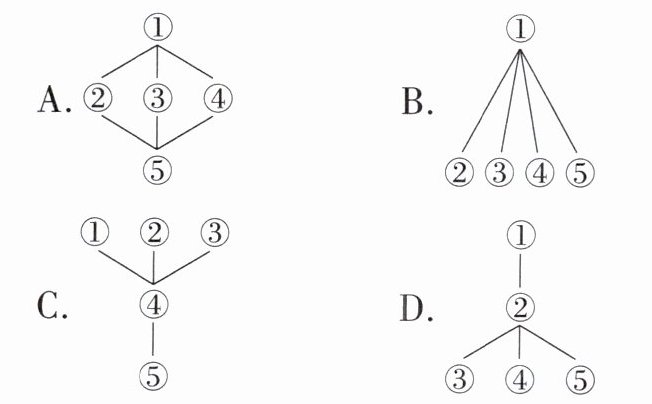
)4. [新考法·篇章结构] What’s the structure (结构) of the passage? 答案
1~4 DCDA
解析
【分析】
本题为英语时文阅读理解题,需结合原文内容逐一分析各题目:
1. 第1题是细节理解题,需明确学生在博物馆可参与的活动,区分博物馆工作人员行为与学生行为,排除错误选项;
2. 第2题是段落理解题,定位第4段,分析各选项与原文表述的匹配度;
3. 第3题是词义猜测题,结合前文围绕诗人、诗歌的内容,推断空格处词汇;
4. 第4题是篇章结构题,梳理文章段落逻辑,确定结构类型并匹配对应选项。
【解析】
1. 第1题:原文第②段提到博物馆工作人员“give talks about poems”,并非学生的行为,故①错误;原文明确学生可参与的活动有:观看诗人相关表演(对应②)、学习书法(对应③)、在戏剧中体验诗人生活(对应④),因此答案选D。
2. 第2题:第4段首句“The museum also cares about village students”表明博物馆关心乡村学生;A项“博物馆像公交车”错误(是公交车像移动博物馆),B项“村里有小博物馆”无依据,D项“关于乡村学生的表演”错误,答案选C。
3. 第3题:前文围绕诗人、诗歌(属于历史范畴)展开,空格处需体现相关主题,因此选“History”,答案选D。
4. 第4题:文章第①段总起引出省博物馆受学生喜爱,第②③④段分述博物馆的具体举措,第⑤段总结原因,结构为总-分-总,对应选项A的结构,答案选A。
【答案】
1~4 DCDA
【知识点】
阅读理解细节理解、词义猜测、篇章结构
【点评】
本题以省博物馆为主题,考查学生的细节定位、段落理解、词义猜测及篇章分析能力,需仔细梳理原文信息,区分不同主体行为,理清文章逻辑结构。
【难度系数】
0.6
本题为英语时文阅读理解题,需结合原文内容逐一分析各题目:
1. 第1题是细节理解题,需明确学生在博物馆可参与的活动,区分博物馆工作人员行为与学生行为,排除错误选项;
2. 第2题是段落理解题,定位第4段,分析各选项与原文表述的匹配度;
3. 第3题是词义猜测题,结合前文围绕诗人、诗歌的内容,推断空格处词汇;
4. 第4题是篇章结构题,梳理文章段落逻辑,确定结构类型并匹配对应选项。
【解析】
1. 第1题:原文第②段提到博物馆工作人员“give talks about poems”,并非学生的行为,故①错误;原文明确学生可参与的活动有:观看诗人相关表演(对应②)、学习书法(对应③)、在戏剧中体验诗人生活(对应④),因此答案选D。
2. 第2题:第4段首句“The museum also cares about village students”表明博物馆关心乡村学生;A项“博物馆像公交车”错误(是公交车像移动博物馆),B项“村里有小博物馆”无依据,D项“关于乡村学生的表演”错误,答案选C。
3. 第3题:前文围绕诗人、诗歌(属于历史范畴)展开,空格处需体现相关主题,因此选“History”,答案选D。
4. 第4题:文章第①段总起引出省博物馆受学生喜爱,第②③④段分述博物馆的具体举措,第⑤段总结原因,结构为总-分-总,对应选项A的结构,答案选A。
【答案】
1~4 DCDA
【知识点】
阅读理解细节理解、词义猜测、篇章结构
【点评】
本题以省博物馆为主题,考查学生的细节定位、段落理解、词义猜测及篇章分析能力,需仔细梳理原文信息,区分不同主体行为,理清文章逻辑结构。
【难度系数】
0.6
