

 登录
登录
一、读课文第58和59页课文,给下列句子排序。
(
(
(
(
(
(
4
) Then Lu Ban made the first saw in the world.(
5
) People still use the saw today.(
2
) He looked at the leaf and found many sharp teeth on it.(
1
) One day, a leaf cut Lu Ban’s finger when he worked on a mountain.(
3
) Lu Ban had an idea to make a tool with teeth like these.答案
(4, 5, 2, 1, 3)
二、读短文,判断正(T)误(F)。
Today people all over the world make and fly kites for fun. Kites were the first flying devices(装置). People in China used kites as flying devices about 2,000 years ago. In Marco Polo(马可·波罗)'s book, the Chinese used big kites to carry people up into the sky. The idea of kites helped people make planes. Lawrence Hargrave(劳伦斯·哈格雷夫)made four big kites in Australia in 1894. These four kites lifted him 5 metres(米)into the air.
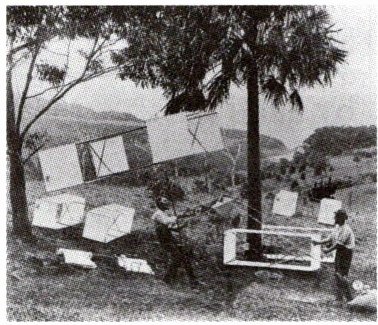
Now people around the world use kites in festivals. Kites can have all kinds of colours and shapes, but the most important thing is that they can fly well.
(
(
(
(
(
Today people all over the world make and fly kites for fun. Kites were the first flying devices(装置). People in China used kites as flying devices about 2,000 years ago. In Marco Polo(马可·波罗)'s book, the Chinese used big kites to carry people up into the sky. The idea of kites helped people make planes. Lawrence Hargrave(劳伦斯·哈格雷夫)made four big kites in Australia in 1894. These four kites lifted him 5 metres(米)into the air.
Now people around the world use kites in festivals. Kites can have all kinds of colours and shapes, but the most important thing is that they can fly well.
(
F
)1. People all over the world used kites as flying machines in the past.(
F
)2. The Chinese used big kites to carry food into the sky.(
F
)3. The idea of planes helped people to make big kites.(
T
)4. The four kites lifted Lawrence Hargrave 5 metres into the air in 1894.(
F
)5. The most important thing about a kite is to have beautiful colours and shapes.答案
1. F 2. F 3. F 4. T 5. F
解析
【分析】本题为英语阅读理解的判断正误题,解题思路是:先明确每道题的题干含义,再回到短文中定位与题干相关的细节内容,将题干信息与原文内容逐一对比,判断是否一致,从而得出正确答案。
【解析】1. 题干意为“过去全世界人都把风筝当作飞行器”,原文仅提到“2000年前中国人把风筝用作飞行器”,并非全世界,故判断为错误;2. 题干意为“中国人用大风筝把食物运上天”,原文提到“中国人用大风筝把人运上天”,并非食物,故判断为错误;3. 题干意为“飞机的想法帮助人们制作大风筝”,原文是“风筝的想法帮助人们制造飞机”,逻辑颠倒,故判断为错误;4. 题干意为“1894年四个风筝把劳伦斯·哈格雷夫抬到5米高空”,原文明确对应“1894年劳伦斯制作四个大风筝,这四个风筝把他抬到5米高空”,故判断为正确;5. 题干意为“风筝最重要的是有漂亮的颜色和形状”,原文提到“风筝最重要的是能飞得好”,故判断为错误。
【答案】1.F 2.F 3.F 4.T 5.F
【知识点】英语阅读理解、细节判断
【点评】本题考查英语阅读理解的细节正误判断,需准确提取原文关键信息,对比题干内容即可解题,题型基础,难度适中。
【难度系数】0.5
【解析】1. 题干意为“过去全世界人都把风筝当作飞行器”,原文仅提到“2000年前中国人把风筝用作飞行器”,并非全世界,故判断为错误;2. 题干意为“中国人用大风筝把食物运上天”,原文提到“中国人用大风筝把人运上天”,并非食物,故判断为错误;3. 题干意为“飞机的想法帮助人们制作大风筝”,原文是“风筝的想法帮助人们制造飞机”,逻辑颠倒,故判断为错误;4. 题干意为“1894年四个风筝把劳伦斯·哈格雷夫抬到5米高空”,原文明确对应“1894年劳伦斯制作四个大风筝,这四个风筝把他抬到5米高空”,故判断为正确;5. 题干意为“风筝最重要的是有漂亮的颜色和形状”,原文提到“风筝最重要的是能飞得好”,故判断为错误。
【答案】1.F 2.F 3.F 4.T 5.F
【知识点】英语阅读理解、细节判断
【点评】本题考查英语阅读理解的细节正误判断,需准确提取原文关键信息,对比题干内容即可解题,题型基础,难度适中。
【难度系数】0.5
三、古代中国有许多伟大的发明家,请填写对应的人物。
Ancient Chinese Inventors
Lu Ban
He invented the saw. It can cut things easily.
1.
He invented paper.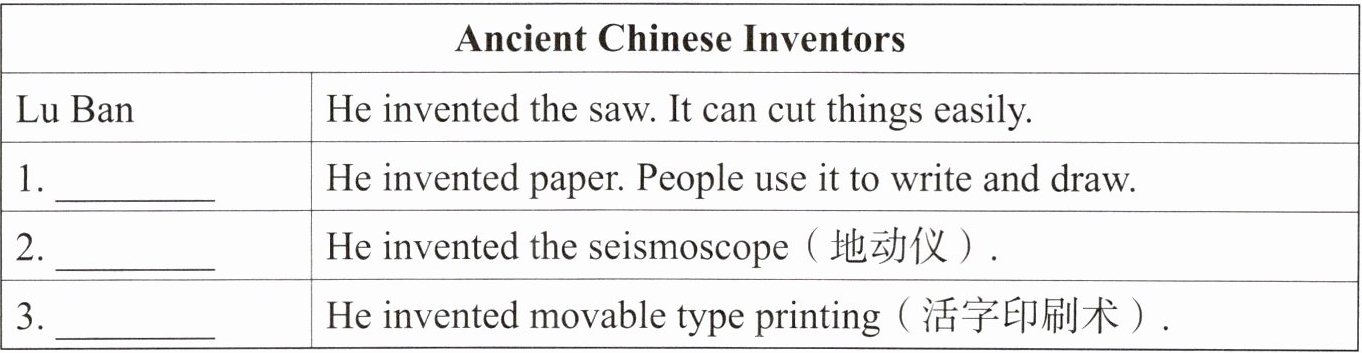 ople use it to write and draw.
2.
He invented the seismoscope(地动仪).
3.
He invented movable type printing(活字印刷术).
Ancient Chinese Inventors
Lu Ban
He invented the saw. It can cut things easily.
1.
Cai Lun
He invented paper.
ople use it to write and draw.2.
Zhang Heng
He invented the seismoscope(地动仪).
3.
Bi Sheng
He invented movable type printing(活字印刷术).
答案
1. Cai Lun 2. Zhang Heng 3. Bi Sheng
解析
【分析】
本题考查中国古代发明家及其发明的对应关系,解题思路是回忆历史常识:发明造纸术的是蔡伦,发明地动仪的是张衡,发明活字印刷术的是毕昇,据此填写对应人物即可。
【解析】
根据中国古代科技史常识,发明纸的是蔡伦,发明地动仪的是张衡,发明活字印刷术的是毕昇,对应填入表格空缺处。
【答案】
1. Cai Lun 2. Zhang Heng 3. Bi Sheng
【知识点】
中国古代发明家、四大发明常识
【点评】
本题为基础常识识记题,考查对中国古代重要发明家及其发明成果的掌握,属于需要记忆的内容,难度较低。
【难度系数】
0.2
本题考查中国古代发明家及其发明的对应关系,解题思路是回忆历史常识:发明造纸术的是蔡伦,发明地动仪的是张衡,发明活字印刷术的是毕昇,据此填写对应人物即可。
【解析】
根据中国古代科技史常识,发明纸的是蔡伦,发明地动仪的是张衡,发明活字印刷术的是毕昇,对应填入表格空缺处。
【答案】
1. Cai Lun 2. Zhang Heng 3. Bi Sheng
【知识点】
中国古代发明家、四大发明常识
【点评】
本题为基础常识识记题,考查对中国古代重要发明家及其发明成果的掌握,属于需要记忆的内容,难度较低。
【难度系数】
0.2
