

 登录
登录
Ⅱ. 阅读下面四位同学的音乐爱好描述,连线匹配图片和文本。

答案
Picture 1: Zhao Lin
Picture 2: Lucy
Picture 3: Xu Lei
Picture 4: Wang Xin
Picture 2: Lucy
Picture 3: Xu Lei
Picture 4: Wang Xin
Ⅲ. 根据上一题的描述,从文本中提取关键信息,完成下面的表格。(每空不超过3个单词)
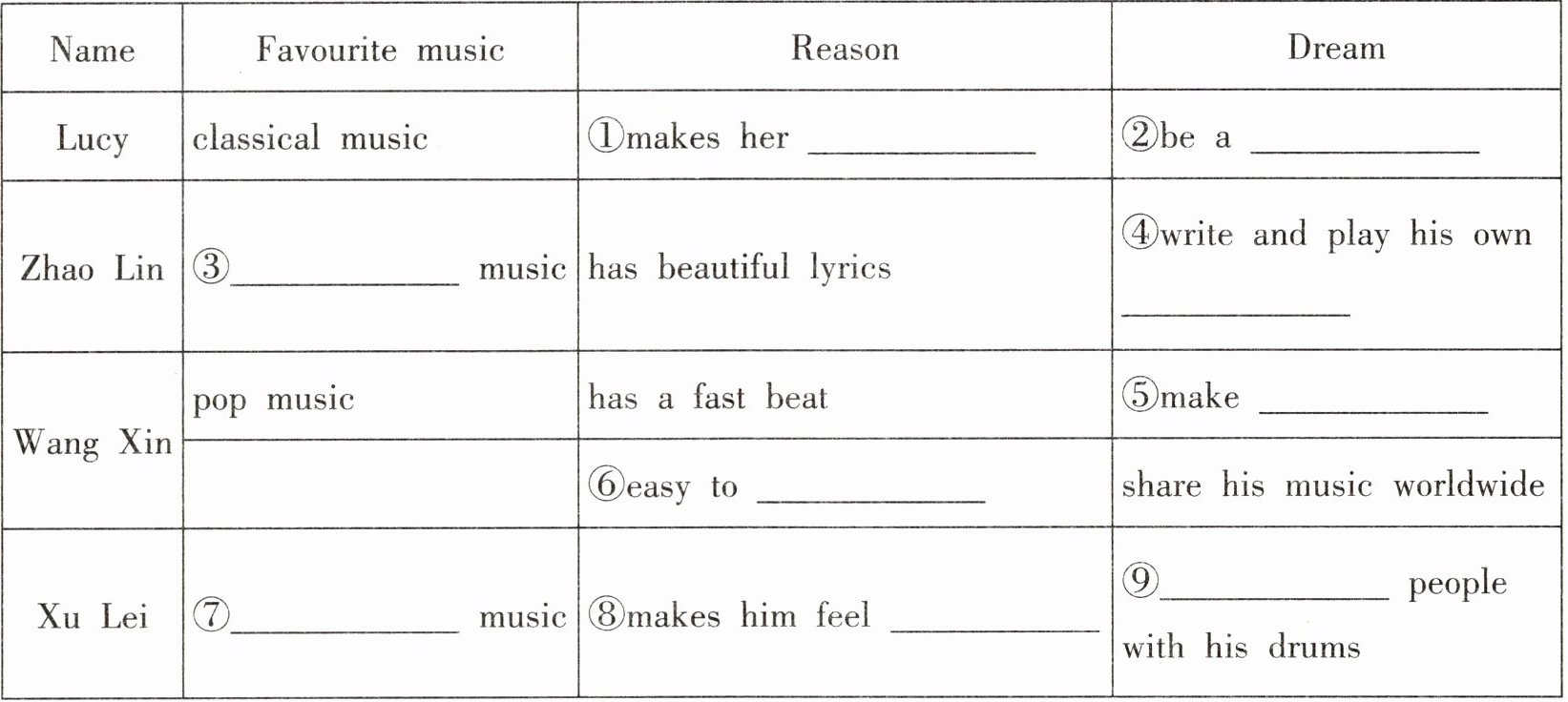
Name Favourite music Reason Dream
Lucy classical music ①makes her
Zhao Lin ③
Wang Xin pop music has a fast beat ⑤make
Wang Xin ⑥easy to
Xu Lei ⑦
Name Favourite music Reason Dream
Lucy classical music ①makes her
relaxed
②be a composer
Zhao Lin ③
country
music has beautiful lyrics ④write and play his own country songs
Wang Xin pop music has a fast beat ⑤make
his own record
Wang Xin ⑥easy to
sing along to
share his music worldwideXu Lei ⑦
jazz
music ⑧makes him feel energetic
⑨inspire
people with his drums答案
① relaxed
② composer
③ country
④ country songs
⑤ his own record
⑥ sing along to
⑦ jazz
⑧ energetic
⑨ inspire
② composer
③ country
④ country songs
⑤ his own record
⑥ sing along to
⑦ jazz
⑧ energetic
⑨ inspire
Ⅳ. 阅读理解。
What's your favorite song? What do you like about it? Do you often share the music you like with a friend or family member? Do they like it as much as you do? Maybe they do—or maybe not. Sometimes, people's musical tastes can be very different.
Why do we like some styles of music but not others? There are several reasons.
One reason is personality. Are you quiet or loud? Peaceful or full of energy? People often choose music that matches who they are.
Another reason is age. Your favorite songs may not be the same as your parents’ top choices. The music you listen to in your teen years shapes your preferences for the rest of your life. However, it’s also common for these preferences to change as you get older.
Environment also matters. The place and culture you grow up in influence the music you hear. That’s why when people move to new places or meet new people, they often hear different styles of music.
Your mood(情绪) can change your music choices, too. On some days when you feel sad, you may want slow, soft songs. But on others, you may want loud songs with a fast beat. These choices can be influenced by your mood and by how you want others to see you.
All these things—personality, age, environment, and mood—help shape your musical taste.
▲ Respect their choices, and they’ll respect yours!
(
A. By listing facts.
B. By asking questions.
C. By giving an example.
(
A. They are mainly influenced by their parents.
B. They will hardly change after their teen years.
C. They may influence their lifelong taste in music.
(
A. Fast and loud music.
B. Slow and soft music.
C. Music by famous singers.
(
A. And people from the same place must love the same music.
B. That’s why we should only stick to the music we already like.
C. And it’s perfectly fine if you and your friends enjoy different songs.
(
A. To explain why people have different music preferences.
B. To teach readers how to enjoy different music styles.
C. To advise readers to listen to more music.
What's your favorite song? What do you like about it? Do you often share the music you like with a friend or family member? Do they like it as much as you do? Maybe they do—or maybe not. Sometimes, people's musical tastes can be very different.
Why do we like some styles of music but not others? There are several reasons.
One reason is personality. Are you quiet or loud? Peaceful or full of energy? People often choose music that matches who they are.
Another reason is age. Your favorite songs may not be the same as your parents’ top choices. The music you listen to in your teen years shapes your preferences for the rest of your life. However, it’s also common for these preferences to change as you get older.
Environment also matters. The place and culture you grow up in influence the music you hear. That’s why when people move to new places or meet new people, they often hear different styles of music.
Your mood(情绪) can change your music choices, too. On some days when you feel sad, you may want slow, soft songs. But on others, you may want loud songs with a fast beat. These choices can be influenced by your mood and by how you want others to see you.
All these things—personality, age, environment, and mood—help shape your musical taste.
▲ Respect their choices, and they’ll respect yours!
(
B
)1. How does the writer start the passage?A. By listing facts.
B. By asking questions.
C. By giving an example.
(
C
)2. What can we know about teenagers’ music preferences?A. They are mainly influenced by their parents.
B. They will hardly change after their teen years.
C. They may influence their lifelong taste in music.
(
B
)3. If a person feels sad, what kind of music might he choose to listen to according to the passage?A. Fast and loud music.
B. Slow and soft music.
C. Music by famous singers.
(
C
)4. Which of the following sentences can be put in “▲”?A. And people from the same place must love the same music.
B. That’s why we should only stick to the music we already like.
C. And it’s perfectly fine if you and your friends enjoy different songs.
(
A
)5. Why does the writer write the passage?A. To explain why people have different music preferences.
B. To teach readers how to enjoy different music styles.
C. To advise readers to listen to more music.
答案
1. B
2. C
3. B
4. C
5. A
2. C
3. B
4. C
5. A
