

 登录
1. 如图,二次函数$y=ax^2+bx+c$的图象经过$A(-3,0),B(1,0),C(0,-3)$三点。
(1)求抛物线的函数表达式。
(2)点P在直线AC下方的抛物线上运动,求点P到直线AC的最大距离。
(3)动点Q在抛物线的对称轴上,作射线QA,若射线QA绕点Q逆时针旋转$90°$,与抛物线交于点D,是否存在点Q使$AQ=QD$?若存在,请直接写出点Q的坐标;若不存在,请说明理由。
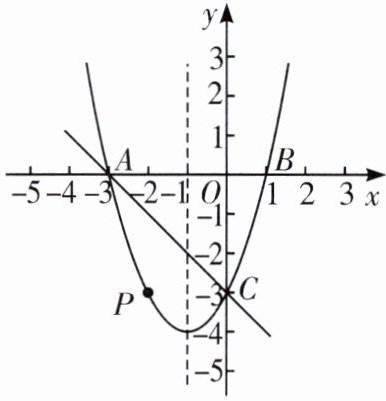
(1)求抛物线的函数表达式。
(2)点P在直线AC下方的抛物线上运动,求点P到直线AC的最大距离。
(3)动点Q在抛物线的对称轴上,作射线QA,若射线QA绕点Q逆时针旋转$90°$,与抛物线交于点D,是否存在点Q使$AQ=QD$?若存在,请直接写出点Q的坐标;若不存在,请说明理由。
答案
1. (1) $y=x^2+2x-3$。
(2) 解:由点$A(-3,0),C(0,-3)$可得直线$AC$的函数表达式为$y=-x-3$。
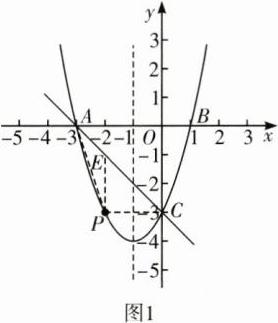 过点$P$作$PE// y$轴交$AC$于点$E$,连接$AP,CP$,设$P(p,p^2+2p-3)(-3<p<0)$,则$E(p,-p-3)$,
$\therefore PE=-p-3-(p^2+2p-3)=-p^2-3p=-(p+\dfrac{3}{2})^2 + \dfrac{9}{4}$。$\because S_{△ ACP}= S_{△ APE} + S_{△ CPE}$,
$\therefore S_{△ ACP}=\dfrac{1}{2}PE· [0-p+p-(-3)]=\dfrac{3}{2}PE$,$\therefore$当$PE$有最大值时,$S_{△ ACP}$有最大值。$\because PE=-(p+\dfrac{3}{2})^2 + \dfrac{9}{4}$,$-1<0$,$-3<p<0$,$\therefore$当$p+\dfrac{3}{2}=0$,即$p=-\dfrac{3}{2}$时,$PE$有最大值,最大值为$\dfrac{9}{4}$,$\therefore S_{△ ACP}$的最大值为$\dfrac{3}{2}×\dfrac{9}{4}=\dfrac{27}{8}$。$\because A(-3,0),C(0,-3)$,$\therefore OA=OC=3$,$∠ AOC= 90°$,由勾股定理得$AC=\sqrt{OA^2+OC^2}=3\sqrt{2}$。设点$P$到直线$AC$的距离为$h$,$\therefore S_{△ ACP}=\dfrac{1}{2}AC· h=\dfrac{3\sqrt{2}}{2}h$,$\therefore h=\dfrac{\sqrt{2}}{3}S_{△ ACP}$。$\because$当$S_{△ ACP}$有最大值时,$h$有最大值,$\therefore h$的最大值为$\dfrac{\sqrt{2}}{3}×\dfrac{27}{8}=\dfrac{9\sqrt{2}}{8}$,$\therefore$点$P$到直线$AC$的最大距离为$\dfrac{9\sqrt{2}}{8}$。
(3) 解:
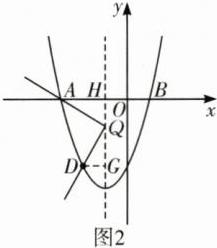 当点$Q$在$x$轴下方时,设抛物线对称轴交$x$轴于点$H$,过点$D$作$DG⊥ QH$于点$G$。$\because$抛物线的函数表达式为$y=x^2+2x-3=(x+1)^2-4$,$\therefore$抛物线对称轴为直线$x=-1$,$\therefore H(-1,0)$,$\therefore OH=1$。$\because A(-3, 0)$,$\therefore AH=-1-(-3)=2$。设点$Q$的坐标为$(-1,q)$,则$QH=-q$。由旋转的性质可得$∠ AQD = 90°$,又$\because∠ AHQ= ∠ QGD = 90°$,$\therefore∠ HAQ+ ∠ HQA =∠ HQA + ∠ GQD = 90°$,$\therefore∠ HAQ= ∠ GQD$。又$\because AQ=QD$,$\therefore△ HAQ≌△ GQD(\mathrm{AAS})$,$\therefore DG=QH=-q$,$QG=AH=2$,$\therefore HG=QH+QG=2-q$,$\therefore$点$D$的横坐标为$-1-(-q)=-1+q$,纵坐标为$-(2-q)=q-2$,$\therefore D(-1+q,q-2)$。$\because$点$D$在抛物线上,$\therefore (-1+q)^2+2(-1+q)-3=q-2$,$\therefore q^2-2q+1-2+2q-3=q-2$,整理,得$q^2-q-2=0$,解得$q=-1$或$q=2$(舍去),$\therefore$此时点$Q$的坐标为$(-1,-1)$。
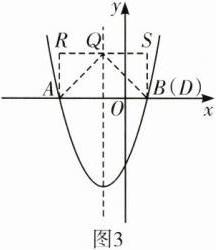 当点$Q$在$x$轴上方时,过点$Q$作$RS// x$轴,分别过点$A$,点$D$作直线$RS$的垂线,垂足分别为$R,S$,连接$AQ,DQ$,设点$Q$的坐标为$(-1,q)$,$\therefore∠ R=∠ S=90°$。由旋转的性质可得$∠ AQD=90°$,$\therefore ∠ RAQ + ∠ RQA =∠ RQA + ∠ SQD = 90°$,$\therefore∠ RAQ= ∠ SQD$。又$\because AQ= QD$,$\therefore △ RAQ ≌ △ SQD(\mathrm{AAS})$,$\therefore QS=AR=q$,$DS=QR=-1-(-3)=2$,$\therefore$点$D$的横坐标为$-1+q$,纵坐标为$q-2$,即$D(-1+q,q-2)$。$\because$点$D$在抛物线上,$\therefore (-1+q)^2+2(-1+q)-3=q-2$,$\therefore q^2-2q+1-2+2q-3=q-2$,$\therefore q^2-q-2=0$,解得$q=2$或$q=-1$(舍去),$\therefore$此时点$Q$的坐标为$(-1,2)$。
综上所述,存在点$Q$使$AQ=QD$,此时点$Q$的坐标为$(-1,-1)$或$(-1,2)$。
2. 如图,在平面直角坐标系中,二次函数$y=x^2+bx+c$($b,c$为常数)的图象与$x$轴交于$A(-1,0)$,$B$两点,交$y$轴于点$C$,对称轴为直线$x=1$。
(1)求二次函数表达式。
(2)连接$AC,BC$,抛物线上是否存在点$P$,使$∠ CBP+∠ ACO=45°$?若存在,求出点$P$的坐标;若不存在,请说明理由。
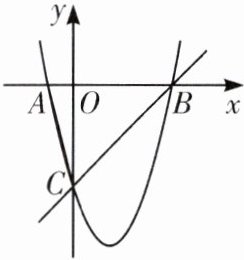
(1)求二次函数表达式。
(2)连接$AC,BC$,抛物线上是否存在点$P$,使$∠ CBP+∠ ACO=45°$?若存在,求出点$P$的坐标;若不存在,请说明理由。
答案
(1) $y=x^2-2x-3$。
(2) 解:由$y=x^2-2x-3$可知$C(0,-3)$,$B(3,0)$,$\therefore OB=OC=3$,即$∠ OCB=∠ OBC=45°$。分两种情况:
当点$P$在直线$BC$上方时,
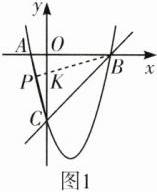 记$BP$与$y$轴交于点$K$,则$∠ OBP+∠ CBP = ∠ OBC = 45°$。又$\because∠ CBP+ ∠ ACO = 45°$,$\therefore∠ OBP=∠ ACO$。$\because ∠ BOK=∠ AOC=90°$,$\therefore△ BOK∽△ COA$,$\therefore\dfrac{OK}{OB}=\dfrac{OA}{OC}=\dfrac{1}{3}$。
$\therefore OK=\dfrac{1}{3}OB=1$。由$B(3,0),K(0,-1)$可得直线$BP$的表达式为$y = \dfrac{1}{3}x-1$,联立方程组$\begin{cases}y=\dfrac{1}{3}x-1,\\y=x^2-2x-3,\end{cases}$解得$\begin{cases}x=3,\\y=0\end{cases}$(与$B$点重合)或$\begin{cases}x=-\dfrac{2}{3},\\y=-\dfrac{11}{9}\end{cases}$,$\therefore P(-\dfrac{2}{3},-\dfrac{11}{9})$。当点$P$在直线$BC$下方时,
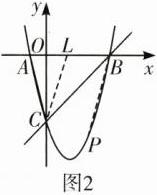 作点$A$关于$y$轴的对称点$L$,连接$CL$,则$∠ ACO=∠ LCO$,$L(1, 0)$。$\because∠ CBP+∠ ACO= 45°$,$∠ LCO+∠ BCL = 45°$,$\therefore∠ CBP=∠ BCL$,$\therefore BP// CL$。由$C(0,-3),L(1,0)$可得直线$CL$的表达式为$y=3x-3$,$\therefore$设直线$BP$:$y=3x+n$,将$B(3,0)$代入得$n=-9$,$\therefore$直线$BP$的表达式为$y = 3x - 9$,联立方程组$\begin{cases}y=3x-9,\\y=x^2-2x-3,\end{cases}$解得$\begin{cases}x=3,\\y=0\end{cases}$(与$B$点重合)或$\begin{cases}x=2,\\y=-3\end{cases}$。$\therefore P(2,-3)$。
综上,点$P$的坐标为$(-\dfrac{2}{3},-\dfrac{11}{9})$或$(2,-3)$。
