

 登录
登录
阅读短文,从方框中选出能填入空白处的最佳选项,使短文意思通顺、内容完整。
Marie Curie is a famous scientist who is most famous for discovering two new radioactive elements(放射性元素). During the First World War, Marie Curie invented a great machine. 1.
Marie Curie was born in Poland on 7 November, 1867. Marie's parents were both teachers and her father would often teach her science at home. When she grew older, Marie wanted to go to university and learn all about physics. 2.
After she had learnt all about physics at university, Marie worked in a lab with her husband, Pierre Curie. During this time, Marie made great progress and discovered two new radioactive elements. 3.
4.
5.
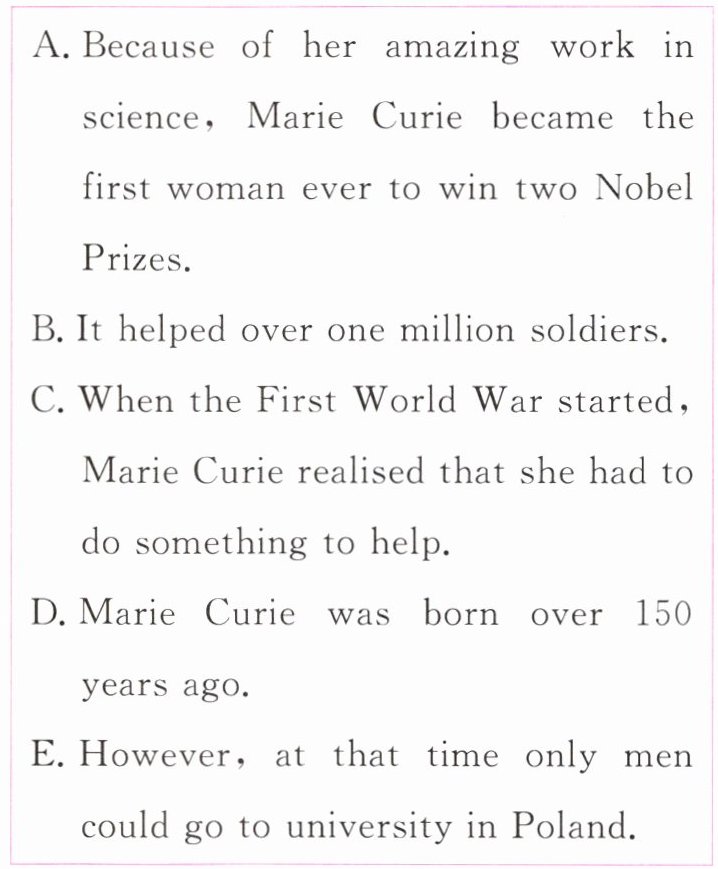
Marie Curie is a famous scientist who is most famous for discovering two new radioactive elements(放射性元素). During the First World War, Marie Curie invented a great machine. 1.
B
Marie Curie was born in Poland on 7 November, 1867. Marie's parents were both teachers and her father would often teach her science at home. When she grew older, Marie wanted to go to university and learn all about physics. 2.
E
This meant that Marie had to go to France to study.After she had learnt all about physics at university, Marie worked in a lab with her husband, Pierre Curie. During this time, Marie made great progress and discovered two new radioactive elements. 3.
A
She received the first in 1903 for physics and the second for chemistry(化学) in 1911.4.
C
Marie found that wounded soldiers recovered(恢复) better if they were treated quickly. Putting her knowledge and understanding of radiation to good use, Marie invented a machine to help soldiers close to the front.5.
D
But her work is still well-known all over the world today. Amazingly, some treatments being used in hospitals today started out as inventions in her lab. Many places even use Marie's name as recognition(表彰) of the great work she carried out.答案
1. B 2. E 3. A 4. C 5. D
解析
【分析】
本题为英语句子还原题,需结合上下文的逻辑关系、时间顺序及事件关联选择合适句子。第1空前文提到居里夫人在一战期间发明机器,后文应说明机器的作用,对应选项B;第2空前文说玛丽想上大学,后文提到她必须去法国学习,中间需说明波兰当时的大学情况,对应选项E;第3空前文讲她发现新放射性元素,后文说两次诺贝尔奖,对应选项A;第4空后文描述她帮助士兵的行动,前文应说明一战爆发时她的想法,对应选项C;第5空后文提到她的工作至今知名,前文应说明她的出生时间,对应选项D。
【解析】
1. 第1空:空前提到“invented a great machine”,选项B说明该机器帮助了超过一百万士兵,衔接发明机器的作用,故选B。
2. 第2空:空前说“Marie wanted to go to university”,后文说“had to go to France to study”,选项E指出当时波兰只有男性能上大学,解释了必须去法国的原因,故选E。
3. 第3空:前文讲她发现两种新放射性元素,后文说两次诺贝尔奖,选项A说明因为科学成就成为首位获两次诺贝尔奖的女性,衔接因果关系,故选A。
4. 第4空:后文描述她帮助士兵的具体做法,选项C说明一战开始时她意识到要帮忙,引出下文行动,故选C。
5. 第5空:后文说她的工作至今知名,选项D说明她出生于150多年前,时间上衔接,故选D。
【答案】
1. B 2. E 3. A 4. C 5. D
【知识点】
英语句子还原、阅读理解
【点评】
本题围绕居里夫人的生平成就设置,考查学生对上下文逻辑、时间顺序的把握,需理清人物经历的关联,难度适中。
【难度系数】
0.5
本题为英语句子还原题,需结合上下文的逻辑关系、时间顺序及事件关联选择合适句子。第1空前文提到居里夫人在一战期间发明机器,后文应说明机器的作用,对应选项B;第2空前文说玛丽想上大学,后文提到她必须去法国学习,中间需说明波兰当时的大学情况,对应选项E;第3空前文讲她发现新放射性元素,后文说两次诺贝尔奖,对应选项A;第4空后文描述她帮助士兵的行动,前文应说明一战爆发时她的想法,对应选项C;第5空后文提到她的工作至今知名,前文应说明她的出生时间,对应选项D。
【解析】
1. 第1空:空前提到“invented a great machine”,选项B说明该机器帮助了超过一百万士兵,衔接发明机器的作用,故选B。
2. 第2空:空前说“Marie wanted to go to university”,后文说“had to go to France to study”,选项E指出当时波兰只有男性能上大学,解释了必须去法国的原因,故选E。
3. 第3空:前文讲她发现两种新放射性元素,后文说两次诺贝尔奖,选项A说明因为科学成就成为首位获两次诺贝尔奖的女性,衔接因果关系,故选A。
4. 第4空:后文描述她帮助士兵的具体做法,选项C说明一战开始时她意识到要帮忙,引出下文行动,故选C。
5. 第5空:后文说她的工作至今知名,选项D说明她出生于150多年前,时间上衔接,故选D。
【答案】
1. B 2. E 3. A 4. C 5. D
【知识点】
英语句子还原、阅读理解
【点评】
本题围绕居里夫人的生平成就设置,考查学生对上下文逻辑、时间顺序的把握,需理清人物经历的关联,难度适中。
【难度系数】
0.5
At my primary school, I was one of the smartest kids there. I never studied, but always got perfect scores. I thought I was born clever. At least I believed so. I was also a prodigy in music according to myself. I could sing better than almost anyone else in my school. I was pretty sure that once I got to sixth grade, everyone would be surprised by me. But actually they weren't.
When I arrived at my new class, I couldn't wait to show everyone what I could do. However, there was always someone else who could do better. My grades began to suffer(变差). More talented girls often sang solos(独唱). I believed I wasn't smart. I believed I wasn't talented. I believed I was a failure.
Over the next two years, I had to work very hard. Every prize for the singing competition was given to me for hard work and efforts. Grades were still very low but improving little by little. I worked really hard. However, I was never the best at everything. I haven't realised until recently that I really don't have to be the best at everything. I was too hard on myself. In fact, when I did badly in a test, my classmates never laughed at me. No one is perfect.
There will probably always be someone better than me at something. Anyway, there are over eight billion people in this world. I will never be the number one at everything,and that's really okay.
(
A. A smart kid.
B. A crazy fan.
C. A common child.
D. A lazy girl.
(
A. she lost her interest in music
B. she had difficulty in learning
C. she surprised everyone in solos
D. she got on badly with her classmates
(
A. She won many prizes without any efforts.
B. She became the perfect student in her class.
C. She gave up trying because of the low scores.
D. She improved little by little by working hard.
(
A. No One Is Perfect
B. My Past Life as a Young Girl
C. Hard Work Doesn't Work
D. Try Your Best to Be Perfect
(
A. Nervous.
B. Satisfied.
C. Doubtful.
D. Worried.
When I arrived at my new class, I couldn't wait to show everyone what I could do. However, there was always someone else who could do better. My grades began to suffer(变差). More talented girls often sang solos(独唱). I believed I wasn't smart. I believed I wasn't talented. I believed I was a failure.
Over the next two years, I had to work very hard. Every prize for the singing competition was given to me for hard work and efforts. Grades were still very low but improving little by little. I worked really hard. However, I was never the best at everything. I haven't realised until recently that I really don't have to be the best at everything. I was too hard on myself. In fact, when I did badly in a test, my classmates never laughed at me. No one is perfect.
There will probably always be someone better than me at something. Anyway, there are over eight billion people in this world. I will never be the number one at everything,and that's really okay.
(
A
)1.【词义猜测题】What does the underlined phrase “a prodigy” mean in Paragraph 1?A. A smart kid.
B. A crazy fan.
C. A common child.
D. A lazy girl.
(
B
)2. When the writer was at the new class, B
.A. she lost her interest in music
B. she had difficulty in learning
C. she surprised everyone in solos
D. she got on badly with her classmates
(
D
)3. What happened to the writer during the next two years?A. She won many prizes without any efforts.
B. She became the perfect student in her class.
C. She gave up trying because of the low scores.
D. She improved little by little by working hard.
(
A
)4.【标题归纳题】What is the best title for this passage?A. No One Is Perfect
B. My Past Life as a Young Girl
C. Hard Work Doesn't Work
D. Try Your Best to Be Perfect
(
C
)5.【态度观点题】What's the writer's attitude to herself?A. Nervous.
B. Satisfied.
C. Doubtful.
D. Worried.
答案
1. A 2. B 3. D 4. A 5. C
解析
【分析】
这是一篇关于自我认知的记叙文阅读理解,包含词义猜测、细节理解、标题归纳、态度观点类题目。解题时需先通读全文把握主旨:作者从小学时自负聪明、有音乐天赋,到六年级发现自己并非最优秀,成绩变差,后努力仍非全能第一,最终明白“没人是完美的”。逐题分析:1. 词义猜测题,结合前文“最聪明的孩子”“成绩优异”及后文“唱歌比别人好”,可知作者认为自己在音乐上是聪明的孩子;2. 细节理解题,根据新班级时“成绩变差”判断学习有困难;3. 细节理解题,依据“接下来两年努力,成绩慢慢提高”确定;4. 标题归纳题,全文围绕“没人是完美的”展开,最后点明主旨;5. 态度观点题,作者曾怀疑自己的聪明与天赋,认为自己是失败者。
【解析】
1. 词义猜测题:第一段作者自述是最聪明的孩子之一,成绩优异,音乐上比多数人唱得好,故“prodigy”意为“聪明的孩子”,选A;
2. 细节理解题:第二段提到到新班级后“My grades began to suffer(成绩变差)”,说明学习有困难,选B;
3. 细节理解题:第三段明确“Over the next two years... Grades were still very low but improving little by little”,即努力后成绩慢慢提高,选D;
4. 标题归纳题:全文最后点明“No one is perfect”,是文章主旨,选A;
5. 态度观点题:作者曾认为自己不聪明、没天赋,觉得自己是失败的,体现对自我的怀疑,选C。
【答案】
1.A 2.B 3.D 4.A 5.C
【知识点】
词义猜测题、细节理解题、主旨大意题
【点评】
本题通过记叙文考查多种阅读题型,需结合语境、细节及主旨解题,传递了正确的自我认知观念,适合学生巩固阅读技巧。
【难度系数】
0.6
这是一篇关于自我认知的记叙文阅读理解,包含词义猜测、细节理解、标题归纳、态度观点类题目。解题时需先通读全文把握主旨:作者从小学时自负聪明、有音乐天赋,到六年级发现自己并非最优秀,成绩变差,后努力仍非全能第一,最终明白“没人是完美的”。逐题分析:1. 词义猜测题,结合前文“最聪明的孩子”“成绩优异”及后文“唱歌比别人好”,可知作者认为自己在音乐上是聪明的孩子;2. 细节理解题,根据新班级时“成绩变差”判断学习有困难;3. 细节理解题,依据“接下来两年努力,成绩慢慢提高”确定;4. 标题归纳题,全文围绕“没人是完美的”展开,最后点明主旨;5. 态度观点题,作者曾怀疑自己的聪明与天赋,认为自己是失败者。
【解析】
1. 词义猜测题:第一段作者自述是最聪明的孩子之一,成绩优异,音乐上比多数人唱得好,故“prodigy”意为“聪明的孩子”,选A;
2. 细节理解题:第二段提到到新班级后“My grades began to suffer(成绩变差)”,说明学习有困难,选B;
3. 细节理解题:第三段明确“Over the next two years... Grades were still very low but improving little by little”,即努力后成绩慢慢提高,选D;
4. 标题归纳题:全文最后点明“No one is perfect”,是文章主旨,选A;
5. 态度观点题:作者曾认为自己不聪明、没天赋,觉得自己是失败的,体现对自我的怀疑,选C。
【答案】
1.A 2.B 3.D 4.A 5.C
【知识点】
词义猜测题、细节理解题、主旨大意题
【点评】
本题通过记叙文考查多种阅读题型,需结合语境、细节及主旨解题,传递了正确的自我认知观念,适合学生巩固阅读技巧。
【难度系数】
0.6
