

 登录
19.(6分)如图,AC平分∠∠BAD,CE⊥AB于点E,CF⊥AD交AD的延长线于点F,且BC=DC.求证:BE=DF. 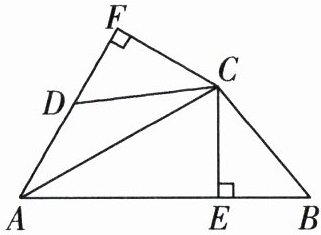
答案
19.证明:$\because AC$ 平分$∠ BAD,CE⊥ AB$ 于点 $E,CF⊥ AD$ 交 $AD$ 的延长线于点 $F, \therefore CE=CF$,$∠ CEB=∠ F=90°$. 在 $\mathrm{Rt}△ BCE$ 和 $\mathrm{Rt}△ DCF$ 中,
$\begin{cases}BC=DC \\CE=CF\end{cases}$
,$\therefore \mathrm{Rt}△ BCE≌\mathrm{Rt}△ DCF(\mathrm{HL})$,$\therefore BE=DF$.
$\begin{cases}BC=DC \\CE=CF\end{cases}$
,$\therefore \mathrm{Rt}△ BCE≌\mathrm{Rt}△ DCF(\mathrm{HL})$,$\therefore BE=DF$.
20.(6分)如图,点D,E在△ABC的边BC上,AB=AC,AD=AE.
(1)求证:BD=CE.
(2)若AD=DE=BD,求∠B的度数.
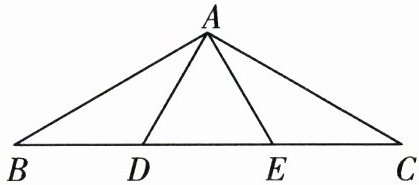
(1)求证:BD=CE.
(2)若AD=DE=BD,求∠B的度数.
答案
20.(1)证明:过点 $A$ 作 $AF⊥ BC$ 于点 $F$. $\because AB=AC,AD=AE,\therefore BF=CF,DF=EF,\therefore BD=CE$. (2)解:$\because AD=DE=AE,\therefore △ ADE$ 是等边三角形, $\therefore ∠ ADE=60°$. $\because AD=BD$,$\therefore ∠ DAB=∠ B$,$\therefore ∠ B=\frac{1}{2}∠ ADE=30°$.
21.(6分)如图,已知D是AC上一点,AB=AD,AB+DC=DE,AE=BC.
(1)求证:∠EAD=∠B.
(2)若∠BAE=127°,求∠ACB的大小.
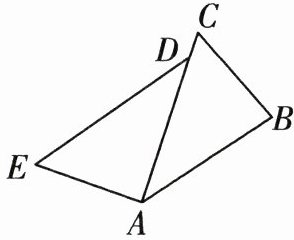
(1)求证:∠EAD=∠B.
(2)若∠BAE=127°,求∠ACB的大小.
答案
21.(1)证明:$\because AB=AD,AB+DC=DE,\therefore AD+DC=DE$. 又$\because AD+DC=AC,\therefore DE=AC$. 在 $△ DAE$ 和 $△ ABC$ 中,
$\begin{cases}DA=AB \\DE=AC \\AE=BC\end{cases}$
,$\therefore △ DAE≌△ ABC(\mathrm{SSS}),\therefore ∠ EAD=∠ B$.
(2)解: $\because ∠ EAD = ∠ B$, $∠ BAE = 127°$,$\therefore ∠ CAB+∠ B = ∠ CAB+∠ EAD = ∠ BAE = 127°$,$\therefore ∠ ACB=180°-(∠ CAB+∠ B)=180°-127°=53°$.
$\begin{cases}DA=AB \\DE=AC \\AE=BC\end{cases}$
,$\therefore △ DAE≌△ ABC(\mathrm{SSS}),\therefore ∠ EAD=∠ B$.
(2)解: $\because ∠ EAD = ∠ B$, $∠ BAE = 127°$,$\therefore ∠ CAB+∠ B = ∠ CAB+∠ EAD = ∠ BAE = 127°$,$\therefore ∠ ACB=180°-(∠ CAB+∠ B)=180°-127°=53°$.
22. (10分)(1)如图①,在$△ ABC$中,$∠ BAC=90°$,$AB=AC$,直线$m$经过点$A$,$BD⊥$直线$m$,$CE⊥$直线$m$,垂足分别为$D$,$E$.求证:$DE=BD+CE$.
(2)如图②,将(1)中的条件改为在$△ ABC$中,$AB=AC$,$D$,$A$,$E$三点都在直线$m$上,并且有$∠ BDA=∠ AEC=∠ BAC=α$,其中$α$为任意锐角或钝角,请问$DE=BD+CE$是否仍成立?若成立,请给出证明;若不成立,请说明理由.
(3)如图③,在(2)的条件下,若$α=120°$,且$△ ACF$为等边三角形,试判断$△ DEF$的形状,并说明理由.
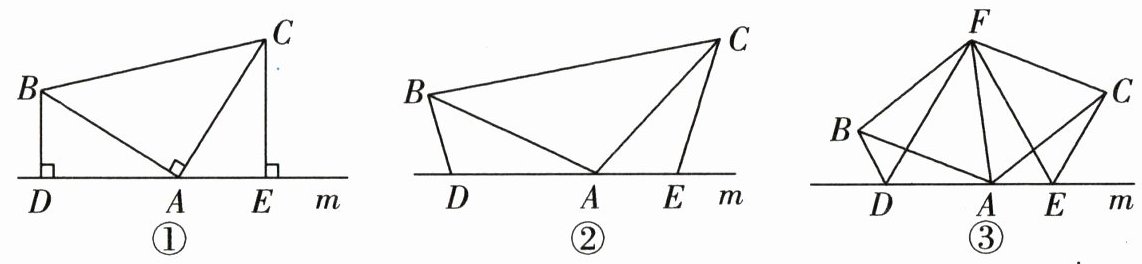
(2)如图②,将(1)中的条件改为在$△ ABC$中,$AB=AC$,$D$,$A$,$E$三点都在直线$m$上,并且有$∠ BDA=∠ AEC=∠ BAC=α$,其中$α$为任意锐角或钝角,请问$DE=BD+CE$是否仍成立?若成立,请给出证明;若不成立,请说明理由.
(3)如图③,在(2)的条件下,若$α=120°$,且$△ ACF$为等边三角形,试判断$△ DEF$的形状,并说明理由.
答案
22.(1)证明:$\because BD⊥$直线$m,CE⊥$直线$m,\therefore ∠ BDA=∠ CEA=90°$. $\because ∠ BAC=90°,\therefore ∠ BAD+∠ CAE = 90°$. $\because ∠ BAD + ∠ ABD = 90°$,$\therefore ∠ CAE = ∠ ABD$. 在 $△ ADB$ 和 $△ CEA$ 中,
$\begin{cases}∠ ABD=∠ CAE \\∠ BDA=∠ AEC \\AB=CA\end{cases}$
,$\therefore △ ADB≌△ CEA(\mathrm{AAS})$,$\therefore BD=AE,AD=CE$,$\therefore DE=AE+AD=BD+CE$. (2)解:成立.证明:$\because ∠ BDA=∠ BAC=α$,$\therefore ∠ ABD+∠ BAD=∠ BAD+∠ CAE=180°-α$,$\therefore ∠ ABD=∠ CAE$. 在 $△ ADB$ 和 $△ CEA$ 中,
$\begin{cases}∠ ABD=∠ CAE \\∠ BDA=∠ AEC \\AB=CA\end{cases}$
,$\therefore △ ADB≌△ CEA(\mathrm{AAS})$,$\therefore BD=AE,AD=CE$,$\therefore DE=AE+AD=BD+CE$. (3)解:$△ DEF$ 为等边三角形.理由如下:由(2)知,$△ ADB≌△ CEA$,$BD=AE$,$∠ DBA=∠ CAE$. $\because △ ACF$ 为等边三角形,$\therefore ∠ CAF=60°$,$AF=AC$. 又$\because AB=AC$,$\therefore AB=AF$. $\because ∠ BAC=120°$,$\therefore ∠ BAF=60°$,$\therefore △ ABF$ 是等边三角形,$\therefore ∠ ABF=∠ BFA=60°$,$BF=AF$,$\therefore ∠ ABD + ∠ ABF = ∠ CAE + ∠ CAF$,$\therefore ∠ DBF = ∠ EAF$. 在 $△ BDF$ 和 $△ AEF$ 中,
$\begin{cases}BF=AF \\∠ DBF=∠ EAF \\BD=AE\end{cases}$
,$\therefore △ BDF≌△ AEF(\mathrm{SAS})$,$\therefore DF = EF$, $∠ BFD = ∠ AFE$. $\therefore ∠ DFE = ∠ DFA+∠ AFE = ∠ DFA+∠ BFD = ∠ BFA = 60°$,$\therefore △ DEF$ 为等边三角形.
$\begin{cases}∠ ABD=∠ CAE \\∠ BDA=∠ AEC \\AB=CA\end{cases}$
,$\therefore △ ADB≌△ CEA(\mathrm{AAS})$,$\therefore BD=AE,AD=CE$,$\therefore DE=AE+AD=BD+CE$. (2)解:成立.证明:$\because ∠ BDA=∠ BAC=α$,$\therefore ∠ ABD+∠ BAD=∠ BAD+∠ CAE=180°-α$,$\therefore ∠ ABD=∠ CAE$. 在 $△ ADB$ 和 $△ CEA$ 中,
$\begin{cases}∠ ABD=∠ CAE \\∠ BDA=∠ AEC \\AB=CA\end{cases}$
,$\therefore △ ADB≌△ CEA(\mathrm{AAS})$,$\therefore BD=AE,AD=CE$,$\therefore DE=AE+AD=BD+CE$. (3)解:$△ DEF$ 为等边三角形.理由如下:由(2)知,$△ ADB≌△ CEA$,$BD=AE$,$∠ DBA=∠ CAE$. $\because △ ACF$ 为等边三角形,$\therefore ∠ CAF=60°$,$AF=AC$. 又$\because AB=AC$,$\therefore AB=AF$. $\because ∠ BAC=120°$,$\therefore ∠ BAF=60°$,$\therefore △ ABF$ 是等边三角形,$\therefore ∠ ABF=∠ BFA=60°$,$BF=AF$,$\therefore ∠ ABD + ∠ ABF = ∠ CAE + ∠ CAF$,$\therefore ∠ DBF = ∠ EAF$. 在 $△ BDF$ 和 $△ AEF$ 中,
$\begin{cases}BF=AF \\∠ DBF=∠ EAF \\BD=AE\end{cases}$
,$\therefore △ BDF≌△ AEF(\mathrm{SAS})$,$\therefore DF = EF$, $∠ BFD = ∠ AFE$. $\therefore ∠ DFE = ∠ DFA+∠ AFE = ∠ DFA+∠ BFD = ∠ BFA = 60°$,$\therefore △ DEF$ 为等边三角形.
