

 登录
例4(2025年烟台)如图,抛物线$y=ax^2+bx+3$与$x$轴交于$A,B$两点(点$A$在点$B$左侧),与$y$轴交于点$C$,$OA=2$,$OB=6$,$D$是直线$BC$上方抛物线上一动点,作$DF⊥AB$交$BC$于点$E$,垂足为点$F$,连接$CD$。
(1)求抛物线的表达式。
(2)设点$D$的横坐标为$t$:
①用含有$t$的代数式表示线段$DE$的长度。
②是否存在点$D$,使$△ CDE$是等腰三角形?若存在,请求出所有满足条件的点$D$的坐标;若不存在,请说明理由。
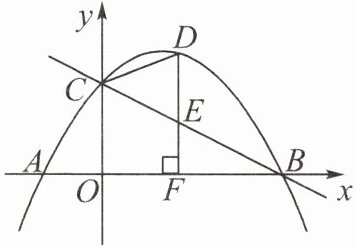
[点拨] (1)运用待定系数法即可求解。
(2)①求出直线$BC:y=-\frac{1}{2}x+3$,则$D(t,-\frac{1}{4}t^2+t+3),E(t,-\frac{1}{2}t+3)$,即可用$t$的代数式表示$DE$。
②分别表示三边,分类讨论,建立方程求解即可。
[解] (1)∵抛物线$y=ax^2+bx+3$与$x$轴交于$A,B$两点(点$A$在点$B$左侧),与$y$轴交于点$C$,$OA=2$,$OB=6$,
∴$A(-2,0),B(6,0)$,
∴$\begin{cases}4a - 2b + 3 = 0, \\36a + 6b + 3 = 0,\end{cases}$解得$\begin{cases}a = -\frac{1}{4}, \\b = 1,\end{cases}$
∴抛物线表达式为$y=-\frac{1}{4}x^2 + x + 3$。
(2)①对于抛物线表达式$y=-\frac{1}{4}x^2 + x + 3$,当$x=0$时,$y=3$,
∴$C(0,3)$。
设直线$BC$表达式为$y=kx + b$,
则$\begin{cases}6k + b = 0, \\b = 3,\end{cases}$解得$\begin{cases}k = -\frac{1}{2}, \\b = 3,\end{cases}$
∴直线$BC:y=-\frac{1}{2}x + 3$,
∵$DE⊥AB$,
∴$D(t,-\frac{1}{4}t^2 + t + 3),E(t,-\frac{1}{2}t + 3)$,
∴$DE=-\frac{1}{4}t^2 + t + 3 - (-\frac{1}{2}t + 3)=-\frac{1}{4}t^2 + \frac{3}{2}t$,
∴$DE=-\frac{1}{4}t^2 + \frac{3}{2}t(0<t<6)$。
②存在,
$CD=\sqrt{t^2 + (-\frac{1}{4}t^2 + t + 3 - 3)^2}=\sqrt{t^2 + (-\frac{1}{4}t^2 + t)^2}$,
而$CE=\sqrt{t^2 + (-\frac{1}{2}t + 3 - 3)^2}=\frac{\sqrt{5}}{2}t$,
当$DE=CE$时,$-\frac{1}{4}t^2 + \frac{3}{2}t=\frac{\sqrt{5}}{2}t$,
解得$t=6 - 2\sqrt{5}$或$t=0$(舍),
∴$-\frac{1}{4}t^2 + t + 3=-\frac{1}{4}×(6 - 2\sqrt{5})^2 + 6 - 2\sqrt{5} + 3=4\sqrt{5} - 5$,
∴$D(6 - 2\sqrt{5},4\sqrt{5} - 5)$,
当$CD=DE$时,
$t^2 + (-\frac{1}{4}t^2 + t)^2=(-\frac{1}{4}t^2 + \frac{3}{2}t)^2$,
整理得$t^2(-t + 1)=0$,
解得$t=1$或$t=0$(舍),
∴$-\frac{1}{4}t^2 + t + 3=-\frac{1}{4}×1^2 + 1 + 3=\frac{15}{4}$,
∴$D(1,\frac{15}{4})$,
当$CD=CE$时,
$t^2 + (-\frac{1}{4}t^2 + t)^2=(\frac{\sqrt{5}}{2}t)^2$,
整理得$t^2(\frac{1}{16}t^2 - \frac{1}{2}t + \frac{3}{4})=0$,
解得$t=2$或$t=6$(舍)或$t=0$(舍),
∴$-\frac{1}{4}t^2 + t + 3=-\frac{1}{4}×2^2 + 2 + 3=4$,
∴$D(2,4)$,
综上,$△ CDE$是等腰三角形时,$D(2,4)$,$D(1,\frac{15}{4})$或$D(6 - 2\sqrt{5},4\sqrt{5} - 5)$。
(1)求抛物线的表达式。
(2)设点$D$的横坐标为$t$:
①用含有$t$的代数式表示线段$DE$的长度。
②是否存在点$D$,使$△ CDE$是等腰三角形?若存在,请求出所有满足条件的点$D$的坐标;若不存在,请说明理由。
[点拨] (1)运用待定系数法即可求解。
(2)①求出直线$BC:y=-\frac{1}{2}x+3$,则$D(t,-\frac{1}{4}t^2+t+3),E(t,-\frac{1}{2}t+3)$,即可用$t$的代数式表示$DE$。
②分别表示三边,分类讨论,建立方程求解即可。
[解] (1)∵抛物线$y=ax^2+bx+3$与$x$轴交于$A,B$两点(点$A$在点$B$左侧),与$y$轴交于点$C$,$OA=2$,$OB=6$,
∴$A(-2,0),B(6,0)$,
∴$\begin{cases}4a - 2b + 3 = 0, \\36a + 6b + 3 = 0,\end{cases}$解得$\begin{cases}a = -\frac{1}{4}, \\b = 1,\end{cases}$
∴抛物线表达式为$y=-\frac{1}{4}x^2 + x + 3$。
(2)①对于抛物线表达式$y=-\frac{1}{4}x^2 + x + 3$,当$x=0$时,$y=3$,
∴$C(0,3)$。
设直线$BC$表达式为$y=kx + b$,
则$\begin{cases}6k + b = 0, \\b = 3,\end{cases}$解得$\begin{cases}k = -\frac{1}{2}, \\b = 3,\end{cases}$
∴直线$BC:y=-\frac{1}{2}x + 3$,
∵$DE⊥AB$,
∴$D(t,-\frac{1}{4}t^2 + t + 3),E(t,-\frac{1}{2}t + 3)$,
∴$DE=-\frac{1}{4}t^2 + t + 3 - (-\frac{1}{2}t + 3)=-\frac{1}{4}t^2 + \frac{3}{2}t$,
∴$DE=-\frac{1}{4}t^2 + \frac{3}{2}t(0<t<6)$。
②存在,
$CD=\sqrt{t^2 + (-\frac{1}{4}t^2 + t + 3 - 3)^2}=\sqrt{t^2 + (-\frac{1}{4}t^2 + t)^2}$,
而$CE=\sqrt{t^2 + (-\frac{1}{2}t + 3 - 3)^2}=\frac{\sqrt{5}}{2}t$,
当$DE=CE$时,$-\frac{1}{4}t^2 + \frac{3}{2}t=\frac{\sqrt{5}}{2}t$,
解得$t=6 - 2\sqrt{5}$或$t=0$(舍),
∴$-\frac{1}{4}t^2 + t + 3=-\frac{1}{4}×(6 - 2\sqrt{5})^2 + 6 - 2\sqrt{5} + 3=4\sqrt{5} - 5$,
∴$D(6 - 2\sqrt{5},4\sqrt{5} - 5)$,
当$CD=DE$时,
$t^2 + (-\frac{1}{4}t^2 + t)^2=(-\frac{1}{4}t^2 + \frac{3}{2}t)^2$,
整理得$t^2(-t + 1)=0$,
解得$t=1$或$t=0$(舍),
∴$-\frac{1}{4}t^2 + t + 3=-\frac{1}{4}×1^2 + 1 + 3=\frac{15}{4}$,
∴$D(1,\frac{15}{4})$,
当$CD=CE$时,
$t^2 + (-\frac{1}{4}t^2 + t)^2=(\frac{\sqrt{5}}{2}t)^2$,
整理得$t^2(\frac{1}{16}t^2 - \frac{1}{2}t + \frac{3}{4})=0$,
解得$t=2$或$t=6$(舍)或$t=0$(舍),
∴$-\frac{1}{4}t^2 + t + 3=-\frac{1}{4}×2^2 + 2 + 3=4$,
∴$D(2,4)$,
综上,$△ CDE$是等腰三角形时,$D(2,4)$,$D(1,\frac{15}{4})$或$D(6 - 2\sqrt{5},4\sqrt{5} - 5)$。
答案
解:(1)
∵抛物线$y=ax^2+bx+3$与$x$轴交于$A,B$两点(点$A$在点$B$左侧),与$y$轴交于点$C$,$OA=2$,$OB=6$,
∴$A(-2,0)$,$B(6,0)$,
将$A,B$两点坐标代入抛物线解析式得:
$\begin{cases}4a - 2b + 3 = 0 \\36a + 6b + 3 = 0\end{cases}$
解得$\begin{cases}a = -\dfrac{1}{4} \\b = 1\end{cases}$
∴抛物线的表达式为$y=-\dfrac{1}{4}x^2 + x + 3$。
(2)①
对于抛物线$y=-\dfrac{1}{4}x^2 + x + 3$,令$x=0$,得$y=3$,
∴$C(0,3)$。
设直线$BC$的表达式为$y=kx + b$,将$B(6,0)$、$C(0,3)$代入得:
$\begin{cases}6k + b = 0 \\b = 3\end{cases}$
解得$\begin{cases}k = -\dfrac{1}{2} \\b = 3\end{cases}$
∴直线$BC$的表达式为$y=-\dfrac{1}{2}x + 3$。
∵$DF⊥AB$,点$D$的横坐标为$t$,
∴$D(t,-\dfrac{1}{4}t^2 + t + 3)$,$E(t,-\dfrac{1}{2}t + 3)$,
∴$DE = (-\dfrac{1}{4}t^2 + t + 3) - (-\dfrac{1}{2}t + 3) = -\dfrac{1}{4}t^2 + \dfrac{3}{2}t$,
其中$0<t<6$,即$DE=-\dfrac{1}{4}t^2 + \dfrac{3}{2}t\ (0<t<6)$。
②存在满足条件的点$D$,求解如下:
由两点间距离公式得:
$CD=\sqrt{t^2 + (-\dfrac{1}{4}t^2 + t + 3 - 3)^2}=\sqrt{t^2 + (-\dfrac{1}{4}t^2 + t)^2}$,
$CE=\sqrt{t^2 + (-\dfrac{1}{2}t + 3 - 3)^2}=\dfrac{\sqrt{5}}{2}t$。
分三种情况讨论:
1. 当$DE=CE$时:
$-\dfrac{1}{4}t^2 + \dfrac{3}{2}t = \dfrac{\sqrt{5}}{2}t$,
∵$0<t<6$,$t≠0$,整理得$-\dfrac{1}{4}t + \dfrac{3}{2} = \dfrac{\sqrt{5}}{2}$,
解得$t=6-2\sqrt{5}$,舍去$t=0$,
将$t=6-2\sqrt{5}$代入$D$点纵坐标得:
$y=-\dfrac{1}{4}(6-2\sqrt{5})^2 + (6-2\sqrt{5}) + 3=4\sqrt{5}-5$,
∴此时$D(6-2\sqrt{5},4\sqrt{5}-5)$。
2. 当$CD=DE$时:
$t^2 + (-\dfrac{1}{4}t^2 + t)^2 = (-\dfrac{1}{4}t^2 + \dfrac{3}{2}t)^2$,
整理得$t^2(-t+1)=0$,
解得$t=1$,舍去$t=0$,
将$t=1$代入$D$点纵坐标得:
$y=-\dfrac{1}{4}×1^2 + 1 + 3=\dfrac{15}{4}$,
∴此时$D(1,\dfrac{15}{4})$。
3. 当$CD=CE$时:
$t^2 + (-\dfrac{1}{4}t^2 + t)^2 = (\dfrac{\sqrt{5}}{2}t)^2$,
整理得$t^2(\dfrac{1}{16}t^2 - \dfrac{1}{2}t + \dfrac{3}{4})=0$,
解得$t=2$,舍去$t=0$、$t=6$,
将$t=2$代入$D$点纵坐标得:
$y=-\dfrac{1}{4}×2^2 + 2 + 3=4$,
∴此时$D(2,4)$。
综上,所有满足条件的点$D$的坐标为$(2,4)$、$(1,\dfrac{15}{4})$、$(6-2\sqrt{5},4\sqrt{5}-5)$。
解析
【分析】
(1) 求抛物线表达式时,先根据OA=2、OB=6确定A、B两点的坐标,再将两点坐标代入抛物线的一般式,通过解二元一次方程组求出待定系数a、b,即可得到抛物线解析式。
(2) ①要表示DE的长度,首先需先求直线BC的解析式:先由抛物线解析式得到C点坐标,再用待定系数法求出直线BC的表达式;由于DF垂直x轴,D、E两点的横坐标均为t,分别代入抛物线和直线BC的解析式得到两点纵坐标,因D在直线BC上方,故DE的长度等于D点纵坐标减去E点纵坐标,化简后即可得到结果。
②判断△CDE为等腰三角形时,需分三类讨论:DE=CE、CD=DE、CD=CE,先根据两点间距离公式分别表示出CD、CE的长度,再对应列方程求解,结合t的取值范围0<t<6舍去不符合的解,即可得到对应D点的坐标。
【解析】
(1)
∵抛物线$y=ax^2+bx+3$与$x$轴交于$A,B$两点(点$A$在点$B$左侧),与$y$轴交于点$C$,$OA=2$,$OB=6$,
∴$A(-2,0)$,$B(6,0)$,
将$A,B$两点坐标代入抛物线解析式得:
$\begin{cases}4a - 2b + 3 = 0 \\36a + 6b + 3 = 0\end{cases}$
解得$\begin{cases}a = -\dfrac{1}{4} \\b = 1\end{cases}$
∴抛物线的表达式为$y=-\dfrac{1}{4}x^2 + x + 3$。
(2) ① 对于抛物线$y=-\dfrac{1}{4}x^2 + x + 3$,令$x=0$,得$y=3$,
∴$C(0,3)$。
设直线$BC$的表达式为$y=kx + b$,将$B(6,0)$、$C(0,3)$代入得:
$\begin{cases}6k + b = 0 \\b = 3\end{cases}$
解得$\begin{cases}k = -\dfrac{1}{2} \\b = 3\end{cases}$
∴直线$BC$的表达式为$y=-\dfrac{1}{2}x + 3$。
∵$DF⊥AB$,点$D$的横坐标为$t$,
∴$D(t,-\dfrac{1}{4}t^2 + t + 3)$,$E(t,-\dfrac{1}{2}t + 3)$,
∴$DE = (-\dfrac{1}{4}t^2 + t + 3) - (-\dfrac{1}{2}t + 3) = -\dfrac{1}{4}t^2 + \dfrac{3}{2}t$,
其中$0<t<6$,即$DE=-\dfrac{1}{4}t^2 + \dfrac{3}{2}t\ (0<t<6)$。
② 存在满足条件的点$D$,求解如下:
由两点间距离公式得:
$CD=\sqrt{t^2 + (-\dfrac{1}{4}t^2 + t + 3 - 3)^2}=\sqrt{t^2 + (-\dfrac{1}{4}t^2 + t)^2}$,
$CE=\sqrt{t^2 + (-\dfrac{1}{2}t + 3 - 3)^2}=\dfrac{\sqrt{5}}{2}t$。
分三种情况讨论:
1. 当$DE=CE$时:
$-\dfrac{1}{4}t^2 + \dfrac{3}{2}t = \dfrac{\sqrt{5}}{2}t$,
∵$0<t<6$,$t≠0$,整理得$-\dfrac{1}{4}t + \dfrac{3}{2} = \dfrac{\sqrt{5}}{2}$,
解得$t=6-2\sqrt{5}$,舍去$t=0$,
将$t=6-2\sqrt{5}$代入$D$点纵坐标得:
$y=-\dfrac{1}{4}(6-2\sqrt{5})^2 + (6-2\sqrt{5}) + 3=4\sqrt{5}-5$,
∴此时$D(6-2\sqrt{5},4\sqrt{5}-5)$。
2. 当$CD=DE$时:
$t^2 + (-\dfrac{1}{4}t^2 + t)^2 = (-\dfrac{1}{4}t^2 + \dfrac{3}{2}t)^2$,
整理得$t^2(-t+1)=0$,
解得$t=1$,舍去$t=0$,
将$t=1$代入$D$点纵坐标得:
$y=-\dfrac{1}{4}×1^2 + 1 + 3=\dfrac{15}{4}$,
∴此时$D(1,\dfrac{15}{4})$。
3. 当$CD=CE$时:
$t^2 + (-\dfrac{1}{4}t^2 + t)^2 = (\dfrac{\sqrt{5}}{2}t)^2$,
整理得$t^2(\dfrac{1}{16}t^2 - \dfrac{1}{2}t + \dfrac{3}{4})=0$,
解得$t=2$,舍去$t=0$、$t=6$,
将$t=2$代入$D$点纵坐标得:
$y=-\dfrac{1}{4}×2^2 + 2 + 3=4$,
∴此时$D(2,4)$。
【答案】
(1) $\boldsymbol{y=-\dfrac{1}{4}x^2 + x + 3}$
(2) ① $\boldsymbol{DE=-\dfrac{1}{4}t^2 + \dfrac{3}{2}t\ (0<t<6)}$
② 存在,点$D$的坐标为$\boldsymbol{(2,4)}$、$\boldsymbol{(1,\dfrac{15}{4})}$、$\boldsymbol{(6-2\sqrt{5},4\sqrt{5}-5)}$
【知识点】
待定系数法求解析式,二次函数动点问题,等腰三角形分类讨论
【点评】
本题是二次函数与一次函数、等腰三角形结合的综合题,既考查了待定系数法求函数解析式的基础应用,也考查了分类讨论思想、方程思想在动点问题中的应用,解题时要注意结合自变量的取值范围舍去不符合题意的解,属于中考常考的综合题型。
【难度系数】
0.3
