

 登录
Four outstanding ancient Chinese scientists
China has a long history of science. Many ancient scientists made great achievements, and they are the pride of our country. Here are four famous ones.
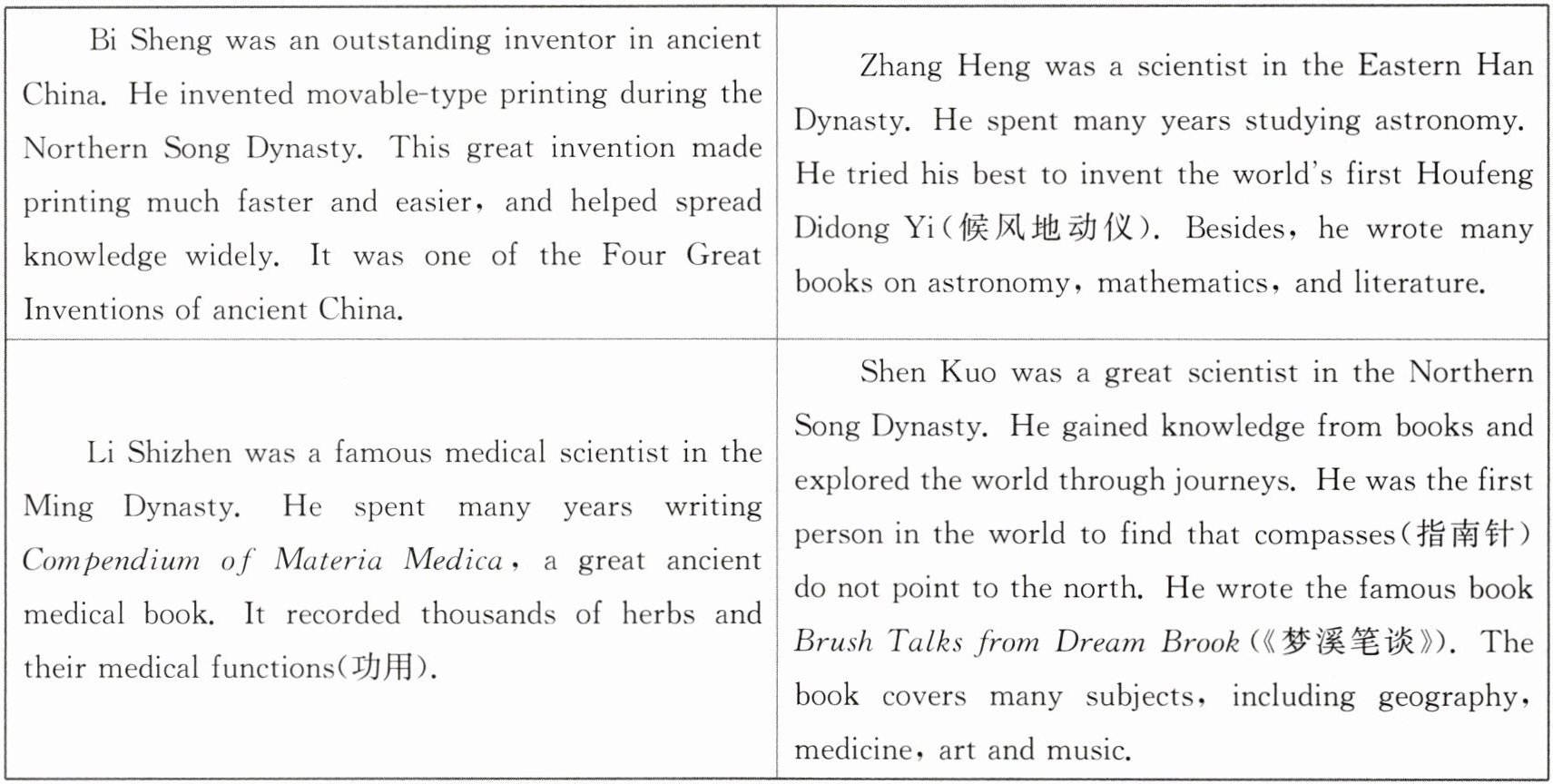
(
A. Zhang Heng. B. Bi Sheng. C. Li Shizhen. D. Shen Kuo.
(
A. He was a scientist in the Ming Dynasty.
B. He tried to invent the first seismograph(地震仪) in the world.
C. The Houfeng Didong Yi was one of the Four Great Inventions.
D. He wrote a famous book about geography, medicine, art and music.
(
A. A science and history magazine. B. A sports newspaper.
C. A fashion website. D. A children's storybook.
China has a long history of science. Many ancient scientists made great achievements, and they are the pride of our country. Here are four famous ones.
(
B
)46. Who invented the movable-type printing?A. Zhang Heng. B. Bi Sheng. C. Li Shizhen. D. Shen Kuo.
(
B
)47. Which of the following is correct about Zhang Heng?A. He was a scientist in the Ming Dynasty.
B. He tried to invent the first seismograph(地震仪) in the world.
C. The Houfeng Didong Yi was one of the Four Great Inventions.
D. He wrote a famous book about geography, medicine, art and music.
(
A
)48. Where is this passage most probably from?A. A science and history magazine. B. A sports newspaper.
C. A fashion website. D. A children's storybook.
答案
46. B 47. B 48. A
解析
【分析】
解答这类阅读理解题,需先明确每个问题的考查点,再回到原文对应段落定位关键信息,逐一比对选项得出答案。细节题要精准匹配原文内容,推理题需结合文本主题判断来源。
【解析】
46题:考查细节理解,定位毕昇的介绍段落,原文明确提到“Bi Sheng...invented movable-type printing”,即毕昇发明了活字印刷。选项A张衡发明地动仪,C李时珍著《本草纲目》,D沈括著《梦溪笔谈》,均不符合,故选B。
47题:考查细节理解,定位张衡的介绍段落:A选项,张衡是东汉科学家,非明朝,错误;B选项,原文“He tried his best to invent the world's first Houfeng Didong Yi”,对应“世界第一地震仪”,正确;C选项,中国四大发明是活字印刷,非地动仪,错误;D选项,著多学科书籍的是沈括,错误,故选B。
48题:考查推理判断,文本主题是介绍中国古代科学家及其科学成就,属于科学与历史范畴,因此最可能来自科学历史杂志。B体育、C时尚、D儿童故事均与文本主题不符,故选A。
【答案】
46. B 47. B 48. A
【知识点】
阅读理解,细节理解,推理判断
【点评】
本题为英语阅读理解题,围绕中国古代科学家的成就设题,考查学生的信息定位与分析能力,题目难度适中,学生准确提取原文关键信息即可解答。
【难度系数】
0.3
B 跨学科 语文
Most of the Chinese people will think of the famous poem written by Yu Guangzhong when it comes to homesickness. It seems far away from you. However, in a few months, you will enter senior high school and move into a school dormitory(宿舍). When you are away from your family for a long time, you may sense homesickness.
Sadness plays a big part in feeling homesick. People always have some good memories of home. When we compare our daily life with our experiences back home, we will feel upset.
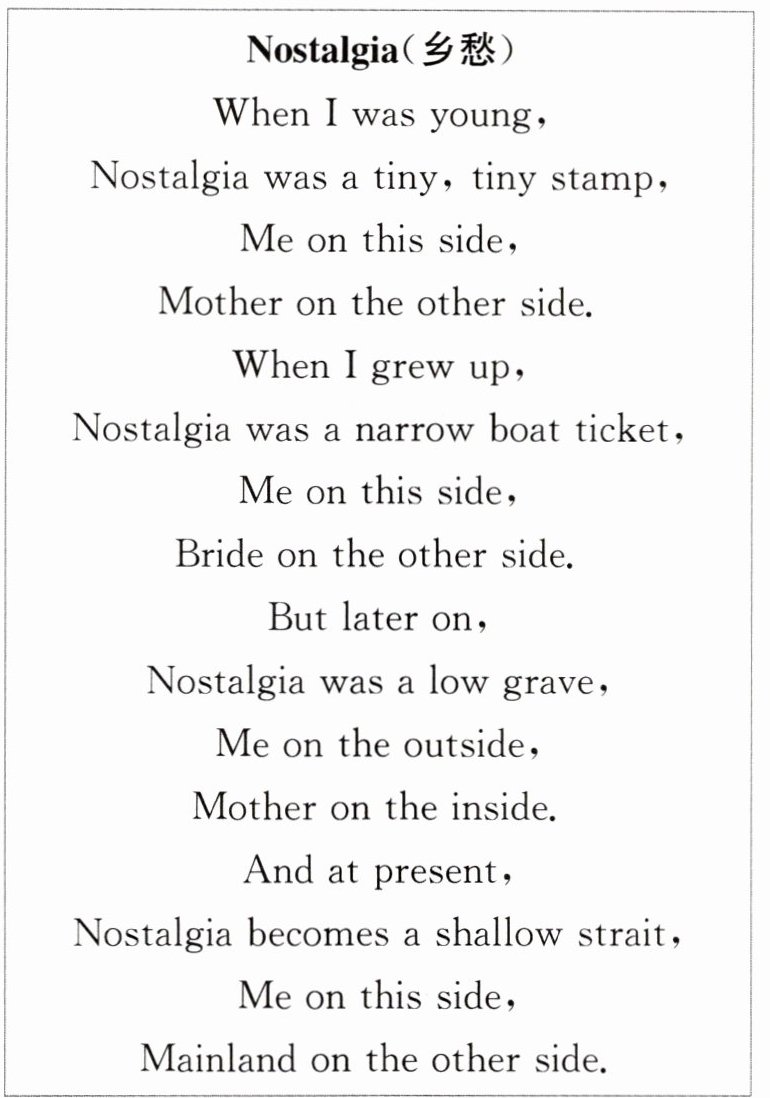
Different people deal with homesickness in different ways. Some ring home and have a chat with the people who they think represent “home”—often their parents. This may be a good idea for you to feel that you are not lonely. It reminds you that home is still there. However, it can make you miss them and want to be home even more. For this very reason, some people find it better not to contact family members but to let the lonely feeling pass by doing fun activities. This can work well to help you get used to the place which you are living or staying in. Besides, we should pay more attention to the people around us. For example, share your feelings with your roommates, which makes you have a better understanding of homesickness.
Reminding yourself where you are can make you see the bigger picture. So remind yourself that home is great, but where you are right now is also great for different reasons!
(
A. places B. time
C. persons D. opinions
(
A. get in touch with B. come up with
C. catch up with D. get on well with
(
① Make a call home. ② Write letters home.
③ Do fun activities. ④ Share feelings with others.
A. ①②③ B. ②③④ C. ①③④ D. ①②④
(
A. He missed his family and homeland a lot.
B. He didn't want to come to his homeland.
C. He lived with his mother on the riverside.
D. His mother had died when he got married.
Most of the Chinese people will think of the famous poem written by Yu Guangzhong when it comes to homesickness. It seems far away from you. However, in a few months, you will enter senior high school and move into a school dormitory(宿舍). When you are away from your family for a long time, you may sense homesickness.
Sadness plays a big part in feeling homesick. People always have some good memories of home. When we compare our daily life with our experiences back home, we will feel upset.
Different people deal with homesickness in different ways. Some ring home and have a chat with the people who they think represent “home”—often their parents. This may be a good idea for you to feel that you are not lonely. It reminds you that home is still there. However, it can make you miss them and want to be home even more. For this very reason, some people find it better not to contact family members but to let the lonely feeling pass by doing fun activities. This can work well to help you get used to the place which you are living or staying in. Besides, we should pay more attention to the people around us. For example, share your feelings with your roommates, which makes you have a better understanding of homesickness.
Reminding yourself where you are can make you see the bigger picture. So remind yourself that home is great, but where you are right now is also great for different reasons!
(
B
)49. (创新考法·行文方式)The poem “Nostalgia” was written in order of B
.A. places B. time
C. persons D. opinions
(
A
)50. The underlined word “contact” means “A
”.A. get in touch with B. come up with
C. catch up with D. get on well with
(
C
)51. (创新考法·组合选择)What may people do when they feel homesick according to the passage?① Make a call home. ② Write letters home.
③ Do fun activities. ④ Share feelings with others.
A. ①②③ B. ②③④ C. ①③④ D. ①②④
(
A
)52. What can we learn from the poem “Nostalgia”?A. He missed his family and homeland a lot.
B. He didn't want to come to his homeland.
C. He lived with his mother on the riverside.
D. His mother had died when he got married.
答案
49. B 50. A 51. C 52. A
解析
【分析】
49题需梳理诗歌的写作线索,诗中依次出现“小时候”“长大后”“后来”“现在”等时间表述,判断顺序类型;50题需结合上下文语境推测划线词含义,前文提到“打电话聊天”,对应“联系家人”的语境;51题需定位文中处理乡愁的具体方式,逐一核对选项;52题需结合诗歌意象理解作者的情感主旨,排除不符合文意的选项。
【解析】
49题:诗歌中依次出现“When I was young”“When I grew up”“But later on”“And at present”等明确的时间节点,说明是按时间顺序写作,故选B。
50题:根据前文“ring home and have a chat(打电话聊天)”及后文“not to contact family members”的语境,contact意为“联系”,对应A选项“get in touch with”,故选A。
51题:文中提到处理乡愁的方式有:①打电话回家;③做有趣的活动;④和室友分享感受,未提及写信,故①③④正确,选C。
52题:诗歌将乡愁寄托于邮票、船票、坟墓、海峡,表达对家人和祖国的深切思念,A选项符合;B选项与文意相反,C、D选项无依据,故选A。
【答案】
49.B 50.A 51.C 52.A
【知识点】
英语阅读理解、词义猜测、文本信息提取
【点评】
本题为跨学科英语阅读理解题,结合语文经典诗歌《乡愁》,考查学生对文本行文顺序、词义、细节信息及主旨的理解,题型基础,注重对文本内容的精准把握。
【难度系数】
0.7
