

 登录
登录
A. 请用三步画出你自己的故事主角。
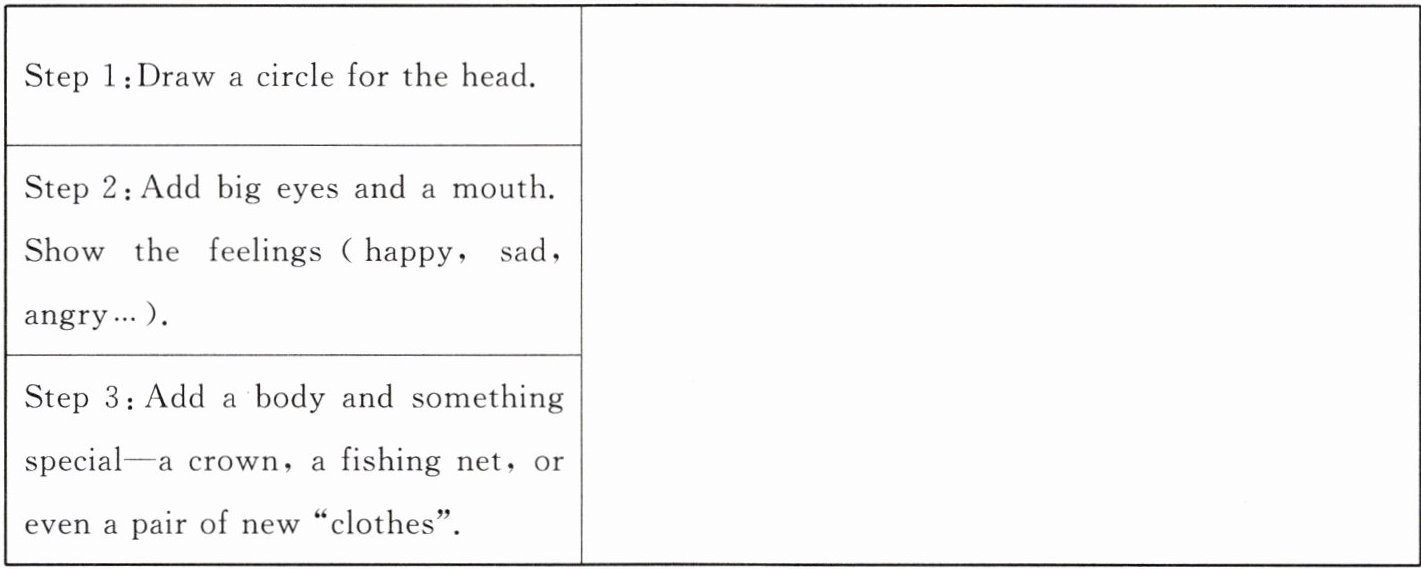
Step 1:Draw a circle for the head.
Step 2:Add big eyes and a mouth.
Show the feelings (happy, sad, angry…).
Step 3:Add a body and something special—a crown, a fishing net, or even a pair of new “clothes”.
Step 1:Draw a circle for the head.
Step 2:Add big eyes and a mouth.
Show the feelings (happy, sad, angry…).
Step 3:Add a body and something special—a crown, a fishing net, or even a pair of new “clothes”.
答案
可参考上述步骤在空白区域绘制出头戴皇冠、手持魔法棒、面带开心笑容的小魔法师卡通形象,也可以根据自己的喜好选择不同的情绪和特殊装饰,创作出独一无二的故事主角。
解析
本题为创意实践类题目,按照题干给出的三步要求逐步操作即可完成绘制:① 第一步在右侧空白栏画一个大小合适的圆形,作为故事主角的头部;② 第二步在圆形内部画出大大的圆眼睛,再画向上扬起的弯弧线作为嘴巴,体现出happy(开心)的情绪;③ 第三步在头部下方画出可爱的卡通身体,再给主角添加上金色小皇冠和星星魔法棒作为特殊装饰,就完成了专属原创故事主角的创作。
B. 关于故事的一些有趣的事情。
Here are some fun facts about stories from around the world—simple and easy to understand.
• Stories are very old.
People told stories long before there were books. In many places, stories were passed down by grandparents and storytellers.
• Some stories teach us lessons.
Like The Lion and the Mouse tells us: Even the small can help the big.
• Many cultures have the same kind of stories.
For example, “Cinderella” has many different versions in China, Europe, and
Africa.
• Stories often start with “Once upon a time…”
This helps readers know:A story begins!
• Every story has a problem and a solution.
The characters try to solve the problem, and in the end, something changes.
任务一:请朗读短文,并了解有关"故事"的有趣事实。
任务二:请口头介绍一下你最喜欢的故事,说说它有什么特点。
Here are some fun facts about stories from around the world—simple and easy to understand.
• Stories are very old.
People told stories long before there were books. In many places, stories were passed down by grandparents and storytellers.
• Some stories teach us lessons.
Like The Lion and the Mouse tells us: Even the small can help the big.
• Many cultures have the same kind of stories.
For example, “Cinderella” has many different versions in China, Europe, and
Africa.
• Stories often start with “Once upon a time…”
This helps readers know:A story begins!
• Every story has a problem and a solution.
The characters try to solve the problem, and in the end, something changes.
任务一:请朗读短文,并了解有关"故事"的有趣事实。
任务二:请口头介绍一下你最喜欢的故事,说说它有什么特点。
答案
任务二口语参考示例:My favourite story is *The Lion and the Mouse*. It's a short but interesting story. First, it teaches me a good lesson: even a small person can help the big one. Second, it has a clear problem that the lion is caught in the net, and the mouse helps him get out at last. It's easy to understand and I love it.
解析
任务一:先逐句通顺朗读短文,即可梳理出文中介绍的5个和故事相关的趣味事实:1. 故事的历史十分悠久,在书籍诞生之前人们就已经开始讲故事,很多地方的故事最初是由祖辈和故事讲述者口口相传留存下来的;2. 部分故事能给我们带来启发、传递道理,比如《狮子和老鼠》就告诉我们哪怕是弱小的个体,也可以给强大的人提供帮助;3. 很多不同的文化中都有同类型的故事,比如《灰姑娘》在中国、欧洲、非洲都有不一样的改编版本;4. 故事通常会以“Once upon a time(很久很久以前)”开头,用来提示读者故事正式开始了;5. 每个故事都包含矛盾问题和对应的解决过程,故事里的角色会努力尝试解决问题,最终情节会发生相应的转变。
任务二:可以结合自己熟悉的故事,参考文中提到的几个故事特点来组织口语表达,内容简单通顺、符合逻辑即可。
任务二:可以结合自己熟悉的故事,参考文中提到的几个故事特点来组织口语表达,内容简单通顺、符合逻辑即可。
