

 登录
Ⅱ. 数据存储 数据存储将我们的生活逐渐数字化.Daniel 思考它是否能完全取代我们的存储方式。
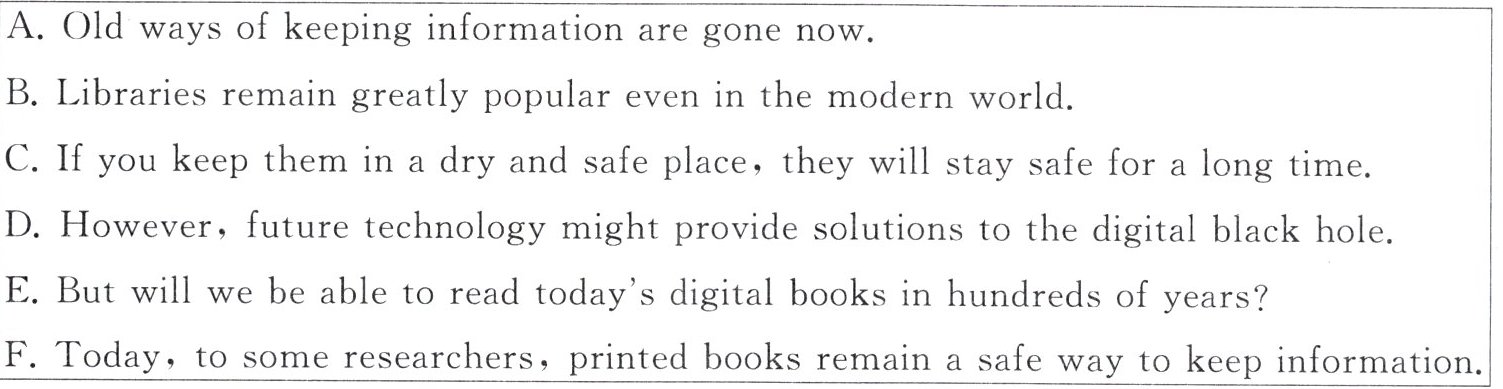
(2026·成都二模改编)Libraries around the world still keep old books hundreds of years old. 1. Librarians are worried. Even now, we can’t open some files(文件) from 20 or 25 years ago. Will our digital works be lost in a digital black hole? Will we face the loss of valuable information?
Technology is changing fast. 2. They are no longer supported by new technology. For example, many people used floppy discs(软盘) to save files years ago, but today few machines can open them. Also, millions of songs and music pieces were saved on tapes or CDs, but now most old music players no longer work. Another problem is that websites often change or close down, and all the information on them can fall into the digital black hole.
Books, however, are quite easy to keep. We don’t need special tools or technology to read them. 3. Li Shizhen’s great medical book Ben Cao Gang Mu came out in 1593. Amazingly, three copies from the first printing still survive today. That’s not bad for a book more than 400 years old.
4. In 2014, a group began to raise money to print a famous online encyclopedia into 1,000 books. This would make sure that even if digital technology fails, the knowledge can still be kept.
For now, when it comes to storing information, printed copies seem to be the safest choice.
5. Time will tell.
Questions: What problems can digital books solve? And what risks might they bring? Give your opinions in more than 30 words.
(2026·成都二模改编)Libraries around the world still keep old books hundreds of years old. 1. Librarians are worried. Even now, we can’t open some files(文件) from 20 or 25 years ago. Will our digital works be lost in a digital black hole? Will we face the loss of valuable information?
Technology is changing fast. 2. They are no longer supported by new technology. For example, many people used floppy discs(软盘) to save files years ago, but today few machines can open them. Also, millions of songs and music pieces were saved on tapes or CDs, but now most old music players no longer work. Another problem is that websites often change or close down, and all the information on them can fall into the digital black hole.
Books, however, are quite easy to keep. We don’t need special tools or technology to read them. 3. Li Shizhen’s great medical book Ben Cao Gang Mu came out in 1593. Amazingly, three copies from the first printing still survive today. That’s not bad for a book more than 400 years old.
4. In 2014, a group began to raise money to print a famous online encyclopedia into 1,000 books. This would make sure that even if digital technology fails, the knowledge can still be kept.
For now, when it comes to storing information, printed copies seem to be the safest choice.
5. Time will tell.
Questions: What problems can digital books solve? And what risks might they bring? Give your opinions in more than 30 words.
答案
1. E 2. A 3. C 4. F 5. D
【语篇解读】本文是一篇说明文,说明数字信息会因技术更新而面临丢失风险,并通过纸质书的长期保存优势探讨信息存储方式。
Question: I think digital books solve the problems of heavy paper books and limited storage space. They are easy to carry, search and share. However, files may become unreadable when formats or devices change, and valuable information may disappear if websites close.
Ⅲ. 机器人 机器人的应用日渐普及,在生活各个方面都能见到它们。一款新颖的采茶机器人引起了 Daniel 的注意。
Spring is the season to harvest West Lake Longjing tea, which is now picked by not only human workers but also “metal workers”—tea-picking robots!
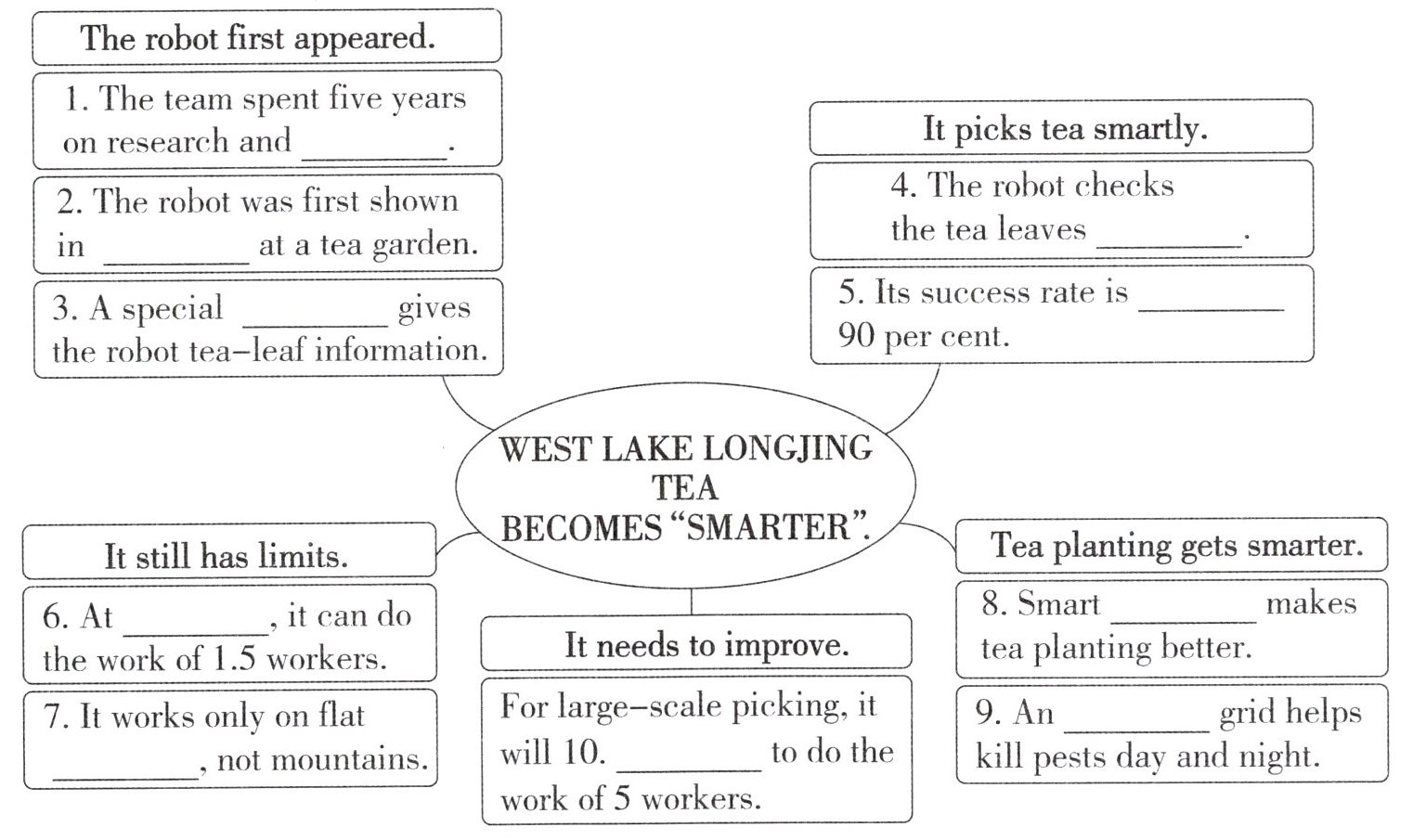
At the end of March, Hangzhou welcomed its best period of large-scale(大规模的) harvesting of West Lake Longjing tea. In one tea garden, a smart tea-picking robot invented by Zhejiang Sci-Tech University first appeared in public after five years of research and development.
With a pull and a suck(吸), the robotic arm separates the leaves from the trees and then puts them into a storage box quickly. “The robot learned its skills through a specially designed model that offers it a large amount of information about tea leaves,” said Chen Jianneng, one of the researchers. “This allows the robot to recognize tea leaves by itself with a success rate(成功率) of over 90 per cent,” Chen added.
Yet, the robot's picking system needs improving before it can be more widely used. According to Professor Wu Chuanyu, leader of the research team, the robot can only take on the work of 1.5 workers at present. It will need to do the work of 5 workers if it is used for a large-scale harvesting. In addition, the robot can now only be used on flat ground, not on rough(崎岖不平的) surfaces such as mountains. It may take five more years to realize these goals, Wu told China News.
Tea planting and processing are also becoming “smarter”. For example, there are special lamps that can attract pests(害虫) but will not hurt other “friendly” insects. This machine works for 24 hours, using colour boards and lights to draw pests in day and night and then kill them with an electric grid(电网).
In terms of tea roasting(炒制), although machine-roasted tea is used widely, many tea lovers argue that this method will make the tea not have the same taste as the tea made by hand-roasting. Researchers at Zhejiang University are trying to find out the tiny differences between the two methods to improve machine performance. They're researching AI technologies to help them gain necessary information and make adjustments(调整) to roasting methods and temperatures in time.
新考法 思维导图 Daniel 制作了一张思维导图来介绍采茶机器人,我们来帮他补充完整吧!(每空限一词)
Spring is the season to harvest West Lake Longjing tea, which is now picked by not only human workers but also “metal workers”—tea-picking robots!
At the end of March, Hangzhou welcomed its best period of large-scale(大规模的) harvesting of West Lake Longjing tea. In one tea garden, a smart tea-picking robot invented by Zhejiang Sci-Tech University first appeared in public after five years of research and development.
With a pull and a suck(吸), the robotic arm separates the leaves from the trees and then puts them into a storage box quickly. “The robot learned its skills through a specially designed model that offers it a large amount of information about tea leaves,” said Chen Jianneng, one of the researchers. “This allows the robot to recognize tea leaves by itself with a success rate(成功率) of over 90 per cent,” Chen added.
Yet, the robot's picking system needs improving before it can be more widely used. According to Professor Wu Chuanyu, leader of the research team, the robot can only take on the work of 1.5 workers at present. It will need to do the work of 5 workers if it is used for a large-scale harvesting. In addition, the robot can now only be used on flat ground, not on rough(崎岖不平的) surfaces such as mountains. It may take five more years to realize these goals, Wu told China News.
Tea planting and processing are also becoming “smarter”. For example, there are special lamps that can attract pests(害虫) but will not hurt other “friendly” insects. This machine works for 24 hours, using colour boards and lights to draw pests in day and night and then kill them with an electric grid(电网).
In terms of tea roasting(炒制), although machine-roasted tea is used widely, many tea lovers argue that this method will make the tea not have the same taste as the tea made by hand-roasting. Researchers at Zhejiang University are trying to find out the tiny differences between the two methods to improve machine performance. They're researching AI technologies to help them gain necessary information and make adjustments(调整) to roasting methods and temperatures in time.
新考法 思维导图 Daniel 制作了一张思维导图来介绍采茶机器人,我们来帮他补充完整吧!(每空限一词)
答案
1. development 解析:原文提到机器人经历了“五年的研究与开发”。research and development 意为“研究与开发”,and 前后的词应保持名词性质,development 是 develop 的名词形式。故填 development。
2. public 解析:原文说机器人在一个茶园中首次公开亮相。in public 是固定搭配,意为“公开地;当众”,与 shown 搭配符合句意。故填 public。
3. model 解析:原文指出机器人通过 specially designed model 学习采茶技能。空前有 A special,需填单数可数名词;空后 gives 也说明主语是单数。故填 model。
4. closely 解析:空处修饰动词 checks,需要副词。closely 意为“仔细地;密切地”,表示机器人仔细识别、检查茶叶。故填 closely。
5. over 解析:原文给出成功率“超过 90%”。“over+数字/百分比”意为“超过”,符合 over 90 per cent 的表达。故填 over。
6. present 解析:at present 是固定短语,意为“目前;现在”。原文说明机器人目前只能完成约 1.5 名工人的工作量。故填 present。
7. ground 解析:原文说明机器人目前只能在平坦地面上工作。flat ground 意为“平坦的地面”,与后面的 not mountains 构成对比。故填 ground。
8. technology 解析:空处位于形容词 smart 后,需填名词;smart technology 意为“智能技术”。文中提到智能灯、电网等设备使茶叶种植更智能。故填 technology。
9. electric 解析:空处修饰名词 grid,需用形容词。electric grid 意为“电网”;electricity 是名词,不能直接修饰 grid。故填 electric。
10. need 解析:根据原文“will need to ... if ...”可知,这里表达的是用于大规模采摘所需达到的要求,故填 need。
