

 登录
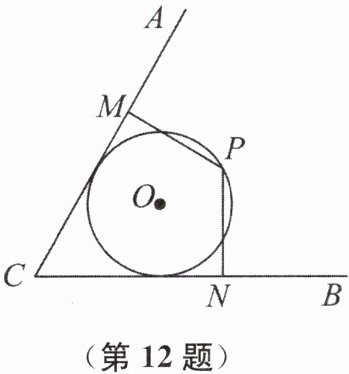
12. (2025·扬州二模)如图, ∠ACB = 60°, ⊙O 的半径为 3 且与∠ACB 两边都相切, 点 P 为圆上一动点, 分别作 PM ⊥ CA,PN ⊥ CB, 令 s = PM + 2PN, 则 s 的最大值与最小值的差为
$6\sqrt{3}$
.答案
12. $6\sqrt{3}$
解析
解:设⊙O与CA相切于点E,与CB相切于点F,连接OE,OF,OC。
∵⊙O与∠ACB两边都相切,∠ACB=60°,
∴OE⊥CA,OF⊥CB,OE=OF=3,∠OCE=∠OCF=30°。
在Rt△OCE中,OC=OE/sin30°=3/(1/2)=6。
以点C为原点,CB所在直线为x轴建立平面直角坐标系,
则点O坐标为(OC·cos30°, OC·sin30°)=(6×√3/2, 6×1/2)=(3√3, 3)。
设点P坐标为(3√3 + 3cosθ, 3 + 3sinθ),θ为参数。
∵PM⊥CA,CA所在直线方程为y=√3x(tan60°=√3),
∴PM=|√3(3√3 + 3cosθ) - (3 + 3sinθ)|/√( (√3)² + (-1)² )=|9 + 3√3cosθ - 3 - 3sinθ|/2=|6 + 3√3cosθ - 3sinθ|/2。
∵PN⊥CB,CB为x轴,
∴PN=3 + 3sinθ。
s=PM + 2PN=|6 + 3√3cosθ - 3sinθ|/2 + 2(3 + 3sinθ)。
∵点P在∠ACB内部,6 + 3√3cosθ - 3sinθ>0,
∴s=(6 + 3√3cosθ - 3sinθ)/2 + 6 + 6sinθ=3 + (3√3cosθ - 3sinθ)/2 + 6 + 6sinθ=9 + (3√3cosθ + 9sinθ)/2=9 + 3(√3cosθ + 3sinθ)/2。
√3cosθ + 3sinθ=2√3sin(θ + 30°),其最大值为2√3,最小值为-2√3。
s最大值=9 + 3×2√3/2=9 + 3√3,
s最小值=9 + 3×(-2√3)/2=9 - 3√3。
s最大值与最小值的差=(9 + 3√3)-(9 - 3√3)=6√3。
6√3
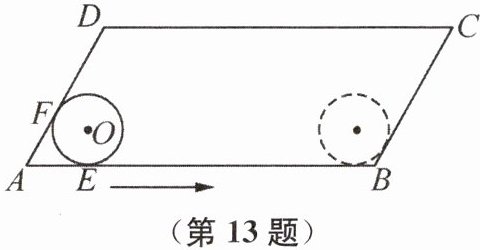
13. 如图, 在▱ABCD 中, ∠DAB = 60°,AB = 15 cm. 已知⊙O 的半径等于 3 cm,AB,AD 分别与⊙O 相切于点 E,F. ⊙O 在▱ABCD 内沿 AB 方向滚动, 与 BC 边相切时运动停止. 试求⊙O 滚过的路程.
答案
13. 解:连接 OE, OA. $\because$ AB, AD 分别与⊙O 相切于点 E, F,
$\therefore OE \perp AB$,$OE = 3 cm$,$\therefore \angle OAE = 30^{\circ}$。
在 Rt$\triangle AOE$ 中,$AE = 3\sqrt{3} cm$. $\because AD//BC$,
$\angle DAB = 60^{\circ}$,$\therefore \angle ABC = 120^{\circ}$。
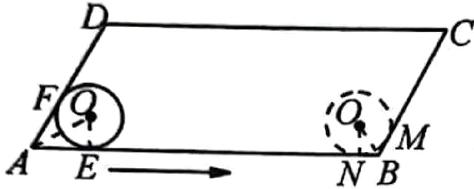
设当运动停止时,⊙O 与 BC, AB 分别相切于点 M, N,
连接 ON, OB. 同理可得 $BN = \sqrt{3} cm$,
$\therefore EN = AB - AE - BN = 15 - 3\sqrt{3} - \sqrt{3} =$
$(15 - 4\sqrt{3}) cm$,
$\therefore$ ⊙O 滚过的路程为$(15 - 4\sqrt{3}) cm$。
14. 已知△ABC 的内切圆⊙O 与 AB,BC,AC 分别相切于点 D,E,F, 若⌢{EF} = ⌢{DE}, 如图 1.
(1) 判断△ABC 的形状, 并证明你的结论;
(2) 设 AE 与 DF 相交于点 M, 如图 2,AF = 2FC = 4, 求 AM 的长.
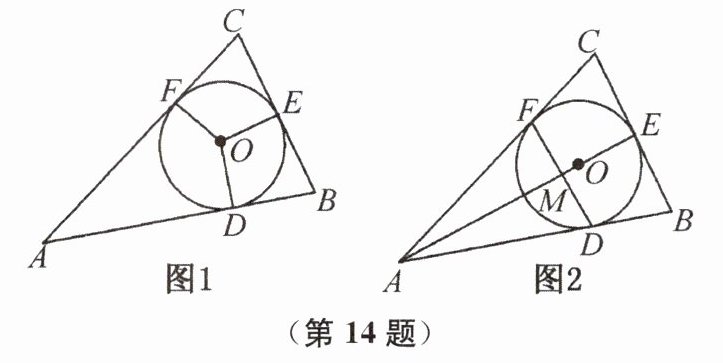
(1) 判断△ABC 的形状, 并证明你的结论;
(2) 设 AE 与 DF 相交于点 M, 如图 2,AF = 2FC = 4, 求 AM 的长.
答案
14.
(1) 解:$\triangle ABC$ 为等腰三角形.
证明:$\because \triangle ABC$ 的内切圆⊙O 与 AB, BC, AC 分别切于点 D, E, F,
$\therefore \angle CFE = \angle CEF = \angle BDO = \angle BEO = 90^{\circ}$。
$\because$ 四边形内角和为 $360^{\circ}$,$\therefore \angle EOF + \angle C = 180^{\circ}$,$\angle DOE + \angle B = 180^{\circ}$。
$\because EF = DE$,$\therefore \angle EOF = \angle DOE$,
$\therefore \angle B = \angle C$,$AB = AC$,$\therefore \triangle ABC$ 为等腰三角形。
(2) $AM = \frac{8\sqrt{2}}{3}$
