

 登录
登录
一、根据句意及汉语提示填写单词
1. The
2. Thank you, Mum. Everything
3. Would you like
4. Today's special
5. Do you want to eat
1. The
waiters
(服务员) in the restaurant respect every customer.2. Thank you, Mum. Everything
tastes
(品尝) delicious.3. Would you like
to order
(点菜) some vegetable salad?4. Today's special
dish
(一道菜) is mutton dumplings.5. Do you want to eat
anything
(任何东西) with beef?答案
一、1. waiters 2. tastes 3. to order 4. dish 5. anything
解析
【分析】
本题需结合句意、汉语提示及英语语法规则(名词单复数、动词形式、固定搭配、不定代词用法)填空:
1. 汉语提示“服务员”,谓语动词为原形,主语需用复数;
2. 汉语提示“品尝”,主语是不定代词,谓语用第三人称单数;
3. 固定搭配would like to do sth,需用不定式;
4. 汉语提示“一道菜”,用单数名词;
5. 疑问句中,“任何东西”用anything。
【解析】
1. “服务员”对应waiter,主语为复数,故填waiters;
2. “品尝”对应taste,主语everything为不定代词,谓语用第三人称单数tastes;
3. 固定搭配would like to do sth,“点菜”对应order,故填to order;
4. “一道菜”对应dish,单数形式,故填dish;
5. 疑问句中,“任何东西”用anything,故填anything。
【答案】
1. waiters 2. tastes 3. to order 4. dish 5. anything
【知识点】
英语词汇运用、固定搭配、不定代词用法
【点评】
本题考查基础词汇及语法的综合运用,结合句意和提示即可解答,侧重基础知识点的掌握。
【难度系数】
0.8
本题需结合句意、汉语提示及英语语法规则(名词单复数、动词形式、固定搭配、不定代词用法)填空:
1. 汉语提示“服务员”,谓语动词为原形,主语需用复数;
2. 汉语提示“品尝”,主语是不定代词,谓语用第三人称单数;
3. 固定搭配would like to do sth,需用不定式;
4. 汉语提示“一道菜”,用单数名词;
5. 疑问句中,“任何东西”用anything。
【解析】
1. “服务员”对应waiter,主语为复数,故填waiters;
2. “品尝”对应taste,主语everything为不定代词,谓语用第三人称单数tastes;
3. 固定搭配would like to do sth,“点菜”对应order,故填to order;
4. “一道菜”对应dish,单数形式,故填dish;
5. 疑问句中,“任何东西”用anything,故填anything。
【答案】
1. waiters 2. tastes 3. to order 4. dish 5. anything
【知识点】
英语词汇运用、固定搭配、不定代词用法
【点评】
本题考查基础词汇及语法的综合运用,结合句意和提示即可解答,侧重基础知识点的掌握。
【难度系数】
0.8
二、在空白处填入适当的单词或用括号中所给词的适当形式填空
1. —What about
—Good idea.
2. There
3. Do you like noodles
4. I don't like mutton
5. I don't like mutton either.
6. Tom likes to eat vegetable soup
7. —May I take your order?
—Yes. One Gongbao chicken, one Mapo tofu
8. They would like to eat
9. There are many
10. Let's
1. —What about
getting
(get) some soup?—Good idea.
2. There
is
(be) some beef, tomatoes and tofu in the basket.3. Do you like noodles
with
beef and tomatoes?4. I don't like mutton
or
beef.5. I don't like mutton either.
But
I like beef a lot.6. Tom likes to eat vegetable soup
because
it's good for health.7. —May I take your order?
—Yes. One Gongbao chicken, one Mapo tofu
and
one large bowl of vegetable soup.8. They would like to eat
chicken
(chicken) with rice for lunch.9. There are many
chickens
(chicken) on the farm.10. Let's
try
(try) Gongbao chicken here. It is very delicious.答案
二、1. getting 2. is 3. with 4. or 5. But 6. because 7. and 8. chicken 9. chickens 10. try
解析
【分析】本题为英语适当形式填空及词汇运用题,需结合固定搭配、语法规则、词汇用法逐一分析:1. 考查固定搭配中动词形式;2. 考查there be句型的就近原则;3. 考查介词表“带有”的用法;4. 考查否定句中并列连词的选择;5. 考查转折连词的运用;6. 考查原因连词的使用;7. 考查并列连词的用法;8. 考查名词的不可数含义;9. 考查名词的可数含义及复数变化;10. 考查固定搭配中动词形式。
【解析】1. “what about doing sth”是固定搭配,意为“做某事怎么样”,介词后接动名词,故将get变为getting;2. there be句型遵循就近原则,be动词由离它最近的名词决定,此处最近的是不可数名词beef,故用is;3. 此处表示“带有牛肉和番茄的面条”,用介词with表“带有”;4. 否定句中连接并列否定成分,用or代替and;5. 前句“不喜欢羊肉”与后句“喜欢牛肉”是转折关系,用But;6. 后句“对健康有益”是前句“喜欢蔬菜汤”的原因,用because引导原因状语;7. 此处是并列菜品,用and连接;8. 此处chicken意为“鸡肉”,是不可数名词,用原形;9. 此处chicken意为“小鸡”,是可数名词,many后接复数,故用chickens;10. “let sb do sth”是固定搭配,意为“让某人做某事”,接动词原形,故用try。
【答案】二、1. getting 2. is 3. with 4. or 5. But 6. because 7. and 8. chicken 9. chickens 10. try
【知识点】固定搭配、主谓一致、名词单复数
【点评】本题考查初中英语基础语法与词汇运用,涵盖日常交际固定结构、there be规则、介词连词用法及名词一词多义,均为核心基础知识点,适合巩固基础。
【难度系数】0.8
【解析】1. “what about doing sth”是固定搭配,意为“做某事怎么样”,介词后接动名词,故将get变为getting;2. there be句型遵循就近原则,be动词由离它最近的名词决定,此处最近的是不可数名词beef,故用is;3. 此处表示“带有牛肉和番茄的面条”,用介词with表“带有”;4. 否定句中连接并列否定成分,用or代替and;5. 前句“不喜欢羊肉”与后句“喜欢牛肉”是转折关系,用But;6. 后句“对健康有益”是前句“喜欢蔬菜汤”的原因,用because引导原因状语;7. 此处是并列菜品,用and连接;8. 此处chicken意为“鸡肉”,是不可数名词,用原形;9. 此处chicken意为“小鸡”,是可数名词,many后接复数,故用chickens;10. “let sb do sth”是固定搭配,意为“让某人做某事”,接动词原形,故用try。
【答案】二、1. getting 2. is 3. with 4. or 5. But 6. because 7. and 8. chicken 9. chickens 10. try
【知识点】固定搭配、主谓一致、名词单复数
【点评】本题考查初中英语基础语法与词汇运用,涵盖日常交际固定结构、there be规则、介词连词用法及名词一词多义,均为核心基础知识点,适合巩固基础。
【难度系数】0.8
三、句子翻译
1. 我们经常在美国吃宫保鸡丁。
2. 你想要一份热的豆腐吗?
3. 我们也应该点一份蔬菜沙拉。
4. 他想要喝鱼汤。
5. —你想要饺子还是面条?—饺子。
1. 我们经常在美国吃宫保鸡丁。
We often have Gongbao chicken in America.
2. 你想要一份热的豆腐吗?
Would you like a hot tofu dish?
3. 我们也应该点一份蔬菜沙拉。
We should also order a vegetable salad.
4. 他想要喝鱼汤。
He wants/would like to have fish soup.
5. —你想要饺子还是面条?—饺子。
—Would you like dumplings or noodles? —Dumplings.
答案
三、1. We often have Gongbao chicken in America. 2. Would you like a hot tofu dish? 3. We should also order a vegetable salad. 4. He wants/would like to have fish soup. 5. —Would you like dumplings or noodles? —Dumplings.
解析
【分析】
翻译此类日常句子时,需先确定核心词汇、时态及句型:1. 句中“经常”对应频度副词often,“吃”用have,地点“在美国”是in America,“宫保鸡丁”为固定译法Gongbao chicken;2. “想要”用礼貌常用表达Would you like,“热的豆腐”译为a hot tofu dish;3. “应该”用情态动词should,“点(餐)”是order,“蔬菜沙拉”为vegetable salad;4. “想要喝”用want/would like to have,“鱼汤”是fish soup;5. 选择疑问句用or连接选项,回答直接对应所选内容。
【解析】
1. We often have Gongbao chicken in America.
2. Would you like a hot tofu dish?
3. We should also order a vegetable salad.
4. He wants/would like to have fish soup.
5. —Would you like dumplings or noodles? —Dumplings.
【答案】
三、1. We often have Gongbao chicken in America. 2. Would you like a hot tofu dish? 3. We should also order a vegetable salad. 4. He wants/would like to have fish soup. 5. —Would you like dumplings or noodles? —Dumplings.
【知识点】
英语句子翻译;would like的用法;选择疑问句
【点评】
本题为基础日常句子翻译题,考查常用词汇、句型及礼貌表达的运用,贴近生活,难度较低,适合基础阶段学生练习。
【难度系数】
0.8
翻译此类日常句子时,需先确定核心词汇、时态及句型:1. 句中“经常”对应频度副词often,“吃”用have,地点“在美国”是in America,“宫保鸡丁”为固定译法Gongbao chicken;2. “想要”用礼貌常用表达Would you like,“热的豆腐”译为a hot tofu dish;3. “应该”用情态动词should,“点(餐)”是order,“蔬菜沙拉”为vegetable salad;4. “想要喝”用want/would like to have,“鱼汤”是fish soup;5. 选择疑问句用or连接选项,回答直接对应所选内容。
【解析】
1. We often have Gongbao chicken in America.
2. Would you like a hot tofu dish?
3. We should also order a vegetable salad.
4. He wants/would like to have fish soup.
5. —Would you like dumplings or noodles? —Dumplings.
【答案】
三、1. We often have Gongbao chicken in America. 2. Would you like a hot tofu dish? 3. We should also order a vegetable salad. 4. He wants/would like to have fish soup. 5. —Would you like dumplings or noodles? —Dumplings.
【知识点】
英语句子翻译;would like的用法;选择疑问句
【点评】
本题为基础日常句子翻译题,考查常用词汇、句型及礼貌表达的运用,贴近生活,难度较低,适合基础阶段学生练习。
【难度系数】
0.8
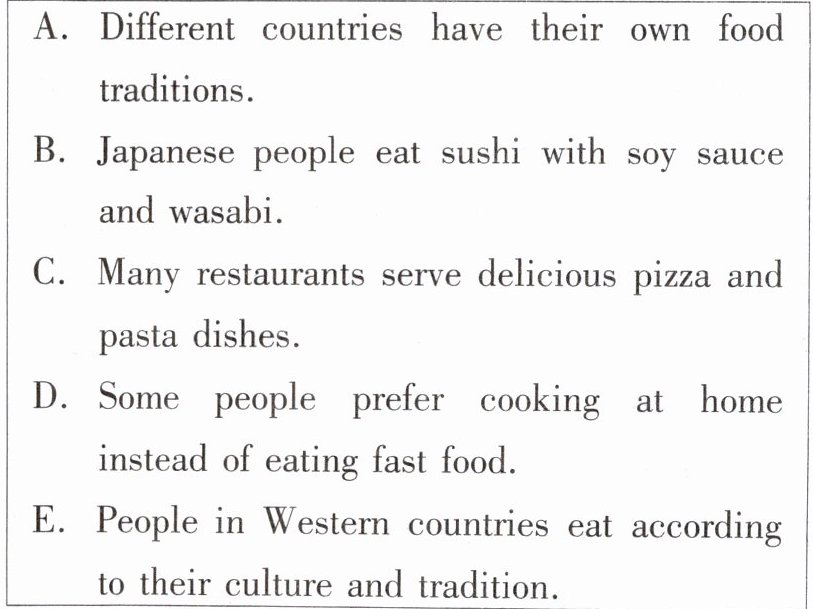
一、阅读短文,从方框内所给选项中选出可以填入空白处的最佳选项,其中有一个多余的选项
People around the world enjoy eating different kinds of food. However, food habits are different in various places. 1.
In China, people often eat rice and noodles with vegetables, meat, or fish. They use chopsticks when eating.
2.
In the United States, people like to eat hamburgers and pizza. Many people also enjoy fast food because it is easy to get and eat. 3.
In Italy, pasta is very popular. Italians often eat pasta with tomato sauce or cheese. 4.
People around the world enjoy eating different kinds of food. However, food habits are different in various places. 1.
A
In China, people often eat rice and noodles with vegetables, meat, or fish. They use chopsticks when eating.
2.
B
In Japan, people also eat rice and fish, but they have a special way of preparing food called sushi. It is made from raw fish and rice.In the United States, people like to eat hamburgers and pizza. Many people also enjoy fast food because it is easy to get and eat. 3.
D
In Italy, pasta is very popular. Italians often eat pasta with tomato sauce or cheese. 4.
C
Italian food is famous all over the world.答案
一、1—4 ABDC
解析
【分析】
本题为选句填空题,需结合上下文语境,分析句子间的逻辑关系,选出符合话题衔接的选项。首先,第1空前文总述世界各地饮食习惯不同,后文开始介绍各国饮食,需总起不同国家饮食传统的句子;第2空后文介绍日本寿司,需对应日本饮食相关内容;第3空前文讲美国快餐,需对应快餐或饮食选择的句子;第4空前文介绍意大利意面,需对应意大利饮食相关内容,同时注意有一个多余选项。
【解析】
1. 第1空:前文总述世界各地饮食习惯不同,后文开始介绍中国饮食,选项A“Different countries have their own food traditions.”(不同国家有自己的饮食传统)起到总起作用,符合语境,故选A。
2. 第2空:后文介绍日本的寿司,选项B“Japanese people eat sushi with soy sauce and wasabi.”(日本人吃寿司配酱油和芥末)与日本饮食相关,衔接后文内容,故选B。
3. 第3空:前文讲美国人喜欢快餐,选项D“Some people prefer cooking at home instead of eating fast food.”(有些人更喜欢在家做饭而不是吃快餐)与快餐话题相关,符合语境,故选D。
4. 第4空:前文介绍意大利的意面,选项C“Many restaurants serve delicious pizza and pasta dishes.”(很多餐厅提供美味的披萨和意面)与意大利饮食相关,衔接后文“意大利食物闻名世界”,故选C。
【答案】
1—4 ABDC
【知识点】
英语选句填空、文化常识
【点评】
本题围绕不同国家饮食文化展开,考查学生对上下文语境的理解能力,需结合话题一致性和逻辑衔接解题,难度适中。
【难度系数】
0.5
本题为选句填空题,需结合上下文语境,分析句子间的逻辑关系,选出符合话题衔接的选项。首先,第1空前文总述世界各地饮食习惯不同,后文开始介绍各国饮食,需总起不同国家饮食传统的句子;第2空后文介绍日本寿司,需对应日本饮食相关内容;第3空前文讲美国快餐,需对应快餐或饮食选择的句子;第4空前文介绍意大利意面,需对应意大利饮食相关内容,同时注意有一个多余选项。
【解析】
1. 第1空:前文总述世界各地饮食习惯不同,后文开始介绍中国饮食,选项A“Different countries have their own food traditions.”(不同国家有自己的饮食传统)起到总起作用,符合语境,故选A。
2. 第2空:后文介绍日本的寿司,选项B“Japanese people eat sushi with soy sauce and wasabi.”(日本人吃寿司配酱油和芥末)与日本饮食相关,衔接后文内容,故选B。
3. 第3空:前文讲美国人喜欢快餐,选项D“Some people prefer cooking at home instead of eating fast food.”(有些人更喜欢在家做饭而不是吃快餐)与快餐话题相关,符合语境,故选D。
4. 第4空:前文介绍意大利的意面,选项C“Many restaurants serve delicious pizza and pasta dishes.”(很多餐厅提供美味的披萨和意面)与意大利饮食相关,衔接后文“意大利食物闻名世界”,故选C。
【答案】
1—4 ABDC
【知识点】
英语选句填空、文化常识
【点评】
本题围绕不同国家饮食文化展开,考查学生对上下文语境的理解能力,需结合话题一致性和逻辑衔接解题,难度适中。
【难度系数】
0.5
