

 登录
登录
(
A.if
B.that
C.which
D.what
A
) 1.They don't know ______ their parents are at home.A.if
B.that
C.which
D.what
答案
A
解析
此题考查宾语从句连接词。主句为否定句"They don't know",从句"their parents are at home"是完整的陈述句,表达“是否”之意,应用if引导。that用于肯定句中引导陈述句作宾语,which和what在从句中需充当成分,此处从句不缺成分,故选A。
(
A.when does he come
B.how will he come
C.whether he'll come
D.if he comes
C
) 2.Can you tell me ______ the day after tomorrow?A.when does he come
B.how will he come
C.whether he'll come
D.if he comes
答案
C
解析
本题考查宾语从句的用法。在宾语从句中要用陈述句语序,A选项“when does he come”和B选项“how will he come”都是疑问句语序,不符合要求,所以排除A、B。根据时间状语“the day after tomorrow”(后天)可知,从句要用一般将来时,D选项“if he comes”是一般现在时,不符合语境,C选项“whether he'll come”是一般将来时且是陈述句语序,符合题意。
( ) 3.
A.When
B.If
C.Whether
D.What
C
to leave Beijing at 5 or 6 hasn't been decided.A.When
B.If
C.Whether
D.What
答案
C
解析
本题考查主语从句的引导词。分析句子结构可知,该句为主语从句,且从句中不缺成分,故排除D选项“What”,因为“What”在从句中要作成分;A选项“When”表示“什么时候”,虽然语义上似乎可行,但在这种还未决定具体时间的语境中,通常用“Whether”来表达“是否”做某事的不确定性;B选项“If”虽然也表示“是否”,但它不能直接引导主语从句置于句首,而“Whether”可以。因此,正确答案是C选项“Whether”,表示“是否在5点或6点离开北京还没有决定”。
( ) 4.—How many students can you see in the reading room? —
A.No one
B.None
C.Nobody
D.Nothing
B
.A.No one
B.None
C.Nobody
D.Nothing
答案
B
解析
首先分析各个选项的含义及用法。A选项“No one”通常用来回答以“who”开头的问题,意为“没有人”;C选项“Nobody”与“No one”意思相近,也用来回答以“who”开头的问题;D选项“Nothing”意为“没有什么”,用来回答以“what”开头的问题,指物。而本题问句是以“How many...”开头,询问数量,且问的是学生(人)的数量。B选项“None”既可以指人也可以指物,用来回答“How many...”或“How much...”开头的问题,表示“一个也没有,毫无”。因此,根据语境和语法规则,应选B。
(
A.prefer
B.want
C.choose
D.miss
A
) 5.—I like the programme Man and Nature. —But I ______ Sports News.A.prefer
B.want
C.choose
D.miss
答案
A
解析
根据对话内容,“I like the programme Man and Nature.”表明了喜欢“人与自然”这个节目,而“But I ______ Sports News.”中的“But”表示转折,说明回答者与前者有不同的喜好。在选项中,“prefer”表示“更喜欢”,符合语境,即回答者更喜欢“体育新闻”;“want”表示“想要”,不符合语境;“choose”表示“选择”,也不符合语境;“miss”表示“想念”或“错过”,同样不符合语境。因此,正确答案是“prefer”。
(
A.to sending
B.to send
C.for being sent
D.to be sent
B
) 6.Stamps are usually used ______ letters.A.to sending
B.to send
C.for being sent
D.to be sent
答案
B
解析
本题考查“be used to do sth.”和“be used for doing sth.”的用法区别。“be used to do sth.”表示“被用来做某事”,其中to是动词不定式符号,后接动词原形;“be used for doing sth.”表示“被用于做某事”,for是介词,后接动词 -ing形式。本题中“Stamps are usually used ______ letters.”表达邮票通常被用来寄信,这里用“be used to do sth.”结构,所以应该用to send。A选项“to sending”中to是介词用法错误;C选项“for being sent”是被动语态形式,不符合本题语境;D选项“to be sent”是动词不定式的被动形式,也不符合本题表达“邮票被用来寄信”的主动含义。
三、任务型阅读
Everyone loves a good listener. Communication is important for strong relationships. However, if you don't truly listen to others, it can be difficult to communicate. Working on your listening skills can help you communicate better. The advice below may be of some value.
Give the speaker your full attention
It's important to make the speaker feel heard and valued. Turn off the TV. Put away your phone. Never think about other things when someone is talking. Instead, focus(集中) only on what he is saying. Communication will be better if you are able to have a true understanding of the other person's opinions. Make sure to show you're listening. Nod as the speaker talks; smile and laugh properly. Even the way you look at the speaker makes a big difference.
Be patient enough
Do not cut in on the speaker. Always allow a few seconds of silence after someone finishes talking before offering your reply. This allows you to make sure the speaker is done talking.
Avoid hurrying the speaker. Don't rush the person talking. Never say things like, "Can you get to the point?" This will make it seem like you have nothing to do with the conversation.
Hold your fire
When someone just wants to talk, you don't need to tell him or her what to do. Try to understand how the person feels and why he does so.
It's never a good idea to listen with judgement. Even if you disagree with his or her actions or opinions, avoid saying he or she is wrong. Otherwise, your communication may end with an argument. When you "win" the argument, you may lose something far more valuable.
Therefore, it's necessary to work hard to improve your communication skills.
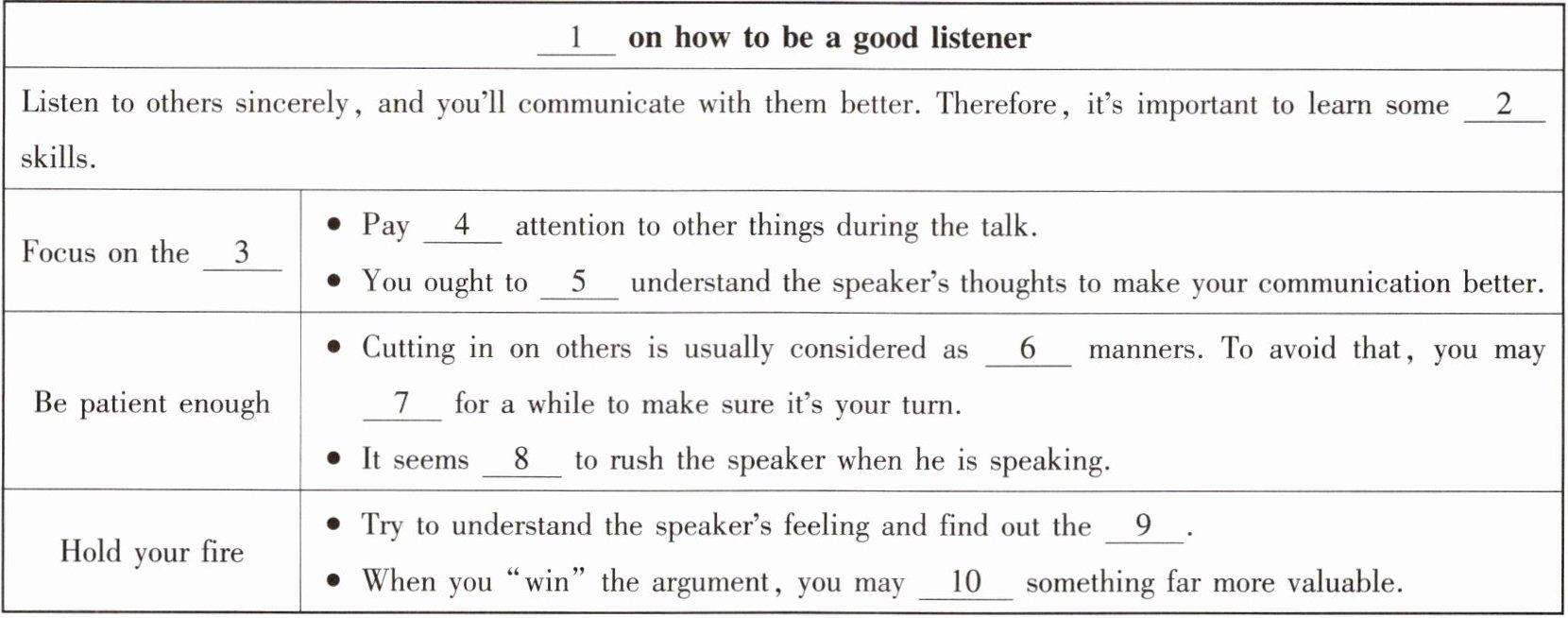
| 1 on how to be a good listener |
| :--- |
| Listen to others sincerely, and you'll communicate with them better. Therefore, it's important to learn some 2 skills. |
| Focus on the 3 | • Pay 4 attention to other things during the talk.• You ought to 5 understand the speaker's thoughts to make your communication better. |
| Be patient enough | • Cutting in on others is usually considered as 6 manners. To avoid that, you may 7 for a while to make sure it's your turn.• It seems 8 to rush the speaker when he is speaking. |
| Hold your fire | • Try to understand the speaker's feeling and find out the 9.• When you "win" the argument, you may 10 something far more valuable. |
1.
2.
3.
4.
5.
6.
7.
8.
9.
10.
Everyone loves a good listener. Communication is important for strong relationships. However, if you don't truly listen to others, it can be difficult to communicate. Working on your listening skills can help you communicate better. The advice below may be of some value.
Give the speaker your full attention
It's important to make the speaker feel heard and valued. Turn off the TV. Put away your phone. Never think about other things when someone is talking. Instead, focus(集中) only on what he is saying. Communication will be better if you are able to have a true understanding of the other person's opinions. Make sure to show you're listening. Nod as the speaker talks; smile and laugh properly. Even the way you look at the speaker makes a big difference.
Be patient enough
Do not cut in on the speaker. Always allow a few seconds of silence after someone finishes talking before offering your reply. This allows you to make sure the speaker is done talking.
Avoid hurrying the speaker. Don't rush the person talking. Never say things like, "Can you get to the point?" This will make it seem like you have nothing to do with the conversation.
Hold your fire
When someone just wants to talk, you don't need to tell him or her what to do. Try to understand how the person feels and why he does so.
It's never a good idea to listen with judgement. Even if you disagree with his or her actions or opinions, avoid saying he or she is wrong. Otherwise, your communication may end with an argument. When you "win" the argument, you may lose something far more valuable.
Therefore, it's necessary to work hard to improve your communication skills.
| 1 on how to be a good listener |
| :--- |
| Listen to others sincerely, and you'll communicate with them better. Therefore, it's important to learn some 2 skills. |
| Focus on the 3 | • Pay 4 attention to other things during the talk.• You ought to 5 understand the speaker's thoughts to make your communication better. |
| Be patient enough | • Cutting in on others is usually considered as 6 manners. To avoid that, you may 7 for a while to make sure it's your turn.• It seems 8 to rush the speaker when he is speaking. |
| Hold your fire | • Try to understand the speaker's feeling and find out the 9.• When you "win" the argument, you may 10 something far more valuable. |
1.
Advice
2.
listening
3.
speaker
4.
no
5.
truly
6.
bad
7.
wait
8.
impolite
9.
reason
10.
lose
答案
1. Advice
2. listening
3. speaker
4. no
5. truly
6. bad
7. wait
8. impolite
9. reason
10. lose
2. listening
3. speaker
4. no
5. truly
6. bad
7. wait
8. impolite
9. reason
10. lose
