

 登录
Ⅰ.补全对话(12分)
A:Ms Lee,I watched a video about "future classrooms"—it looked so cool!
B: 1
A:I saw students with special glasses on. They could "walk" in a forest just in the classroom!
B:That's VR. It will be common in classrooms. It helps students learn about nature or history in a vivid way. 2
A:Wow,that's amazing! 3
B:Yes! Robots will help students,or even be like small teachers.
A: 4
B:Of course. It will create new teaching ways and solve learning problems easily.
A: 5
B:I hope so too! 6
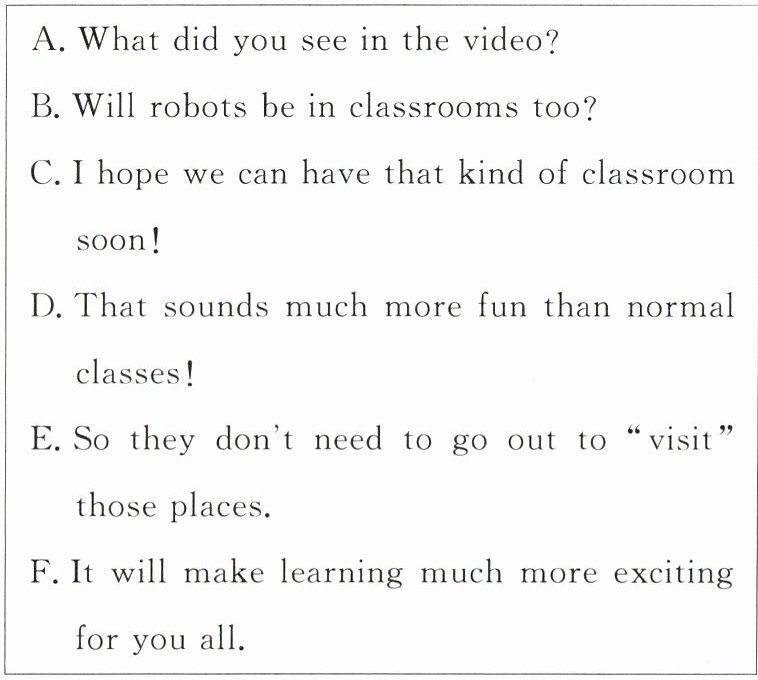
1.
A:Ms Lee,I watched a video about "future classrooms"—it looked so cool!
B: 1
A
A:I saw students with special glasses on. They could "walk" in a forest just in the classroom!
B:That's VR. It will be common in classrooms. It helps students learn about nature or history in a vivid way. 2
E
A:Wow,that's amazing! 3
B
B:Yes! Robots will help students,or even be like small teachers.
A: 4
D
Will technology bring other good things?B:Of course. It will create new teaching ways and solve learning problems easily.
A: 5
C
B:I hope so too! 6
F
1.
A
2. E
3. B
4. D
5. C
6. F
答案
1. A 2. E 3. B 4. D 5. C 6. F
解析
【分析】
补全对话需结合上下文的问答逻辑与语境来匹配句子:首先根据A提到看了未来教室的视频,B的第一句应询问A在视频中的所见;接着B介绍VR的作用后,需承接说明这种方式的优势;然后B提及机器人相关内容,A会询问机器人是否出现在教室;之后A对这种课堂表达感受;再结合B的回应,A会表达对拥有该类教室的希望;最后B补充这种方式对学习的作用。
【解析】
1. 上文A说看了未来教室的视频,下文A回答看到的内容,因此此处选A(What did you see in the video?);
2. 上文提到VR帮助学生生动学习,下文说明不用外出参观,因此此处选E(So they don't need to go out to "visit" those places.);
3. 下文B回答Yes并提及机器人,因此此处是询问机器人是否在教室,选B(Will robots be in classrooms too?);
4. 上文说明机器人的作用,A表达对这种课堂的感受,选D(That sounds much more fun than normal classes!);
5. 下文B说“I hope so too”,因此此处是A希望拥有那样的教室,选C(I hope we can have that kind of classroom soon!);
6. 上文A表达希望,B补充这种方式对学习的作用,选F(It will make learning much more exciting for you all.)。
【答案】1.A 2.E 3.B 4.D 5.C 6.F
【知识点】补全对话、情景交际
【点评】本题考查情景交际中的补全对话,需结合上下文逻辑匹配句子,是常见的英语基础题型,难度适中。
【难度系数】0.5
Ⅱ.阅读理解(10分)
根据短文内容,判断下面各小题的正(T)误(F)。
Life in the future will be different from life today. Between then and now many changes will happen. But what will the changes be?
The population is growing. There will be many people in the world and most of them will live longer than people live now.
Robots will be much smarter and more useful and there will be at least one in every home. And robotics will become a major subject in schools then. People will work fewer hours than they do now and they will have more free time for playing sports, watching TV and travelling. Travelling will be much cheaper and easier. And more people will go to other countries for holidays.
There will be changes in our food too. More land will be used for building new towns and houses for all the people. Then there will be less room for cows and sheep, so meat will be more expensive. Maybe no one will eat it every day. Instead, people will eat more fruit and vegetables. Maybe people will be healthier. Work in the future will be different too. Robots will do dangerous and hard work. Because of this, many people will not have enough work to do. This will be a problem.
(
(
(
(
(
根据短文内容,判断下面各小题的正(T)误(F)。
Life in the future will be different from life today. Between then and now many changes will happen. But what will the changes be?
The population is growing. There will be many people in the world and most of them will live longer than people live now.
Robots will be much smarter and more useful and there will be at least one in every home. And robotics will become a major subject in schools then. People will work fewer hours than they do now and they will have more free time for playing sports, watching TV and travelling. Travelling will be much cheaper and easier. And more people will go to other countries for holidays.
There will be changes in our food too. More land will be used for building new towns and houses for all the people. Then there will be less room for cows and sheep, so meat will be more expensive. Maybe no one will eat it every day. Instead, people will eat more fruit and vegetables. Maybe people will be healthier. Work in the future will be different too. Robots will do dangerous and hard work. Because of this, many people will not have enough work to do. This will be a problem.
(
F
)7. In the future there will be fewer people.(
T
)8. Every family will have at least one robot in the future.(
F
)9. In the future people will have to work for more hours than now.(
T
)10. People may not eat meat as much as they do today.(
T
)11. This passage is about the imagination(想象)of people's future life.答案
7. F 8. T 9. F 10. T 11. T
解析
【分析】
做这类阅读理解判断正误题,需先通读短文把握大意,再针对每个小题,回到短文中定位对应信息,将题目表述与原文内容逐一对比,判断是否一致,从而得出正确答案。
【解析】
7. 原文第二段明确提到“The population is growing. There will be many people in the world”,说明未来人口更多,题目表述“更少人”与原文不符,故为F;
8. 原文第三段提到“there will be at least one in every home”,与题目“每个家庭至少有一个机器人”的表述一致,故为T;
9. 原文第三段提到“People will work fewer hours than they do now”,说明未来工作时间更少,题目表述“工作更多小时”与原文不符,故为F;
10. 原文第四段提到“meat will be more expensive. Maybe no one will eat it every day”,说明人们吃肉会比现在少,与题目表述一致,故为T;
11. 短文围绕未来生活的变化展开,核心是对未来生活的想象,与题目表述一致,故为T。
【答案】
7.F 8.T 9.F 10.T 11.T
【知识点】
阅读理解、判断正误题、未来生活话题
【点评】
本题为英语阅读理解中的判断正误题型,考查学生对短文细节信息的定位与理解能力,难度适中,只要仔细对比原文与题目表述即可正确作答。
【难度系数】
0.7
