

 登录
Ⅴ. Read and choose. (根据情境,选择合适的句子补全对话。)
Liu Jia: Look at the model of the Sun, Earth and the Moon.
Zhang Peng:
Liu Jia: No, there isn't. It's too hot.
Zhang Peng: Does the Sun give us light and warmth?
Liu Jia:
Zhang Peng:
Liu Jia: Because Earth spins.
Zhang Peng:
Liu Jia: Yes, it does.
Zhang Peng:
Liu Jia: An astronaut studies space, stars and planets.
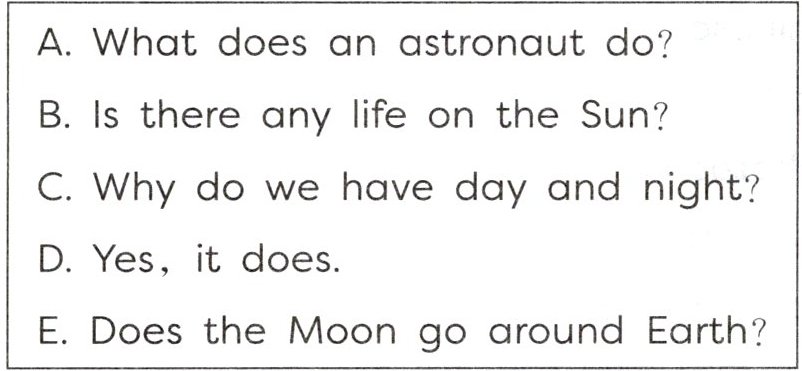
1.
2.
3.
4.
5.
Liu Jia: Look at the model of the Sun, Earth and the Moon.
Zhang Peng:
B
1Liu Jia: No, there isn't. It's too hot.
Zhang Peng: Does the Sun give us light and warmth?
Liu Jia:
D
2Zhang Peng:
C
3Liu Jia: Because Earth spins.
Zhang Peng:
E
4Liu Jia: Yes, it does.
Zhang Peng:
A
5Liu Jia: An astronaut studies space, stars and planets.
1.
B
2.
D
3.
C
4.
E
5.
A
答案
1. B 2. D 3. C 4. E 5. A
解析
【分析】本题是英语情景对话补全题,需结合对话的问答逻辑匹配选项:第一空答句是there be句型的否定回答,对应含there be的一般疑问句;第二空是Does开头的一般疑问句,答句用“Yes, it does”;第三空答句以Because开头,对应Why引导的特殊疑问句;第四空答句是“Yes, it does”,对应Does开头的一般疑问句;第五空答句回答宇航员的工作,对应What引导的特殊疑问句。
【解析】1. 由答句“No, there isn't.”可知,问句是there be句型的一般疑问句,选项B符合;2. 问句是Does引导的一般疑问句,答句需用“Yes, it does”,选项D符合;3. 答句以Because开头表原因,问句应为Why引导的特殊疑问句,选项C符合;4. 答句是“Yes, it does”,问句是Does开头的一般疑问句,选项E符合;5. 答句说明宇航员的工作内容,问句应为What引导的特殊疑问句,选项A符合。
【答案】1.B 2.D 3.C 4.E 5.A
【知识点】情景对话匹配、疑问句答语对应
【点评】本题考查英语对话中问句与答句的逻辑匹配,需掌握不同类型疑问句的答语规则,结合语境选择合适句子,是基础英语题型,注重日常交际用语的运用。
【难度系数】0.5
Ⅵ. Read and fill. (根据首字母提示,将单词补充完整,使句意通顺。)
We know many fun facts about our solar system.
The Sun is very big and 1. h
Our Earth travels 4. a
Mercury is closest to the Sun, but it is not the hottest 6. p
There is very 10. l
1. h
6. p
We know many fun facts about our solar system.
The Sun is very big and 1. h
ot
. There is no life on it, 2. But
it gives us 3. light
and keeps us warm.Our Earth travels 4. a
round
the Sun, so we have four seasons. It 5. spins
all the time, so we have day and night.Mercury is closest to the Sun, but it is not the hottest 6. p
lanet
. 7. Venus
has the highest temperature (467 ℃). 8. Jupiter
is the biggest planet with the Great Red Spot. 9. Neptune
has the fastest wind in the solar system.There is very 10. l
ittle
water on these planets. Astronauts study them on a space station far away.1. h
hot
2. BBut
3. llight
4. aaround
5. sspins
6. p
planet
7. VVenus
8. JJupiter
9. NNeptune
10. llittle
答案
1. hot 2. But 3. light 4. around 5. spins 6. planet 7. Venus 8. Jupiter 9. Neptune 10. little
解析
【分析】首先通读短文,明确短文围绕太阳系的相关内容展开;结合每个空的首字母提示,以及句子的逻辑关系(转折、主谓一致等)、太阳系的基础常识,推导符合语境和语法的单词,保证填入后句意通顺。
【解析】1. 描述太阳的特征,结合首字母h,太阳具备“热”的属性,故填hot;2. 前半句说明太阳上无生命,后半句说明太阳给人类提供光和温暖,二者为转折关系,首字母B,故填But;3. 太阳为地球提供的核心资源之一是“光”,首字母l,故填light;4. 地球绕着太阳公转是固定天文常识,对应固定搭配travel around,首字母a,故填around;5. 地球自转产生昼夜交替,主语it为第三人称单数,动词用spins,首字母s,故填spins;6. 水星是离太阳最近的天体,但并非最热的“行星”,首字母p,故填planet;7. 太阳系中温度最高的行星是金星,首字母V,故填Venus;8. 太阳系体积最大的行星是木星,其标志性特征为大红斑,首字母J,故填Jupiter;9. 太阳系中风速最快的行星是海王星,首字母N,故填Neptune;10. 行星上水资源极少,water为不可数名词,用little修饰表“少量的”,首字母l,故填little。
【答案】1. hot 2. But 3. light 4. around 5. spins 6. planet 7. Venus 8. Jupiter 9. Neptune 10. little
【知识点】太阳系词汇、介词用法、转折连词
【点评】本题考查学生对太阳系基础词汇的掌握及语境逻辑的理解,结合首字母提示和天文常识即可完成填空,属于基础英语词汇题。
【难度系数】0.7
