

 登录
圭表(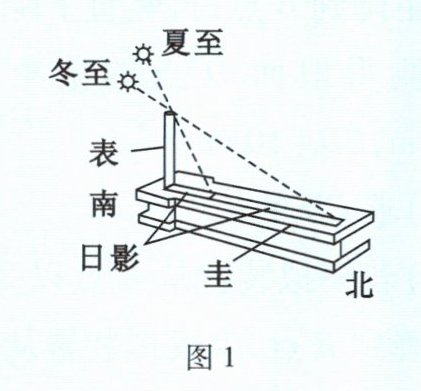 )是我国古代一种通过测量正午日影长度来推断节气的天文仪器,它包括一根直立的标杆(称为“表”)和一把呈南北方向水平固定摆放的与标杆垂直的长尺(称为“圭”).当正午太阳照射在表上时,日影便会投影在圭面上,圭面上日影长度最长的那一天定为冬至,日影长度最短的那一天定为夏至.
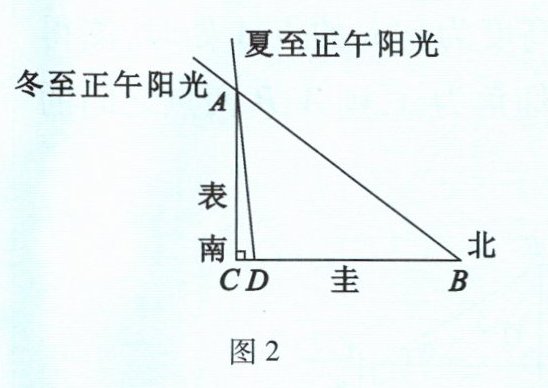 是一个根据某市地理位置设计的圭表平面示意图,表AC垂直于圭BC,已知该市冬至正午太阳高度角(即$∠ABC$)为$37°$,夏至正午太阳高度角(即$∠ADC$)为$84°$,圭面上冬至线与夏至线之间的距离(即DB的长)为4 m.
(1)求$∠BAD$的度数.
(2)求表AC的长. (参考数据:$\sin37°\approx\frac{3}{5},\cos37°\approx\frac{4}{5},\tan37°\approx\frac{3}{4},\tan84°\approx\frac{19}{2}$,精确到0.1 m)
)是我国古代一种通过测量正午日影长度来推断节气的天文仪器,它包括一根直立的标杆(称为“表”)和一把呈南北方向水平固定摆放的与标杆垂直的长尺(称为“圭”).当正午太阳照射在表上时,日影便会投影在圭面上,圭面上日影长度最长的那一天定为冬至,日影长度最短的那一天定为夏至.是一个根据某市地理位置设计的圭表平面示意图,表AC垂直于圭BC,已知该市冬至正午太阳高度角(即$∠ABC$)为$37°$,夏至正午太阳高度角(即$∠ADC$)为$84°$,圭面上冬至线与夏至线之间的距离(即DB的长)为4 m.(1)求$∠BAD$的度数.
(2)求表AC的长. (参考数据:$\sin37°\approx\frac{3}{5},\cos37°\approx\frac{4}{5},\tan37°\approx\frac{3}{4},\tan84°\approx\frac{19}{2}$,精确到0.1 m)
答案
(1) $\because ∠ ADC=84°, ∠ ABC=37°$,
$\therefore ∠ BAD=∠ ADC-∠ ABC=47°$.
(2) 在$\mathrm{Rt}△ ABC$中,$\tan37°=\dfrac{AC}{BC}$,
$\therefore BC=\dfrac{AC}{\tan37°}$.
在$\mathrm{Rt}△ ADC$中,$\tan84°=\dfrac{AC}{DC}$,
$\therefore DC=\dfrac{AC}{\tan84°}$.
$\because BD=4$,
$\therefore BC-DC=\dfrac{AC}{\tan37°}-\dfrac{AC}{\tan84°}=BD=4$.
$\therefore \dfrac{4}{3}AC-\dfrac{2}{19}AC\approx4$.
解得$AC\approx3.3(\mathrm{m})$.
答:表AC的长约为3.3 m.
