

 登录
登录
一、词汇运用。
1. We could hear
2. (2025·四川乐山)We Chinese often s
3. We both keep s
4. (2026·宿迁市沭阳期末)Timmy was ill in hospital for a long time and he felt
5. (2026·宿迁市宿豫区实验中学月考)Don't be
1. We could hear
thunder
(雷声)in the distance, and moments later, a flash of lightning hit the ground, shining the sky with a bright light.2. (2025·四川乐山)We Chinese often s
shake
hands and smile when we meet visitors.3. We both keep s
silent
about the matter, for it's a secret between us.4. (2026·宿迁市沭阳期末)Timmy was ill in hospital for a long time and he felt
weak
(not strong).5. (2026·宿迁市宿豫区实验中学月考)Don't be
nervous
(be worried or afraid)when you give a speech in front of students.答案
1. thunder 2. shake 3. silent 4. weak
5. nervous
5. nervous
解析
【分析】本题为英语词汇运用题,需根据每小题给出的汉语提示、首字母提示或英文释义,结合句子语境及固定搭配,填写正确的单词,同时注意单词的词性和拼写。
【解析】1. 句意:我们能听到远处的雷声,一会儿后,一道闪电击中地面,用明亮的光照亮天空。“雷声”对应的英文名词是thunder,符合语境,故填thunder。2. 句意:我们中国人见到游客时经常握手和微笑。固定搭配shake hands意为“握手”,主语为We,一般现在时,用动词原形,故填shake。3. 句意:我们对这件事都保持沉默,因为这是我们之间的秘密。固定搭配keep silent意为“保持沉默”,符合语境,故填silent。4. 句意:Timmy生病住院很久了,他感觉不强壮,即虚弱的,对应形容词weak,故填weak。5. 句意:当你在学生面前演讲时不要担心或害怕,对应形容词nervous(紧张的,焦虑的),符合提示,故填nervous。
【答案】1. thunder 2. shake 3. silent 4. weak 5. nervous
【知识点】英语词汇运用、固定搭配、形容词辨析
【点评】本题考查基础英语词汇的运用,结合语境、固定搭配及提示填写单词,难度不大,侧重考查学生对核心词汇的掌握。
【难度系数】0.6
【解析】1. 句意:我们能听到远处的雷声,一会儿后,一道闪电击中地面,用明亮的光照亮天空。“雷声”对应的英文名词是thunder,符合语境,故填thunder。2. 句意:我们中国人见到游客时经常握手和微笑。固定搭配shake hands意为“握手”,主语为We,一般现在时,用动词原形,故填shake。3. 句意:我们对这件事都保持沉默,因为这是我们之间的秘密。固定搭配keep silent意为“保持沉默”,符合语境,故填silent。4. 句意:Timmy生病住院很久了,他感觉不强壮,即虚弱的,对应形容词weak,故填weak。5. 句意:当你在学生面前演讲时不要担心或害怕,对应形容词nervous(紧张的,焦虑的),符合提示,故填nervous。
【答案】1. thunder 2. shake 3. silent 4. weak 5. nervous
【知识点】英语词汇运用、固定搭配、形容词辨析
【点评】本题考查基础英语词汇的运用,结合语境、固定搭配及提示填写单词,难度不大,侧重考查学生对核心词汇的掌握。
【难度系数】0.6
1.
A.Unless
B.Though
C.Since
D.Whether
C
you can't work out the problem, perhaps you need to ask your classmates for help.A.Unless
B.Though
C.Since
D.Whether
答案
1. C 【解析】句意:既然你解不出这道题,也许你需要向你的同学寻求帮助。unless意为“除非;若非”;though意为“虽然;尽管”;since意为“由于,既然”;whether意为“是否;不管”。
解析
【分析】本题考查从属连词的词义辨析,解题思路为:先明确句子前后分句的逻辑关系,再逐一分析各选项连词的含义,结合语境选出符合逻辑的连词。句子前半部分“你解不出这道题”是后半句“需要向同学求助”的原因,因此需选表“既然、由于”的连词。
【解析】先理解句子逻辑:“______你解不出这道题,也许你需要向同学寻求帮助”。逐一分析选项:A. Unless意为“除非;若非”,引导条件状语从句,不符合因果逻辑;B. Though意为“虽然;尽管”,引导让步状语从句,表转折,不符合;C. Since意为“由于,既然”,引导原因状语从句,符合前因后果的逻辑;D. Whether意为“是否;不管”,不符合语境。因此选C。
【答案】C
【知识点】从属连词辨析;状语从句
【点评】本题考查基础的连词词义辨析,要求学生结合句子的因果逻辑选择合适的从属连词,需掌握常见连词的含义及用法,属于基础题型。
【难度系数】0.5
【解析】先理解句子逻辑:“______你解不出这道题,也许你需要向同学寻求帮助”。逐一分析选项:A. Unless意为“除非;若非”,引导条件状语从句,不符合因果逻辑;B. Though意为“虽然;尽管”,引导让步状语从句,表转折,不符合;C. Since意为“由于,既然”,引导原因状语从句,符合前因后果的逻辑;D. Whether意为“是否;不管”,不符合语境。因此选C。
【答案】C
【知识点】从属连词辨析;状语从句
【点评】本题考查基础的连词词义辨析,要求学生结合句子的因果逻辑选择合适的从属连词,需掌握常见连词的含义及用法,属于基础题型。
【难度系数】0.5
2.(2026·扬州市树人学校期末)After the accident, the doctors tried their best to keep the boy
A.living
B.alive
C.live
D.lively
B
.A.living
B.alive
C.live
D.lively
答案
2. B 【解析】句意:事故发生后,医生们尽他们最大的努力让这个男孩活着。“keep sb+adj.”表示“使某人保持某种状态”,空处应用alive做宾语补足语。
易混辨析
living意为“活着的”,常做定语;alive意为“活着的”,常做表语或宾语补足语;live意为“活的;现场直播的”,常做定语;lively意为“活泼的;充满活力的”。
易混辨析
living意为“活着的”,常做定语;alive意为“活着的”,常做表语或宾语补足语;live意为“活的;现场直播的”,常做定语;lively意为“活泼的;充满活力的”。
解析
【分析】这道题考查固定搭配和形容词词义辨析。首先回忆固定结构“keep sb + 形容词”,表示“使某人保持某种状态”,需要选择能作宾语补足语的形容词;再区分四个选项的用法,结合句意判断正确选项。
【解析】“keep sb + adj.”是固定结构,意为“使某人保持某种状态”,此处需要形容词作宾语补足语。对选项辨析:A项living意为“活着的”,常作定语;B项alive意为“活着的”,可作表语或宾语补足语,符合此处用法;C项live意为“活的;现场直播的”,多作定语;D项lively意为“活泼的”,不符合句意。结合句意“事故发生后,医生们尽力让这个男孩活着”,可知选B。
【答案】B
【知识点】形容词词义辨析;固定搭配keep sb + adj.
【点评】本题为基础词义辨析与固定搭配题,需掌握易混形容词的用法区别及keep的固定结构,属于初中英语基础考点,难度适中。
【难度系数】0.3
【解析】“keep sb + adj.”是固定结构,意为“使某人保持某种状态”,此处需要形容词作宾语补足语。对选项辨析:A项living意为“活着的”,常作定语;B项alive意为“活着的”,可作表语或宾语补足语,符合此处用法;C项live意为“活的;现场直播的”,多作定语;D项lively意为“活泼的”,不符合句意。结合句意“事故发生后,医生们尽力让这个男孩活着”,可知选B。
【答案】B
【知识点】形容词词义辨析;固定搭配keep sb + adj.
【点评】本题为基础词义辨析与固定搭配题,需掌握易混形容词的用法区别及keep的固定结构,属于初中英语基础考点,难度适中。
【难度系数】0.3
3. (2026·南通市期末)—People lived
—That's exactly why we must practise safety drills regularly and always keep safety tips in our mind.
A.in fear
B.in a mess
C.in peace
D.in surprise
A
during the earthquake, unsure if their buildings would hold.—That's exactly why we must practise safety drills regularly and always keep safety tips in our mind.
A.in fear
B.in a mess
C.in peace
D.in surprise
答案
3. A 【解析】句意:——地震期间人们生活在恐惧中,不确定他们的建筑物是否撑得住。——这正是为什么我们必须定期进行安全演练并一直牢记安全提示。in fear意为“恐惧地,害怕地”;in a mess意为“一团糟,杂乱不堪”;in peace意为“和平地”;in surprise意为“惊讶地”。
解析
【分析】这道题考查介词短语的词义辨析,解题时需先理解句子语境:地震期间人们的状态是不确定建筑物是否撑得住,结合后半句的语境,再逐一分析四个选项的含义,选出符合语境的短语。
【解析】句意:——地震期间人们生活在恐惧中,不确定他们的建筑物是否撑得住。——这正是为什么我们必须定期进行安全演练并一直牢记安全提示。in fear意为“恐惧地,害怕地”;in a mess意为“一团糟,杂乱不堪”;in peace意为“和平地”;in surprise意为“惊讶地”。根据语境,地震时人们因担忧建筑安全而处于恐惧状态,因此选A。
【答案】A
【知识点】介词短语辨析;语境理解
【点评】本题结合地震场景考查常用介词短语的含义,需准确掌握各短语意思并结合语境判断,属于基础题型,注重词汇在具体语境中的运用。
【难度系数】0.3
【解析】句意:——地震期间人们生活在恐惧中,不确定他们的建筑物是否撑得住。——这正是为什么我们必须定期进行安全演练并一直牢记安全提示。in fear意为“恐惧地,害怕地”;in a mess意为“一团糟,杂乱不堪”;in peace意为“和平地”;in surprise意为“惊讶地”。根据语境,地震时人们因担忧建筑安全而处于恐惧状态,因此选A。
【答案】A
【知识点】介词短语辨析;语境理解
【点评】本题结合地震场景考查常用介词短语的含义,需准确掌握各短语意思并结合语境判断,属于基础题型,注重词汇在具体语境中的运用。
【难度系数】0.3
4.(2026·宿迁市泗阳期末)—Why did the workers put up the warning signs?
—Because part of the old wall
A.came down
B.felt down
C.calmed down
D.slowed down
—Because part of the old wall
A
in the thunderstorm this morning.A.came down
B.felt down
C.calmed down
D.slowed down
答案
4. A
解析
【分析】本题考查动词短语辨析,解题时需先理解对话语境,明确答句需表达“旧墙部分在雷暴中倒塌”的含义,再逐一分析各选项动词短语的词义,选出符合语境的正确答案。
【解析】对话意为:——为什么工人们要挂警示标志?——因为今早的雷暴中,旧墙的一部分倒塌了。逐一分析选项:A项came down表示“倒塌;落下”,可用于描述建筑物等坍塌,符合语境;B项felt down意为“感到沮丧”,主语通常是人,不符合描述墙的情况;C项calmed down意为“平静下来”,主语多为人或情绪,不符合;D项slowed down意为“减速”,与墙的状态无关,不符合。因此正确答案为A。
【答案】A
【知识点】动词短语辨析;语境理解
【点评】本题为英语学科基础考点的动词短语辨析题,结合对话语境即可快速判断答案,侧重考查常用短语的词义掌握,难度较低。
【难度系数】0.7
【解析】对话意为:——为什么工人们要挂警示标志?——因为今早的雷暴中,旧墙的一部分倒塌了。逐一分析选项:A项came down表示“倒塌;落下”,可用于描述建筑物等坍塌,符合语境;B项felt down意为“感到沮丧”,主语通常是人,不符合描述墙的情况;C项calmed down意为“平静下来”,主语多为人或情绪,不符合;D项slowed down意为“减速”,与墙的状态无关,不符合。因此正确答案为A。
【答案】A
【知识点】动词短语辨析;语境理解
【点评】本题为英语学科基础考点的动词短语辨析题,结合对话语境即可快速判断答案,侧重考查常用短语的词义掌握,难度较低。
【难度系数】0.7
5. (2026·南京市金陵中学期中)—Did you study any other languages
—Yes, I studied three. But I have forgotten all
A.besides; except
B.except; besides
C.except; except
D.besides; besides
besides
English when you were at college?—Yes, I studied three. But I have forgotten all
except
a few words of each.A.besides; except
B.except; besides
C.except; except
D.besides; besides
答案
5. A 【解析】句意:——你上大学时除了英语还学过其他语言吗?——是的,我学习了三种。但除了每种语言的一些词,其他的我全都忘了。besides意为“除……之外(还有)”,而except意为“除……之外(没有)”。根据答句“Yes,I studied three.”可知,第一空用besides;根据句意可知,第二空用except。
解析
【分析】
这道题考查介词besides和except的用法辨析。解题思路:首先明确两个介词的核心区别:besides表示“除……之外(还有,包含在内)”,except表示“除……之外(没有,排除在外)”;接着分析第一空:问句询问大学时除了英语是否还学其他语言,答句提到学了三种,说明英语是包含在内的,故第一空用besides;最后分析第二空:答句表示除了每种语言的几个词,其他都忘了,是排除部分内容,故第二空用except,由此确定答案。
【解析】
besides意为“除……之外(还有,包含在内)”,except意为“除……之外(没有,排除在外)”。第一空:根据答句“Yes, I studied three.”可知,学的语言包含英语,需用besides;第二空:根据句意“除了每种语言的几个词,其他都忘了”,需用except,因此选A。
【答案】
A
【知识点】
介词辨析(besides与except)
【点评】
本题考查易混介词的用法,需准确区分besides(包含)和except(排除)的含义,结合语境判断即可,属于基础考点题。
【难度系数】
0.6
这道题考查介词besides和except的用法辨析。解题思路:首先明确两个介词的核心区别:besides表示“除……之外(还有,包含在内)”,except表示“除……之外(没有,排除在外)”;接着分析第一空:问句询问大学时除了英语是否还学其他语言,答句提到学了三种,说明英语是包含在内的,故第一空用besides;最后分析第二空:答句表示除了每种语言的几个词,其他都忘了,是排除部分内容,故第二空用except,由此确定答案。
【解析】
besides意为“除……之外(还有,包含在内)”,except意为“除……之外(没有,排除在外)”。第一空:根据答句“Yes, I studied three.”可知,学的语言包含英语,需用besides;第二空:根据句意“除了每种语言的几个词,其他都忘了”,需用except,因此选A。
【答案】
A
【知识点】
介词辨析(besides与except)
【点评】
本题考查易混介词的用法,需准确区分besides(包含)和except(排除)的含义,结合语境判断即可,属于基础考点题。
【难度系数】
0.6
三、完成句子。
1. 地震停止以后,我被困在一座大楼里。
I
2. 我不知道是否有其他人在我附近。
I didn't know
3. 和其他人一样,我竭尽全力想要跑出这个着火的房子。
I
4. 当狼靠近灌木丛时,兔子快速向四面八方跑去。
When the wolf came towards the bushes,
the rabbits
1. 地震停止以后,我被困在一座大楼里。
I
was trapped in a building
after
the earthquake stopped.2. 我不知道是否有其他人在我附近。
I didn't know
if/whether anyone else was
near/around me
.3. 和其他人一样,我竭尽全力想要跑出这个着火的房子。
I
tried my best to run out of
the burning house like other people did.4. 当狼靠近灌木丛时,兔子快速向四面八方跑去。
When the wolf came towards the bushes,
the rabbits
ran in all directions
quickly.答案
1. was trapped in a building after 2. if/whether anyone else was near/around me 3. tried my best to run out of 4. ran in all directions
解析
【分析】
本题为英语完成句子题,需结合语境、时态、固定搭配及从句结构填空:1. 第1题需用一般过去时的被动短语表达“被困”,结合介词“after”对应“在……之后”;2. 第2题需用if/whether引导的宾语从句,注意陈述语序及时态一致;3. 第3题需用固定短语“try one's best to do”及“run out of”,结合一般过去时;4. 第4题需用固定短语“run in all directions”,结合一般过去时。
【解析】
1. 主语I为第一人称,一般过去时被动结构为was + 过去分词,“被困在……”是be trapped in,“大楼”是building,“在……之后”用after,故填was trapped in a building after;
2. 宾语从句引导词用if/whether,“其他人”是anyone else,“在我附近”是near/around me,从句用陈述语序,时态与主句一致为过去式,故填if/whether anyone else was near/around me;
3. “竭尽全力”是固定搭配try one's best to do sth,“跑出”是run out of,一般过去时中try变tried,故填tried my best to run out of;
4. “向四面八方”是固定短语run in all directions,一般过去时中run变ran,故填ran in all directions。
【答案】
1. was trapped in a building after 2. if/whether anyone else was near/around me 3. tried my best to run out of 4. ran in all directions
【知识点】
一般过去时、固定短语搭配、宾语从句
【点评】
本题考查英语基础完成句子,侧重常用短语、时态及宾语从句的运用,需掌握核心词汇和固定表达,难度适中,适合初中阶段学生练习。
【难度系数】
0.6
本题为英语完成句子题,需结合语境、时态、固定搭配及从句结构填空:1. 第1题需用一般过去时的被动短语表达“被困”,结合介词“after”对应“在……之后”;2. 第2题需用if/whether引导的宾语从句,注意陈述语序及时态一致;3. 第3题需用固定短语“try one's best to do”及“run out of”,结合一般过去时;4. 第4题需用固定短语“run in all directions”,结合一般过去时。
【解析】
1. 主语I为第一人称,一般过去时被动结构为was + 过去分词,“被困在……”是be trapped in,“大楼”是building,“在……之后”用after,故填was trapped in a building after;
2. 宾语从句引导词用if/whether,“其他人”是anyone else,“在我附近”是near/around me,从句用陈述语序,时态与主句一致为过去式,故填if/whether anyone else was near/around me;
3. “竭尽全力”是固定搭配try one's best to do sth,“跑出”是run out of,一般过去时中try变tried,故填tried my best to run out of;
4. “向四面八方”是固定短语run in all directions,一般过去时中run变ran,故填ran in all directions。
【答案】
1. was trapped in a building after 2. if/whether anyone else was near/around me 3. tried my best to run out of 4. ran in all directions
【知识点】
一般过去时、固定短语搭配、宾语从句
【点评】
本题考查英语基础完成句子,侧重常用短语、时态及宾语从句的运用,需掌握核心词汇和固定表达,难度适中,适合初中阶段学生练习。
【难度系数】
0.6
四、阅读理解。
新素养 技术应用 Recently, a research on how a new virtual reality(VR,虚拟现实)experience educated children about the fire disasters was done. The new VR
experience was developed by the University of South Australia, hoping to educate children to learn how to be safe in a fire. It presents a situation for children aged 10—12. In the situation, they are tasked to look after a friend’s dog just before a fire event begins. They take part in a set of problem-solving activities to help save and protect themselves and the dog.
The findings showed that over 80% of children could calmly tell the advantages and disadvantages of different choices. They also learnt to make wise decisions to protect themselves from a fire. Children thought it especially important and meaningful, because 91% of them didn’t have knowledge of fires at the beginning, and 67% had said that they were too young to make safety decisions in a fire.
The researchers believed such VR experiences made it possible to engage, educate and empower the young. “As children born in modern times, they are interested in such technology and they can experience events in a real situation yet within the safe environment,” said Delene Weber, one of the researchers. “Well-designed VR can provide children with surprisingly valuable learning tools.” Meanwhile, because children have fewer life experiences, aren’t as physically strong, and are less likely to have learnt much about fire safety, they’re often most at risk. However, the role that children play in the fire safety at their homes should not be underestimated(低估). “Children don’t need to be always waiting for help in disasters. With these VR experiences, we can make children understand the risks and realize they can help,” said Weber.
1. 新考法 观点态度 From the findings, what’s the children’s attitude(态度)towards the new VR experience?
A. Doubtful. B. Worried.
C. Uncertain. D. Supportive.
2. Which of the following in the dictionary best explains the underlined word “engage” in Para. 3?
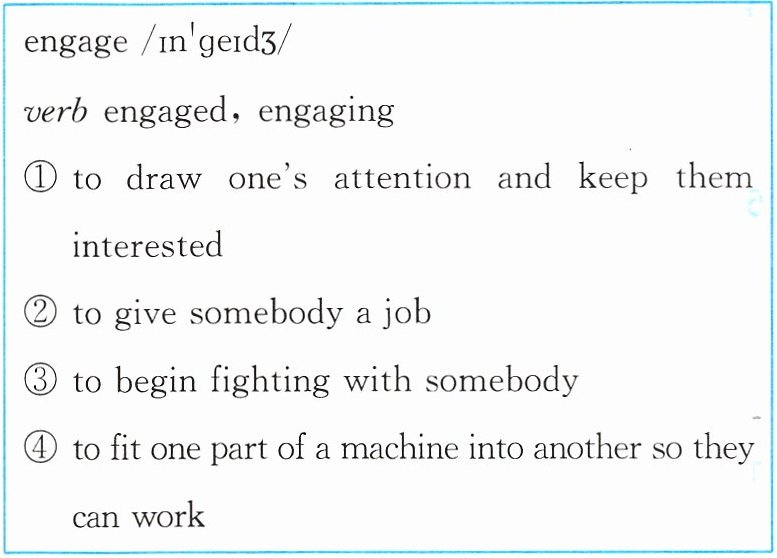
engage /ɪnˈɡeɪdʒ/
verb engaged, engaging
① to draw one's attention and keep them interested
② to give somebody a job
③ to begin fighting with somebody
④ to fit one part of a machine into another so they can work
A. ① B. ② C. ③ D. ④
3. From Para. 3, we mainly get to know the
A. development B. advantages
C. quality D. introduction
4. According to the passage, which of the following is TRUE?
A. Children make no difference in the fire safety at their homes.
B. VR experiences are mainly designed for children in high school.
C. Well-designed VR can offer children amazingly valuable learning tools.
D. 91% of children believed they weren’t old enough to make safety decisions.
新素养 技术应用 Recently, a research on how a new virtual reality(VR,虚拟现实)experience educated children about the fire disasters was done. The new VR
experience was developed by the University of South Australia, hoping to educate children to learn how to be safe in a fire. It presents a situation for children aged 10—12. In the situation, they are tasked to look after a friend’s dog just before a fire event begins. They take part in a set of problem-solving activities to help save and protect themselves and the dog.
The findings showed that over 80% of children could calmly tell the advantages and disadvantages of different choices. They also learnt to make wise decisions to protect themselves from a fire. Children thought it especially important and meaningful, because 91% of them didn’t have knowledge of fires at the beginning, and 67% had said that they were too young to make safety decisions in a fire.
The researchers believed such VR experiences made it possible to engage, educate and empower the young. “As children born in modern times, they are interested in such technology and they can experience events in a real situation yet within the safe environment,” said Delene Weber, one of the researchers. “Well-designed VR can provide children with surprisingly valuable learning tools.” Meanwhile, because children have fewer life experiences, aren’t as physically strong, and are less likely to have learnt much about fire safety, they’re often most at risk. However, the role that children play in the fire safety at their homes should not be underestimated(低估). “Children don’t need to be always waiting
for help in disasters. With these VR experiences, we can make children understand the risks and realize they can help,” said Weber.1. 新考法 观点态度 From the findings, what’s the children’s attitude(态度)towards the new VR experience?
A. Doubtful. B. Worried.
C. Uncertain. D. Supportive.
2. Which of the following in the dictionary best explains the underlined word “engage” in Para. 3?
engage /ɪnˈɡeɪdʒ/
verb engaged, engaging
① to draw one's attention and keep them interested
② to give somebody a job
③ to begin fighting with somebody
④ to fit one part of a machine into another so they can work
A. ① B. ② C. ③ D. ④
3. From Para. 3, we mainly get to know the
B
of the new VR experience.A. development B. advantages
C. quality D. introduction
4. According to the passage, which of the following is TRUE?
A. Children make no difference in the fire safety at their homes.
B. VR experiences are mainly designed for children in high school.
C. Well-designed VR can offer children amazingly valuable learning tools.
D. 91% of children believed they weren’t old enough to make safety decisions.
答案
1. D 2. A
3. B 【解析】通读第三段可知,本段讲述了研究人员对这项VR体验的评价,说明这种VR体验对孩子是有好处的,因此,从该段我们主要可以了解这项新型VR体验的优势。
4. C 【解析】根据第三段中“Well-designed VR can provide children with surprisingly valuable learning tools.”可知,精心设计的VR可以为孩子们提供非常有价值的学习工具。
3. B 【解析】通读第三段可知,本段讲述了研究人员对这项VR体验的评价,说明这种VR体验对孩子是有好处的,因此,从该段我们主要可以了解这项新型VR体验的优势。
4. C 【解析】根据第三段中“Well-designed VR can provide children with surprisingly valuable learning tools.”可知,精心设计的VR可以为孩子们提供非常有价值的学习工具。
解析
【分析】
本题为科技应用类英语阅读理解,包含观点态度、词义猜测、段落主旨、细节理解四类题型。解题思路如下:1. 观点态度题:定位原文中孩子对VR体验的评价,判断其态度倾向;2. 词义猜测题:结合上下文语境,匹配单词的释义;3. 段落主旨题:梳理第三段核心内容,明确段落主题;4. 细节理解题:逐一核对选项与原文细节的一致性,排除错误选项。
【解析】
1. 观点态度题:根据第二段“Children thought it especially important and meaningful”可知,孩子们认为这项VR体验重要且有意义,体现出支持的态度,故选D。
2. 词义猜测题:第三段提到VR能吸引孩子的注意力,结合语境,“engage”在此处意为“吸引注意力”,对应释义①,故选A。
3. 段落主旨题:通读第三段,核心内容是研究人员对这项VR体验的正面评价,说明其对孩子的益处,即优势,故选B。
4. 细节理解题:A项与原文“the role that children play in the fire safety at their homes should not be underestimated”相悖;B项与原文“for children aged 10—12”不符;C项与原文“Well-designed VR can provide children with surprisingly valuable learning tools”一致;D项与原文“67% had said that they were too young to make safety decisions”不符,故选C。
【答案】
1.D 2.A 3.B 4.C
【知识点】
英语阅读理解、词义猜测、细节理解
【点评】
本题围绕VR技术在儿童消防安全教育中的应用展开,考查英语阅读核心题型,要求学生具备定位原文、分析语境、判断主旨的能力,是常规难度的阅读理解题。
【难度系数】
0.6
本题为科技应用类英语阅读理解,包含观点态度、词义猜测、段落主旨、细节理解四类题型。解题思路如下:1. 观点态度题:定位原文中孩子对VR体验的评价,判断其态度倾向;2. 词义猜测题:结合上下文语境,匹配单词的释义;3. 段落主旨题:梳理第三段核心内容,明确段落主题;4. 细节理解题:逐一核对选项与原文细节的一致性,排除错误选项。
【解析】
1. 观点态度题:根据第二段“Children thought it especially important and meaningful”可知,孩子们认为这项VR体验重要且有意义,体现出支持的态度,故选D。
2. 词义猜测题:第三段提到VR能吸引孩子的注意力,结合语境,“engage”在此处意为“吸引注意力”,对应释义①,故选A。
3. 段落主旨题:通读第三段,核心内容是研究人员对这项VR体验的正面评价,说明其对孩子的益处,即优势,故选B。
4. 细节理解题:A项与原文“the role that children play in the fire safety at their homes should not be underestimated”相悖;B项与原文“for children aged 10—12”不符;C项与原文“Well-designed VR can provide children with surprisingly valuable learning tools”一致;D项与原文“67% had said that they were too young to make safety decisions”不符,故选C。
【答案】
1.D 2.A 3.B 4.C
【知识点】
英语阅读理解、词义猜测、细节理解
【点评】
本题围绕VR技术在儿童消防安全教育中的应用展开,考查英语阅读核心题型,要求学生具备定位原文、分析语境、判断主旨的能力,是常规难度的阅读理解题。
【难度系数】
0.6
