

 登录
登录
三、社交媒体对我们的幸福感有影响吗?阅读老师发布的一篇科普文章,选择正确的选项回答问题。
When I was young, my mum always told me, “I just want you to be happy.” She didn’t care what I became, as long as I stayed happy. But what exactly is happiness? Is it a place, or a never-ending journey?
Is happiness on social media? It sure seems that way. People love posting perfect pictures of their best moments online. But if you ever want to feel bad about your life, just jump online and scroll through(滚屏浏览) those posts. Platforms like Weibo and Xiaohongshu make us believe that we could be prettier, healthier, wealthier, and of course, happier. But lots of studies have found that there is a link between social media use and low moods(心情). People who use social media for more than two hours a day are more likely to feel lonely.
When we share a happy moment, we must feel happy, right? Well, yes. We get excited when something good happens, but studies have found that after a short time, we return to feeling the same as before. In other words, happiness only lasts for so long. As the effects(影响) of one “happy” moment wear off, we search(搜寻) for new sources of happiness. And social media has made this search harder than ever.
Happily, there’s still hope for us to find lasting happiness. This happens when we allow(允许) ourselves to experience true feelings like anger, fear and sadness. When we are honest(诚实) about our experiences, we can build more meaningful connections with others. And that can bring us more happiness than any number of “likes” on a screen!
()1. Why does happiness seem to be on social media according to the passage?
A. Because scrolling through social media posts makes people happy.
B. Because social media helps people form deep friendships.
C. Because many people post their happiest moments there.
D. Because many studies have connected social media use to happiness.
()2. What does the underlined word “link” in Paragraph 2 mean?
A. Order. B. Connection.
C. Change. D. Difference.
()3. Which of the following can be put in “”?
A. But why do we feel lonely when we see others' perfect pictures online?
B. But what if we're the ones posting?
C. But how can we find happiness on social media?
D. But what should we do to keep away from social media?
()4. Which line in the following chart correctly shows the change in our feelings after something happy happens to us?
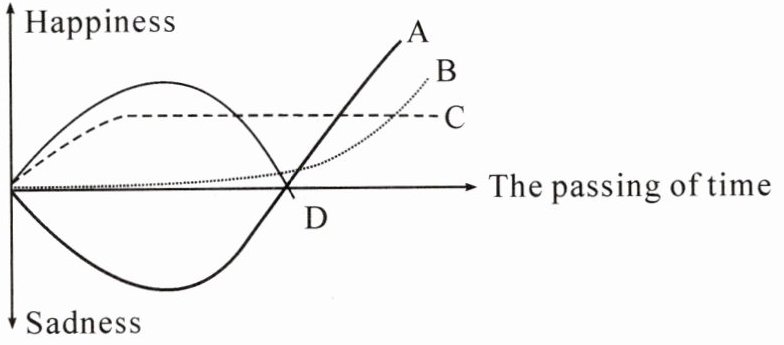
A. A B. B C. C D. D
()5. What does the author suggest(建议) we do with bad feelings?
A. Learn to accept them bravely.
B. Turn a blind eye to them.
C. Post about them on social media.
D. Stay away from them quickly.
When I was young, my mum always told me, “I just want you to be happy.” She didn’t care what I became, as long as I stayed happy. But what exactly is happiness? Is it a place, or a never-ending journey?
Is happiness on social media? It sure seems that way. People love posting perfect pictures of their best moments online. But if you ever want to feel bad about your life, just jump online and scroll through(滚屏浏览) those posts. Platforms like Weibo and Xiaohongshu make us believe that we could be prettier, healthier, wealthier, and of course, happier. But lots of studies have found that there is a link between social media use and low moods(心情). People who use social media for more than two hours a day are more likely to feel lonely.
When we share a happy moment, we must feel happy, right? Well, yes. We get excited when something good happens, but studies have found that after a short time, we return to feeling the same as before. In other words, happiness only lasts for so long. As the effects(影响) of one “happy” moment wear off, we search(搜寻) for new sources of happiness. And social media has made this search harder than ever.
Happily, there’s still hope for us to find lasting happiness. This happens when we allow(允许) ourselves to experience true feelings like anger, fear and sadness. When we are honest(诚实) about our experiences, we can build more meaningful connections with others. And that can bring us more happiness than any number of “likes” on a screen!
()1. Why does happiness seem to be on social media according to the passage?
A. Because scrolling through social media posts makes people happy.
B. Because social media helps people form deep friendships.
C. Because many people post their happiest moments there.
D. Because many studies have connected social media use to happiness.
()2. What does the underlined word “link” in Paragraph 2 mean?
A. Order. B. Connection.
C. Change. D. Difference.
()3. Which of the following can be put in “”?
A. But why do we feel lonely when we see others' perfect pictures online?
B. But what if we're the ones posting?
C. But how can we find happiness on social media?
D. But what should we do to keep away from social media?
()4. Which line in the following chart correctly shows the change in our feelings after something happy happens to us?
A. A B. B C. C D. D
()5. What does the author suggest(建议) we do with bad feelings?
A. Learn to accept them bravely.
B. Turn a blind eye to them.
C. Post about them on social media.
D. Stay away from them quickly.
答案
1.C 2.B 3.B 4.C 5.A
解析
1. 细节理解题:根据原文第二段"Is happiness on social media? It sure seems that way. People love posting perfect pictures of their best moments online."可知,很多人会在社交媒体上发布自己最幸福的高光时刻,所以幸福感看似存在于社交媒体上。A选项表述和原文“刷这类帖子会让人对自己的生活感到糟糕”相悖,B选项文中未提及,D选项研究表明社交媒体使用和低落情绪相关,和原文内容不符,因此选C。
2. 词义猜测题:划线词所在句意为“很多研究发现社交媒体的使用和低落情绪之间存在______”,后文提到每日使用社交媒体超过2小时的人更容易感到孤独,说明二者存在关联,link的含义是“联系、关联”,和选项B Connection(联系)意思一致,因此选B。
3. 推理判断题:设空处前文介绍了我们刷别人发布的完美帖子时的感受,设空处后文转而介绍我们自己分享快乐时刻的体验,B选项“但如果是我们自己发布内容呢?”可以自然承接上下文的两种不同场景,其余选项均无法引出后文内容,因此选B。
4. 细节理解题:根据原文第三段"We get excited when something good happens, but studies have found that after a short time, we return to feeling the same as before."可知,开心的事发生后,我们的幸福感先上升,短时间后就会回落回到之前的水平,对应图表里的线条C,因此选C。
5. 细节理解题:根据原文最后一段"This happens when we allow ourselves to experience true feelings like anger, fear and sadness."可知,作者建议我们允许自己体验愤怒、恐惧这类负面的真实情绪,也就是勇敢接受这些坏情绪,因此选A。
2. 词义猜测题:划线词所在句意为“很多研究发现社交媒体的使用和低落情绪之间存在______”,后文提到每日使用社交媒体超过2小时的人更容易感到孤独,说明二者存在关联,link的含义是“联系、关联”,和选项B Connection(联系)意思一致,因此选B。
3. 推理判断题:设空处前文介绍了我们刷别人发布的完美帖子时的感受,设空处后文转而介绍我们自己分享快乐时刻的体验,B选项“但如果是我们自己发布内容呢?”可以自然承接上下文的两种不同场景,其余选项均无法引出后文内容,因此选B。
4. 细节理解题:根据原文第三段"We get excited when something good happens, but studies have found that after a short time, we return to feeling the same as before."可知,开心的事发生后,我们的幸福感先上升,短时间后就会回落回到之前的水平,对应图表里的线条C,因此选C。
5. 细节理解题:根据原文最后一段"This happens when we allow ourselves to experience true feelings like anger, fear and sadness."可知,作者建议我们允许自己体验愤怒、恐惧这类负面的真实情绪,也就是勇敢接受这些坏情绪,因此选A。
