

 登录
登录
四、根据课本第66页Section B 1b的语篇内容,完成下面的表格。
An Interview
Guest: Dr Lu Xingyuan, 1. of the Future World Research Centre.
When: in the evening
Question Answer
Can you tell us how life will be different in 50 years? You will see 2..
Can you give us some examples? We will have 3.. They will do almost all our housework. They will also help 4.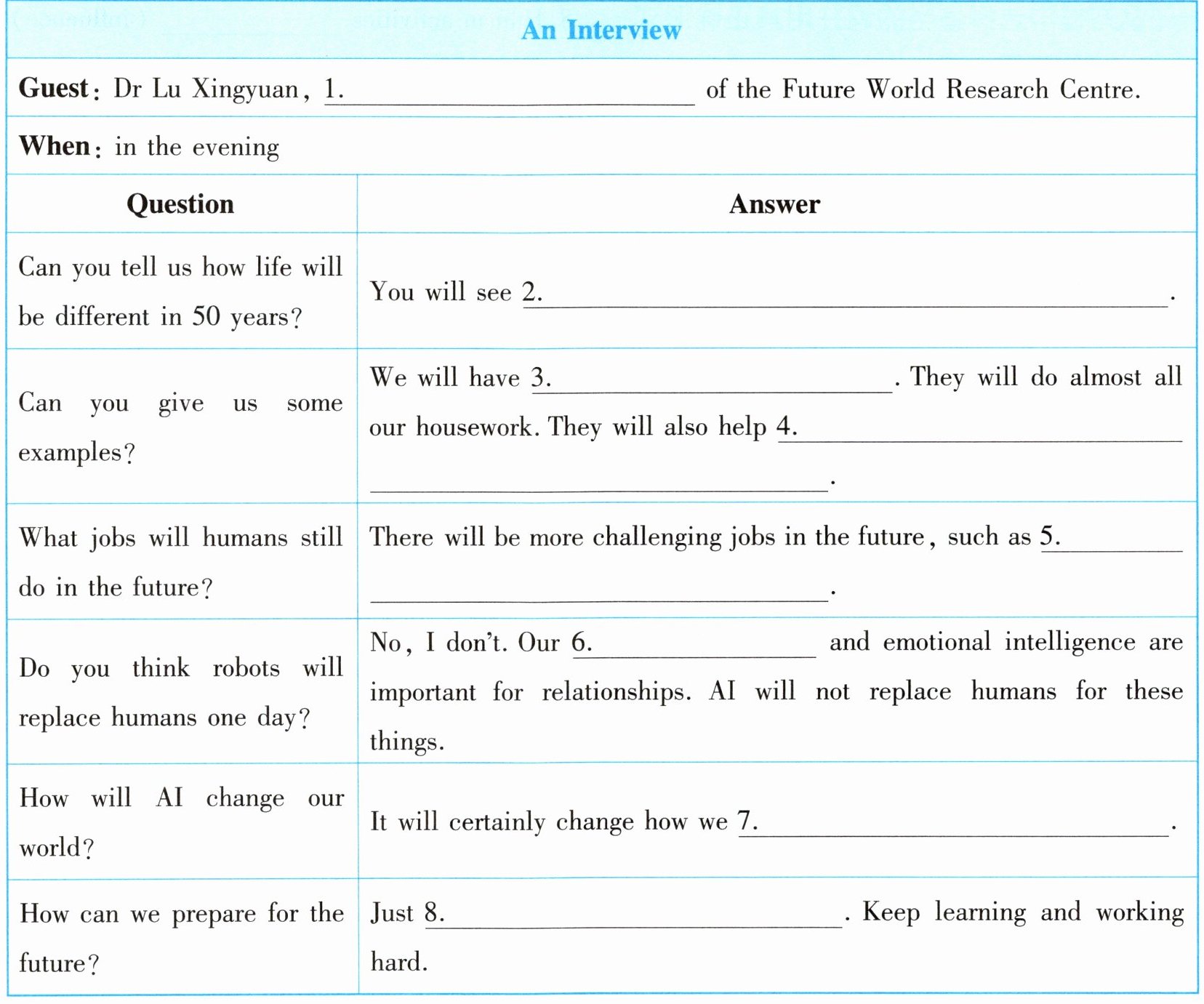 .
.
What jobs will humans still do in the future? There will be more challenging jobs in the future, such as 5..
Do you think robots will replace humans one day? No, I don't. Our 6. and emotional intelligence are important for relationships. AI will not replace humans for these things.
How will AI change our world? It will certainly change how we 7..
How can we prepare for the future? Just 8.. Keep learning and working hard.
An Interview
Guest: Dr Lu Xingyuan, 1. of the Future World Research Centre.
When: in the evening
Question Answer
Can you tell us how life will be different in 50 years? You will see 2..
Can you give us some examples? We will have 3.. They will do almost all our housework. They will also help 4.
.What jobs will humans still do in the future? There will be more challenging jobs in the future, such as 5..
Do you think robots will replace humans one day? No, I don't. Our 6. and emotional intelligence are important for relationships. AI will not replace humans for these things.
How will AI change our world? It will certainly change how we 7..
How can we prepare for the future? Just 8.. Keep learning and working hard.
答案
1. the director
2. many changes in the world of technology
3. robots in our homes
4. us do simple and boring jobs in factories
5. working as teachers and doctors
6. human kindness
7. live, work and play
8. be ready for change
2. many changes in the world of technology
3. robots in our homes
4. us do simple and boring jobs in factories
5. working as teachers and doctors
6. human kindness
7. live, work and play
8. be ready for change
解析
【分析】本题是根据课本指定语篇内容完成表格的填空题,需结合课本Section B 1b的语篇原文信息,对应每个空格的问题语境,提取匹配的内容填入。解题时先明确每个空格对应的问题,再从语篇原文中找到对应答语,确保内容符合语法和语境要求。
【解析】本题为语篇内容匹配填空,依次对应每个空格的位置,结合语篇原文内容填入:1. 对应嘉宾的职位,填the director;2. 对应50年后生活的变化,填many changes in the world of technology;3. 对应家务相关的例子,填robots in our homes;4. 对应机器人的其他帮助内容,填us do simple and boring jobs in factories;5. 对应未来有挑战性的工作举例,填working as teachers and doctors;6. 对应人类不可替代的特质,填human kindness;7. 对应AI改变的生活方面,填live, work and play;8. 对应准备未来的做法,填be ready for change。
【答案】
1. the director
2. many changes in the world of technology
3. robots in our homes
4. us do simple and boring jobs in factories
5. working as teachers and doctors
6. human kindness
7. live, work and play
8. be ready for change
【知识点】
根据语篇内容填空;名词短语;动词短语
【点评】
本题为课本基础语篇填空题,考查对指定语篇内容的记忆与信息提取,难度较低,熟悉课本对应内容即可完成。
【难度系数】
0.8
【解析】本题为语篇内容匹配填空,依次对应每个空格的位置,结合语篇原文内容填入:1. 对应嘉宾的职位,填the director;2. 对应50年后生活的变化,填many changes in the world of technology;3. 对应家务相关的例子,填robots in our homes;4. 对应机器人的其他帮助内容,填us do simple and boring jobs in factories;5. 对应未来有挑战性的工作举例,填working as teachers and doctors;6. 对应人类不可替代的特质,填human kindness;7. 对应AI改变的生活方面,填live, work and play;8. 对应准备未来的做法,填be ready for change。
【答案】
1. the director
2. many changes in the world of technology
3. robots in our homes
4. us do simple and boring jobs in factories
5. working as teachers and doctors
6. human kindness
7. live, work and play
8. be ready for change
【知识点】
根据语篇内容填空;名词短语;动词短语
【点评】
本题为课本基础语篇填空题,考查对指定语篇内容的记忆与信息提取,难度较低,熟悉课本对应内容即可完成。
【难度系数】
0.8
五、根据材料内容,从下面五个选项中选出能填入文中空缺处的最佳选项,使文章意思通顺、内容完整。
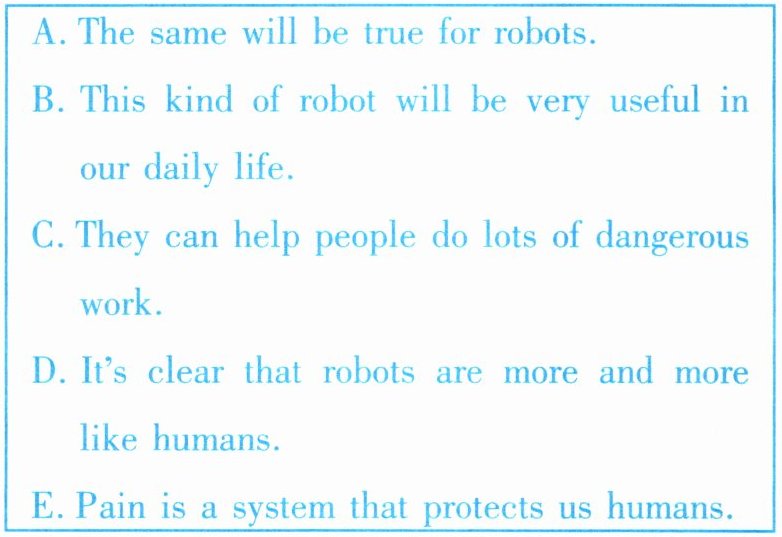
Robots are playing an important part in our life. 1. They won't get tired or bored at all, and they can't feel pain (疼痛) either. But these days, some scientists believe it's a good idea to make robots feel pain.
Scientists from Leibniz University of Hannover in Germany are working on teaching robots how to feel pain. Johannes Kuehn, one of the scientists said, "2. When we stay away from the things that can make us feel pain, we won't get hurt."
Think about how dangerous we will be if we can't feel pain. Although pain hurts, it helps us keep away from danger. 3. As a greater number of people work closely with robots, robots must be smarter to protect themselves. Johannes Kuehn believes that if humans protect robots, robots will protect humans as well.
Some Japanese scientists have already made a kind of robot which can see pain on human faces. 4. For example, if a robot can see pain on an old man's face, it will be able to take good care of the old man.
5. Maybe in the future, robots will think and speak like humans. Do you think so?
Robots are playing an important part in our life. 1. They won't get tired or bored at all, and they can't feel pain (疼痛) either. But these days, some scientists believe it's a good idea to make robots feel pain.
Scientists from Leibniz University of Hannover in Germany are working on teaching robots how to feel pain. Johannes Kuehn, one of the scientists said, "2. When we stay away from the things that can make us feel pain, we won't get hurt."
Think about how dangerous we will be if we can't feel pain. Although pain hurts, it helps us keep away from danger. 3. As a greater number of people work closely with robots, robots must be smarter to protect themselves. Johannes Kuehn believes that if humans protect robots, robots will protect humans as well.
Some Japanese scientists have already made a kind of robot which can see pain on human faces. 4. For example, if a robot can see pain on an old man's face, it will be able to take good care of the old man.
5. Maybe in the future, robots will think and speak like humans. Do you think so?
答案
1. C
2. E
3. A
4. B
5. D
2. E
3. A
4. B
5. D
解析
【分析】
本题为英语阅读理解七选五题型,解题思路是先通读全文把握主旨(机器人在生活中的作用及科学家研究让机器人感知疼痛的意义),再逐个分析空缺处的上下文,通过语义衔接、逻辑关联匹配对应选项:
1. 第1空:前文点明机器人在生活中重要,后文讲机器人的优点,需补充机器人重要的具体体现,对应选项C;
2. 第2空:后文解释疼痛的保护作用,需引出疼痛的本质,对应选项E;
3. 第3空:前文讲人类疼痛的作用,后文过渡到机器人的自我保护,需衔接两者逻辑,对应选项A;
4. 第4空:前文介绍能识别人类疼痛的机器人,后文举例其用途,需说明该机器人的价值,对应选项B;
5. 第5空:后文讲未来机器人会像人类一样思考说话,需总结机器人的发展趋势,对应选项D。
【解析】
1. 第1空:前文提到“Robots are playing an important part in our life.”,后文阐述机器人不会累、无聊等优点,选项C“They can help people do lots of dangerous work.”是机器人重要性的具体体现,符合上下文逻辑,故选C;
2. 第2空:后文“When we stay away from the things that can make us feel pain, we won't get hurt.”解释疼痛的保护作用,选项E“Pain is a system that protects us humans.”引出这一解释,符合语境,故选E;
3. 第3空:前文讲疼痛帮助人类远离危险,后文说明机器人需要保护自己,选项A“The same will be true for robots.”将人类的疼痛作用与机器人的情况衔接,起到过渡作用,故选A;
4. 第4空:前文提到日本科学家制作了能识别人类疼痛表情的机器人,后文举例其照顾老人的用途,选项B“This kind of robot will be very useful in our daily life.”承接上文机器人,引出下文例子,故选B;
5. 第5空:后文“Maybe in the future, robots will think and speak like humans.”说明机器人越来越像人类,选项D“It's clear that robots are more and more like humans.”总结这一趋势,符合语境,故选D。
【答案】
1.C 2.E 3.A 4.B 5.D
【知识点】
英语阅读理解、七选五题型、篇章逻辑衔接
【点评】
本题考查英语篇章的语义衔接与逻辑理解能力,是常见的英语阅读题型,需要学生结合上下文内容匹配合适的句子,整体难度适中,学生通过分析语境逻辑可完成解答。
【难度系数】
0.6
本题为英语阅读理解七选五题型,解题思路是先通读全文把握主旨(机器人在生活中的作用及科学家研究让机器人感知疼痛的意义),再逐个分析空缺处的上下文,通过语义衔接、逻辑关联匹配对应选项:
1. 第1空:前文点明机器人在生活中重要,后文讲机器人的优点,需补充机器人重要的具体体现,对应选项C;
2. 第2空:后文解释疼痛的保护作用,需引出疼痛的本质,对应选项E;
3. 第3空:前文讲人类疼痛的作用,后文过渡到机器人的自我保护,需衔接两者逻辑,对应选项A;
4. 第4空:前文介绍能识别人类疼痛的机器人,后文举例其用途,需说明该机器人的价值,对应选项B;
5. 第5空:后文讲未来机器人会像人类一样思考说话,需总结机器人的发展趋势,对应选项D。
【解析】
1. 第1空:前文提到“Robots are playing an important part in our life.”,后文阐述机器人不会累、无聊等优点,选项C“They can help people do lots of dangerous work.”是机器人重要性的具体体现,符合上下文逻辑,故选C;
2. 第2空:后文“When we stay away from the things that can make us feel pain, we won't get hurt.”解释疼痛的保护作用,选项E“Pain is a system that protects us humans.”引出这一解释,符合语境,故选E;
3. 第3空:前文讲疼痛帮助人类远离危险,后文说明机器人需要保护自己,选项A“The same will be true for robots.”将人类的疼痛作用与机器人的情况衔接,起到过渡作用,故选A;
4. 第4空:前文提到日本科学家制作了能识别人类疼痛表情的机器人,后文举例其照顾老人的用途,选项B“This kind of robot will be very useful in our daily life.”承接上文机器人,引出下文例子,故选B;
5. 第5空:后文“Maybe in the future, robots will think and speak like humans.”说明机器人越来越像人类,选项D“It's clear that robots are more and more like humans.”总结这一趋势,符合语境,故选D。
【答案】
1.C 2.E 3.A 4.B 5.D
【知识点】
英语阅读理解、七选五题型、篇章逻辑衔接
【点评】
本题考查英语篇章的语义衔接与逻辑理解能力,是常见的英语阅读题型,需要学生结合上下文内容匹配合适的句子,整体难度适中,学生通过分析语境逻辑可完成解答。
【难度系数】
0.6
