

 登录
登录
一、用括号内单词的适当形式填空。
1. I have (watch) the film already. I (see) it last week.
2. You needn't tell him about it. I already him about it. (tell)
3. The new couples are not at home. They have (leave) for vacation already.
4. It's the third time that I (meet) him this month.
5. They (not read) the interesting books yet.
6. My father just (come) back from work. He is tired now.
7. The film is worth seeing. I (see) it three times so far.
8. —I'm afraid the tickets to the concert have been sold out.
—Don't worry. I (buy) two tickets online already.
9. The old building in our town is a (culture) treasure, so the government is trying o protect it.
10. We usually use (chopstick) to eat noodles or rice in China.
11. To our surprise, the little boy has no difficulty (express) himself exactly in English.
1. I have (watch) the film already. I (see) it last week.
2. You needn't tell him about it. I already him about it. (tell)
3. The new couples are not at home. They have (leave) for vacation already.
4. It's the third time that I (meet) him this month.
5. They (not read) the interesting books yet.
6. My father just (come) back from work. He is tired now.
7. The film is worth seeing. I (see) it three times so far.
8. —I'm afraid the tickets to the concert have been sold out.
—Don't worry. I (buy) two tickets online already.
9. The old building in our town is a (culture) treasure, so the government is trying o protect it.
10. We usually use (chopstick) to eat noodles or rice in China.
11. To our surprise, the little boy has no difficulty (express) himself exactly in English.
答案
1. watched; saw
2. have; told
3. left
4. have met
5. haven't read
6. has; come
7. have seen
8. have bought
9. cultural
10. chopsticks
11. expressing
2. have; told
3. left
4. have met
5. haven't read
6. has; come
7. have seen
8. have bought
9. cultural
10. chopsticks
11. expressing
解析
本题主要考查八年级核心语法现在完成时的用法、词性转换以及固定搭配:
1. 现在完成时的基本结构为“have/has + 动词过去分词”,常搭配already、yet、just、so far等时间标志词;一般过去时常搭配明确的过去时间状语,如last week。
2. 第1题第一空出现have和already,符合现在完成时结构,watch的过去分词为watched;第二空时间状语last week是一般过去时标志,see的过去式为saw。
3. 第2题出现already,是现在完成时标志,主语为I,助动词用have,tell的过去分词为told。
4. 第3题出现have和already,是现在完成时结构,leave的过去分词为left。
5. 第4题是固定句型It's the + 序数词 + time that...,从句需使用现在完成时,主语为I,故填have met。
6. 第5题yet是现在完成时否定句的标志,主语为they,故现在完成时否定形式为haven't read。
7. 第6题just是现在完成时标志,主语my father是第三人称单数,助动词用has,come的过去分词为come。
8. 第7题so far是现在完成时标志,主语为I,故填have seen。
9. 第8题already是现在完成时标志,主语为I,故填have bought。
10. 第9空修饰名词treasure,需将名词culture变为形容词cultural,意为“文化的”。
11. 第10空,chopstick(筷子)为可数名词,日常使用的筷子是成双的,此处表泛指要用复数形式chopsticks。
12. 第11题是固定搭配have no difficulty (in) doing sth.,意为“做某事没有困难”,动词要变为动名词形式expressing。
1. 现在完成时的基本结构为“have/has + 动词过去分词”,常搭配already、yet、just、so far等时间标志词;一般过去时常搭配明确的过去时间状语,如last week。
2. 第1题第一空出现have和already,符合现在完成时结构,watch的过去分词为watched;第二空时间状语last week是一般过去时标志,see的过去式为saw。
3. 第2题出现already,是现在完成时标志,主语为I,助动词用have,tell的过去分词为told。
4. 第3题出现have和already,是现在完成时结构,leave的过去分词为left。
5. 第4题是固定句型It's the + 序数词 + time that...,从句需使用现在完成时,主语为I,故填have met。
6. 第5题yet是现在完成时否定句的标志,主语为they,故现在完成时否定形式为haven't read。
7. 第6题just是现在完成时标志,主语my father是第三人称单数,助动词用has,come的过去分词为come。
8. 第7题so far是现在完成时标志,主语为I,故填have seen。
9. 第8题already是现在完成时标志,主语为I,故填have bought。
10. 第9空修饰名词treasure,需将名词culture变为形容词cultural,意为“文化的”。
11. 第10空,chopstick(筷子)为可数名词,日常使用的筷子是成双的,此处表泛指要用复数形式chopsticks。
12. 第11题是固定搭配have no difficulty (in) doing sth.,意为“做某事没有困难”,动词要变为动名词形式expressing。
二、根据中文完成句子。
1. 我已经吃过早饭了。
I had breakfast.
2. 他去过北京两次。
He to Beijing twice.
3. 汤姆去图书馆了(还没回来)。
Tom to the library.
4. 你曾经读过这本书吗?
you this book?
5. 我们还没有把信寄给他们。
We the letters to them .
1. 我已经吃过早饭了。
I had breakfast.
2. 他去过北京两次。
He to Beijing twice.
3. 汤姆去图书馆了(还没回来)。
Tom to the library.
4. 你曾经读过这本书吗?
you this book?
5. 我们还没有把信寄给他们。
We the letters to them .
答案
1. have already
2. has been
3. has gone
4. Have; ever read
5. haven't sent; yet
2. has been
3. has gone
4. Have; ever read
5. haven't sent; yet
解析
本题考查现在完成时的相关用法,现在完成时基本结构为“have/has + 动词过去分词”,需区分have been to(去过某地,目前已返回)和have gone to(去了某地,目前尚未返回)的含义,同时掌握already(已经,常用于肯定句)、ever(曾经,常用于疑问句)、yet(还,常用于否定句句末)等标志词的使用:
1. 主语为I,现在完成时助动词用have,“已经”对应already,放在助动词之后,因此填have already。
2. 主语He是第三人称单数,助动词用has,“去过(已返回)”用been,因此填has been。
3. 主语Tom是第三人称单数,助动词用has,“去了未返回”用gone,因此填has gone。
4. 现在完成时的一般疑问句,主语是you,助动词用Have,“曾经”对应ever,“读”的过去分词仍为read,因此依次填Have、ever read。
5. 主语是We,现在完成时否定形式用haven't,“寄”的过去分词是sent,否定句句末的“还”对应yet,因此依次填haven't sent、yet。
1. 主语为I,现在完成时助动词用have,“已经”对应already,放在助动词之后,因此填have already。
2. 主语He是第三人称单数,助动词用has,“去过(已返回)”用been,因此填has been。
3. 主语Tom是第三人称单数,助动词用has,“去了未返回”用gone,因此填has gone。
4. 现在完成时的一般疑问句,主语是you,助动词用Have,“曾经”对应ever,“读”的过去分词仍为read,因此依次填Have、ever read。
5. 主语是We,现在完成时否定形式用haven't,“寄”的过去分词是sent,否定句句末的“还”对应yet,因此依次填haven't sent、yet。
三、口语应用。
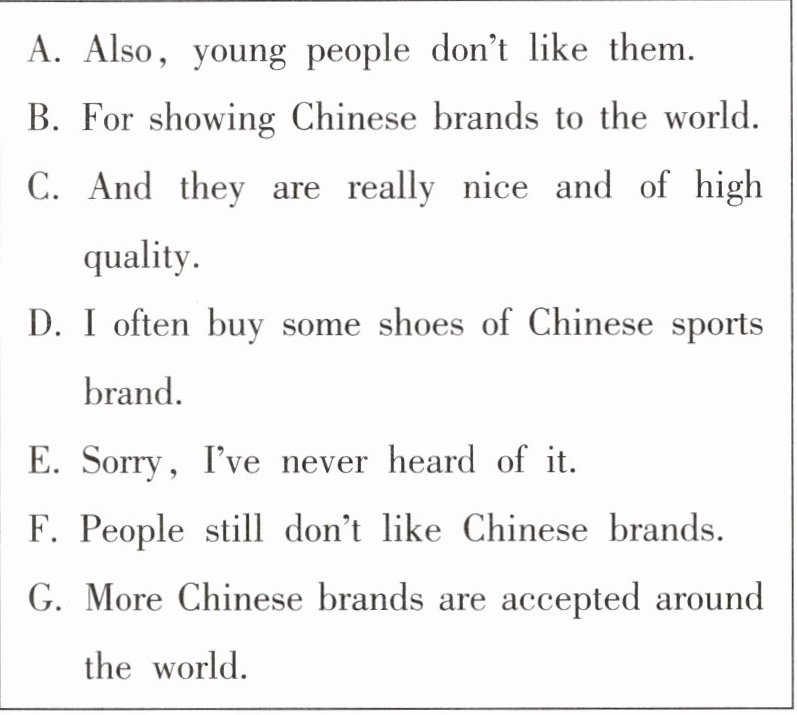
A. Also, young people don't like them.
B. For showing Chinese brands to the world.
C. And they are really nice and of high quality.
D. I often buy some shoes of Chinese sports brand.
E. Sorry, I've never heard of it.
F. People still don't like Chinese brands.
G. More Chinese brands are accepted around the world.
A: Do you know China Brand Day?
B: 1 What's it for?
A: 2 "Made in China" used to remind people of cheap and low-quality products.
B: How about now?
A: It has changed now. 3
B: I see. Have you ever heard of some Chinese sports brands?
A: Certainly. 4
B: What do you think of them?
A: They are not that expensive. 5
B: Wow, I can't wait to have a try. What do you think Chinese brands will be like in 10 years?
A: I think they will do better in showing Chinese culture.
B: I can't agree more.
1. 2. 3.
4. 5.
A. Also, young people don't like them.
B. For showing Chinese brands to the world.
C. And they are really nice and of high quality.
D. I often buy some shoes of Chinese sports brand.
E. Sorry, I've never heard of it.
F. People still don't like Chinese brands.
G. More Chinese brands are accepted around the world.
A: Do you know China Brand Day?
B: 1 What's it for?
A: 2 "Made in China" used to remind people of cheap and low-quality products.
B: How about now?
A: It has changed now. 3
B: I see. Have you ever heard of some Chinese sports brands?
A: Certainly. 4
B: What do you think of them?
A: They are not that expensive. 5
B: Wow, I can't wait to have a try. What do you think Chinese brands will be like in 10 years?
A: I think they will do better in showing Chinese culture.
B: I can't agree more.
1. 2. 3.
4. 5.
答案
【解析】:我们可以结合对话上下文逻辑逐空推导答案:
1. 空1:A询问对方是否知道中国品牌日,B紧接着询问该节日的用途,说明B此前并不了解这个节日,对应选项E。
2. 空2:上文B的问题是“What's it for?”,是在询问中国品牌日的设立目的,需要给出对应的用途回答,对应选项B。
3. 空3:前文提到过去“中国制造”给人的印象是廉价低质,现在情况已经发生了改变,此处说明具体的变化:更多中国品牌在全球范围内得到认可,对应选项G。
4. 空4:上文B询问A是否听说过中国运动品牌,A给出肯定回答后,补充说明自己经常购买中国运动品牌的鞋子,符合对话语境,对应选项D。
5. 空5:前文A提到中国运动品牌价格并不昂贵,此处递进补充说明它们外观好看、质量很高,自然引出下文B想要尝试的表述,对应选项C。
【答案】:1. E
2. B
3. G
4. D
5. C
1. 空1:A询问对方是否知道中国品牌日,B紧接着询问该节日的用途,说明B此前并不了解这个节日,对应选项E。
2. 空2:上文B的问题是“What's it for?”,是在询问中国品牌日的设立目的,需要给出对应的用途回答,对应选项B。
3. 空3:前文提到过去“中国制造”给人的印象是廉价低质,现在情况已经发生了改变,此处说明具体的变化:更多中国品牌在全球范围内得到认可,对应选项G。
4. 空4:上文B询问A是否听说过中国运动品牌,A给出肯定回答后,补充说明自己经常购买中国运动品牌的鞋子,符合对话语境,对应选项D。
5. 空5:前文A提到中国运动品牌价格并不昂贵,此处递进补充说明它们外观好看、质量很高,自然引出下文B想要尝试的表述,对应选项C。
【答案】:1. E
2. B
3. G
4. D
5. C
