

 登录
登录
任务二:请将上文中重点标注的动词-ing形式进行分类,填入不同的表格中。
| 动词-ing形式构成 | 上文中符合条件的动词-ing形式归类 |
| --- | --- |
| 一般动词直接加-ing | 1.
| 以不发音的e结尾,去e加-ing | 2.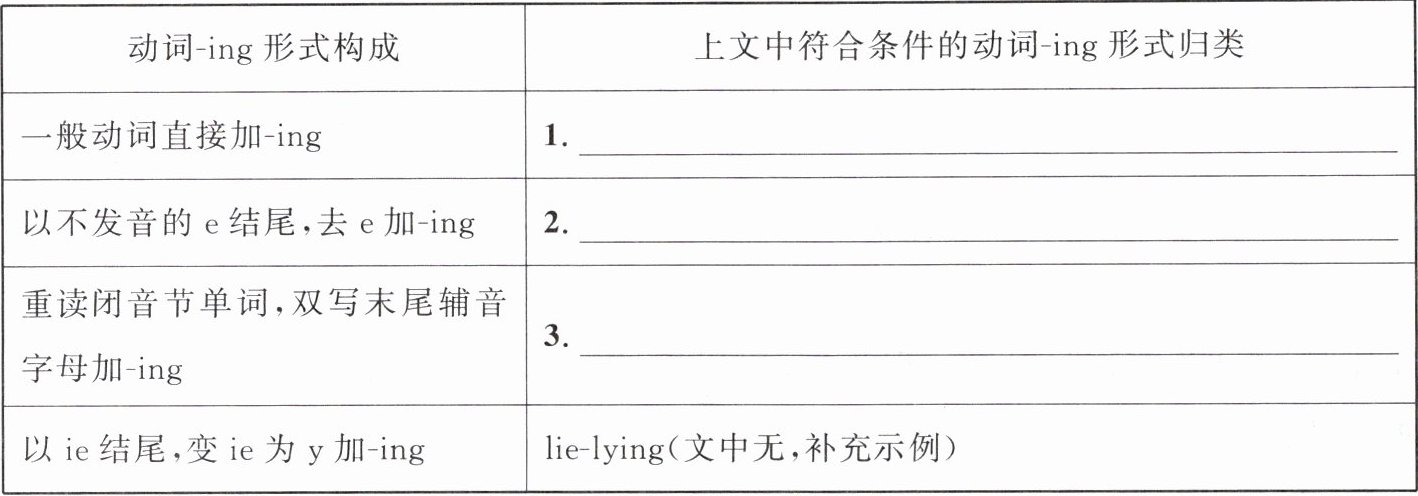 |
|
| 重读闭音节单词,双写末尾辅音字母加-ing | 3.
| 以ie结尾,变ie为y加-ing | lie-lying(文中无,补充示例) |
| 动词-ing形式构成 | 上文中符合条件的动词-ing形式归类 |
| --- | --- |
| 一般动词直接加-ing | 1.
collecting; showing; speaking; boiling; helping; climbing; laughing; singing; joining; trying; enjoying
|| 以不发音的e结尾,去e加-ing | 2.
having; preparing; making
|| 重读闭音节单词,双写末尾辅音字母加-ing | 3.
setting; getting
|| 以ie结尾,变ie为y加-ing | lie-lying(文中无,补充示例) |
答案
1. collecting; showing; speaking; boiling; helping; climbing; laughing; singing; joining; trying; enjoying
2. having; preparing; making
3. setting; getting
2. having; preparing; making
3. setting; getting
根据短文内容,完成下列任务。
Reporter:Good morning, everyone! Today we are at Jingpo Lake in Heilongjiang. It's a famous place with beautiful lakes and waterfalls. Right now, a group of junior high school students are having a study tour here. They are learning about nature and having fun at the same time. Let's talk to them and their teachers.
Reporter:Excuse me, Teacher. What are you and your students doing here?
Miss Wang:Hi! I'm Miss Wang. We are having a summer study tour about water and plants. Look! Some students are watching the lake water carefully. They are using small tubes(管子) to get water samples(样本) and writing down what they find. Other students are listening to our guide—she is telling them about Jingpo Lake's history and how it formed.
Reporter:That's meaningful! What about the students over there?
Miss Wang:Oh, they are doing group work. Some are taking photos of the plants by the lake and writing down their names. A few students are asking the guide questions about how to keep the lake clean. They have many interesting questions.
Reporter:OK. Let's talk to a student. Hi, Boy! What's your name and what are you doing?
Li Ming:Hello! I'm Li Ming. I'm drawing a picture of the lake and the waterfall. My partner is writing a short passage about what we see here. We will share our works in class tomorrow. It's my first time visiting Jingpo Lake. I like this study tour very much—it's more interesting than reading books in the classroom!
Reporter:That's great! What else will you do today?
Miss Wang:This afternoon, we will visit the nearby forest. The students will look at different trees and small animals. We will also talk about how to protect Jingpo Lake. We want students to learn from nature and love the environment.
Reporter:Well said! This study tour lets students learn and play at the same time. Thank you, Miss Wang and Li Ming. Wish you a wonderful day at Jingpo Lake!
Li Ming & Miss Wang:Thank you!
任务一:根据短文内容,选择正确的答案。
(
A. Harbin Polar land in Heilongjiang.
B. Jingpo Lake in Heilongjiang.
C. Harbin Central Street in Heilongjiang.
(
A. Swimming in the lake and taking photos.
B. Getting water samples and writing down their findings.
C. Planting trees by the lake and cleaning the water.
(
A. He is asking the guide about the lake.
B. He is drawing a picture of the lake and the waterfall.
C. He is collecting plants and small animals in the forest.
(
A. Visit the forest and look at trees and small animals.
B. Share their works in front of the class.
C. Go boating on Jingpo Lake with teachers.
(
A. To let students relax and have fun after exams.
B. To help students learn from nature and love the environment.
C. To teach students how to take photos of natural scenery.
任务二:根据短文内容填写信息,灵活运用现在进行时及单元句型表达。
| Category | Details from the Text |
| --- | --- |
| Students' activities | 1. Some students:
Watching the lake water,
2. Li Ming:
3. Other students:
| Teachers' and the guide's activities | 4. Miss Wang:
Answering the reporter's questions and
5. The guide:
| The purpose and plan of the tour | 6. The purpose:
.
7. The afternoon plan:
Reporter:Good morning, everyone! Today we are at Jingpo Lake in Heilongjiang. It's a famous place with beautiful lakes and waterfalls. Right now, a group of junior high school students are having a study tour here. They are learning about nature and having fun at the same time. Let's talk to them and their teachers.
Reporter:Excuse me, Teacher. What are you and your students doing here?
Miss Wang:Hi! I'm Miss Wang. We are having a summer study tour about water and plants. Look! Some students are watching the lake water carefully. They are using small tubes(管子) to get water samples(样本) and writing down what they find. Other students are listening to our guide—she is telling them about Jingpo Lake's history and how it formed.
Reporter:That's meaningful! What about the students over there?
Miss Wang:Oh, they are doing group work. Some are taking photos of the plants by the lake and writing down their names. A few students are asking the guide questions about how to keep the lake clean. They have many interesting questions.
Reporter:OK. Let's talk to a student. Hi, Boy! What's your name and what are you doing?
Li Ming:Hello! I'm Li Ming. I'm drawing a picture of the lake and the waterfall. My partner is writing a short passage about what we see here. We will share our works in class tomorrow. It's my first time visiting Jingpo Lake. I like this study tour very much—it's more interesting than reading books in the classroom!
Reporter:That's great! What else will you do today?
Miss Wang:This afternoon, we will visit the nearby forest. The students will look at different trees and small animals. We will also talk about how to protect Jingpo Lake. We want students to learn from nature and love the environment.
Reporter:Well said! This study tour lets students learn and play at the same time. Thank you, Miss Wang and Li Ming. Wish you a wonderful day at Jingpo Lake!
Li Ming & Miss Wang:Thank you!
任务一:根据短文内容,选择正确的答案。
(
B
)1. Where are the students having a study tour?A. Harbin Polar land in Heilongjiang.
B. Jingpo Lake in Heilongjiang.
C. Harbin Central Street in Heilongjiang.
(
B
)2. What are some students doing to study the lake?A. Swimming in the lake and taking photos.
B. Getting water samples and writing down their findings.
C. Planting trees by the lake and cleaning the water.
(
B
)3. What is Li Ming doing during the study tour?A. He is asking the guide about the lake.
B. He is drawing a picture of the lake and the waterfall.
C. He is collecting plants and small animals in the forest.
(
A
)4. What will the students do in the afternoon?A. Visit the forest and look at trees and small animals.
B. Share their works in front of the class.
C. Go boating on Jingpo Lake with teachers.
(
B
)5. What is the purpose of this study tour?A. To let students relax and have fun after exams.
B. To help students learn from nature and love the environment.
C. To teach students how to take photos of natural scenery.
任务二:根据短文内容填写信息,灵活运用现在进行时及单元句型表达。
| Category | Details from the Text |
| --- | --- |
| Students' activities | 1. Some students:
Watching the lake water,
using small tubes to get water samples
.and writing down what they find
.2. Li Ming:
Drawing a picture of the lake and the waterfall
.3. Other students:
Listening to the guide; doing group work, taking photos of the plants by the lake and writing down their names
.asking the guide questions about how to keep the lake clean
. || Teachers' and the guide's activities | 4. Miss Wang:
Answering the reporter's questions and
having a summer study tour about water and plants
.with the students
.5. The guide:
Telling the students about Jingpo Lake's history and how it formed; answering the students' questions about how to keep the lake clean
. || The purpose and plan of the tour | 6. The purpose:
To help students learn from nature and love the environment
..
7. The afternoon plan:
Visit the nearby forest, look at different trees and small animals, and talk about how to protect Jingpo Lake
. |答案
任务一:1.B 2.B 3.B 4.A 5.B
任务二:
1. Some students:Watching the lake water, using small tubes to get water samples and writing down what they find.
2. Li Ming: Drawing a picture of the lake and the waterfall.
3. Other students:Listening to the guide; doing group work, taking photos of the plants by the lake and writing down their names, asking the guide questions about how to keep the lake clean.
4. Miss Wang:Answering the reporter's questions and having a summer study tour about water and plants with the students.
5. The guide:Telling the students about Jingpo Lake's history and how it formed; answering the students' questions about how to keep the lake clean.
6. The purpose: To help students learn from nature and love the environment.
7. The afternoon plan:Visit the nearby forest, look at different trees and small animals, and talk about how to protect Jingpo Lake.
任务二:
1. Some students:Watching the lake water, using small tubes to get water samples and writing down what they find.
2. Li Ming: Drawing a picture of the lake and the waterfall.
3. Other students:Listening to the guide; doing group work, taking photos of the plants by the lake and writing down their names, asking the guide questions about how to keep the lake clean.
4. Miss Wang:Answering the reporter's questions and having a summer study tour about water and plants with the students.
5. The guide:Telling the students about Jingpo Lake's history and how it formed; answering the students' questions about how to keep the lake clean.
6. The purpose: To help students learn from nature and love the environment.
7. The afternoon plan:Visit the nearby forest, look at different trees and small animals, and talk about how to protect Jingpo Lake.
