

 登录
阅读短文,完成以下任务。
A long time ago, there was no money. People exchanged goods or services directly(直接地). For example, they traded grains(粮食) for cloth(布). But it was slow and difficult.
Later, people used different forms of money. They were commodity money(商品货币), such as shell money, knife money, copper coins and silver ingots(银条). They were easier to carry and trade.
Then people invented paper money because metal coins were heavy. Paper money was light and convenient(方便的).
Today we have many modern payment ways(付款方式): bankbooks, bank cards and cash... Now we can also use mobile phones to pay. It is so quick and easy.
任务(一):根据短文内容,分别写出3种商品货币和3种现代支付方式。
Commodity money:
Modern payment ways:
任务(二):根据短文内容,选择正确的答案。
(
A. Shell money. B. Copper coins. C. Paper money.
(
A. Metal coins were heavy.
B. Shells were hard to find.
C. Modern payment was slow.
(
A. Two. B. Three. C. Four.
任务(三):根据短文内容,判断句子正(T)误(F)。
(
(
(
(
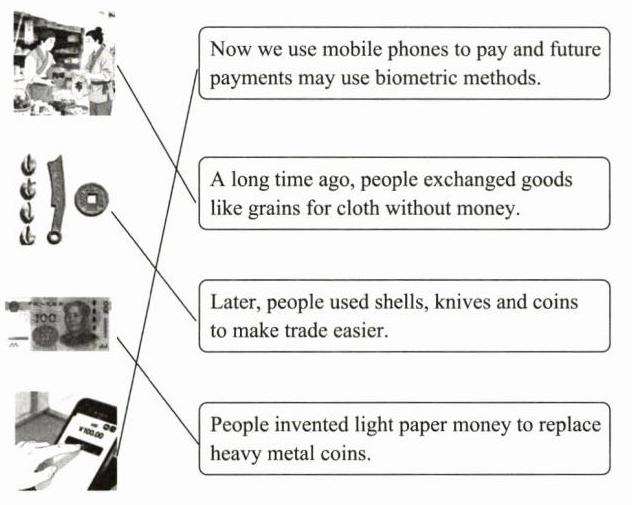
任务(四):根据短文内容连线。

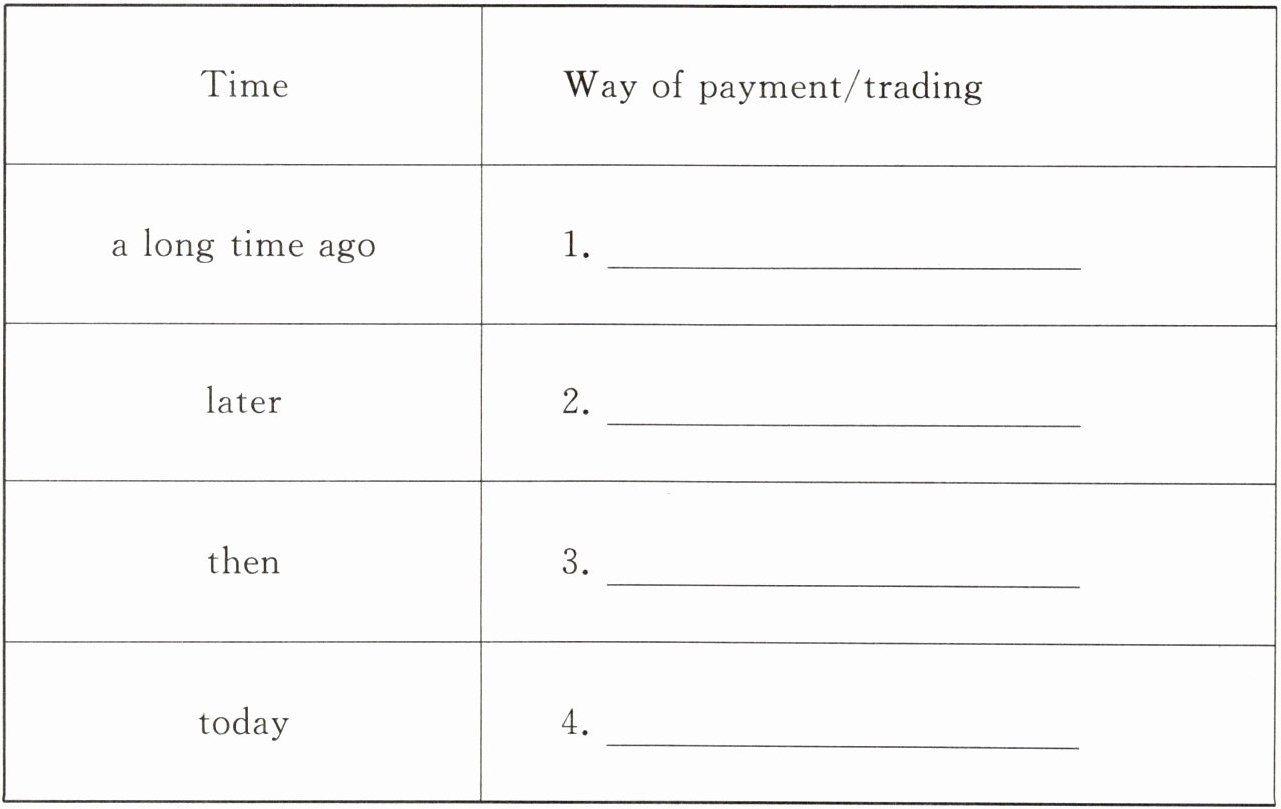
任务(五):根据短文内容,完成下面的表格。
A long time ago, there was no money. People exchanged goods or services directly(直接地). For example, they traded grains(粮食) for cloth(布). But it was slow and difficult.
Later, people used different forms of money. They were commodity money(商品货币), such as shell money, knife money, copper coins and silver ingots(银条). They were easier to carry and trade.
Then people invented paper money because metal coins were heavy. Paper money was light and convenient(方便的).
Today we have many modern payment ways(付款方式): bankbooks, bank cards and cash... Now we can also use mobile phones to pay. It is so quick and easy.
任务(一):根据短文内容,分别写出3种商品货币和3种现代支付方式。
Commodity money:
shell money
, knife money
, copper coins
Modern payment ways:
bankbooks
, bank cards
, cash
任务(二):根据短文内容,选择正确的答案。
(
C
) 1. Which one is NOT commodity money?A. Shell money. B. Copper coins. C. Paper money.
(
A
) 2. Why did people invent paper money?A. Metal coins were heavy.
B. Shells were hard to find.
C. Modern payment was slow.
(
C
) 3. How many modern payment ways are mentioned in the passage?A. Two. B. Three. C. Four.
任务(三):根据短文内容,判断句子正(T)误(F)。
(
T
) 1. People exchanged goods or services a long time ago.(
F
) 2. Shell money is a kind of paper money.(
T
) 3. Metal money was heavy, so people invented paper money.(
T
) 4. Mobile payment is quick and easy.任务(四):根据短文内容连线。
任务(五):根据短文内容,完成下面的表格。
答案
任务(一): Commodity money: shell money; knife money; copper coins; silver ingots(写出3种即可)
Modern payment ways: bankbooks; bank cards; cash; mobile payment(写出3种即可)
任务(二): 1. C 2. A 3. C
任务(三): 1. T 2. F 3. T 4. T
任务(四):
任务(五): 1. exchange goods or services
2. (use) commodity money
3. (use) paper money
4. (use) modern payment/mobile payment
