

 登录
4. (2024·扬州中考)在综合实践活动中,“特殊到一般”是一种常用方法,我们可以先研究特殊情况,猜想结论,然后再研究一般情况,证明结论.
如图,已知△ABC,CA=CB,⊙O是△ABC的外接圆,点D在⊙O上(AD>BD),连接AD,BD,CD.
【特殊化感知】
(1)如图①,若∠ACB=60°,点D在AO延长线上,则AD−BD与CD的数量关系为
【一般化探究】
(2)如图②,若∠ACB=60°,点C,D在AB同侧,判断AD−BD与CD的数量关系并说明理由.
【拓展性延伸】
(3)若∠ACB=α,直接写出AD,BD,CD满足的数量关系.(用含α的式子表示)

如图,已知△ABC,CA=CB,⊙O是△ABC的外接圆,点D在⊙O上(AD>BD),连接AD,BD,CD.
【特殊化感知】
(1)如图①,若∠ACB=60°,点D在AO延长线上,则AD−BD与CD的数量关系为
AD−BD=CD
.【一般化探究】
(2)如图②,若∠ACB=60°,点C,D在AB同侧,判断AD−BD与CD的数量关系并说明理由.
【拓展性延伸】
(3)若∠ACB=α,直接写出AD,BD,CD满足的数量关系.(用含α的式子表示)
答案
4. (1) $AD-BD=CD$ 解析: 设 $AD,BC$ 交于点 $E$.$\because CA=CB$, $∠ ACB=60°$,$\therefore △ ABC$ 是等边三角形, $\therefore ∠ CAB=60°$.$\because \odot O$ 是 $△ ABC$ 的外接圆, $\therefore AD$ 是 $∠ BAC$ 的平分线, $\therefore ∠ DAB=∠ DAC=30°$,$AD⊥ BC$,$\therefore CD=BD$,$BE=CE$.$\because$ 四边形 $ACDB$ 是圆内接四边形, $\therefore ∠ CDB=120°$,$\therefore ∠ DCB=∠ DBC=30°$. 设 $BD=1$, 则 $CD=BD=1$. 在 $Rt△ BDE$ 中, $\therefore BE=BD· \cos30°=\frac{\sqrt{3}}{2}BD=\frac{\sqrt{3}}{2}$,$\therefore BC=\sqrt{3}$.$\because AD$ 是直径, $\therefore ∠ ABD=90°$.在Rt $△ ABD$ 中, $AD=2BD=2$,$\therefore AD-BD=2-1=1$,$\therefore AD-BD=CD$.
(2) $AD-BD=CD$.理由如下:如图①所示,
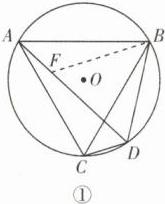 在 $AD$ 上截取 $DF=BD$.$\because \overset{\frown}{AB}=\overset{\frown}{AB}$,$\therefore ∠ ADB=∠ ACB=60°$,$\therefore △ DBF$ 是等边三角形, $\therefore BF=BD$,$∠ BFD=60°$,$\therefore ∠ AFB=120°$.$\because CA=CB$, $∠ ACB=60°$,$\therefore △ ABC$ 是等边三角形, $\therefore ∠ CAB=60°$,$AB=BC$.$\because$ 四边形 $ACDB$ 是圆内接四边形, $\therefore ∠ CDB=120°$, $\therefore ∠ AFB=∠ CDB$.又 $\because \overset{\frown}{BD}=\overset{\frown}{BD}$,$\therefore ∠ BCD=∠ BAF$.在 $△ AFB$ 和 $△ CDB$ 中, $\begin{cases}∠ AFB=∠ CDB,\\∠ BAF=∠ BCD,\\AB=CB,\end{cases}$
$\therefore △ AFB≌△ CDB(AAS)$,$\therefore AF=CD$,$\therefore AD-BD=AD-DF=AF=CD$, 即 $AD-BD=CD$.
(3) 当 $D$ 在 $\overset{\frown}{BC}$ 上时, $AD-BD=2CD· \sin\frac{α}{2}$; 当 $D$ 在 $\overset{\frown}{AB}$ 上时, $AD+BD=2CD· \sin\frac{α}{2}$. 解析:①如图②所示,
 当 $D$ 在 $\overset{\frown}{BC}$ 上时, 在 $AD$ 上截取 $DE=BD$.$\because \overset{\frown}{AB}=\overset{\frown}{AB}$,$\therefore ∠ ACB=∠ ADB$. 又 $\because CA=CB$,$DE=DB$,$\therefore △ CAB∽△ DEB$,$\therefore ∠ ABC=∠ EBD$, $\frac{AB}{EB}=\frac{BC}{BD}$, 即 $\frac{AB}{BC}=\frac{EB}{BD}$. 又 $\because ∠ ABC=∠ EBD$,$\therefore ∠ ABE=∠ CBD$, $\therefore △ ABE∽△ CBD$,$\therefore \frac{AE}{CD}=\frac{AB}{BC}=\frac{BE}{BD}$.$\because AE=AD-DE=AD-BD$, $\therefore \frac{AD-BD}{CD}=\frac{AB}{BC}$.作 $CF⊥ AB$ 于点 $F$, 在 $Rt△ BCF$ 中, $∠ BCF=\frac{1}{2}∠ ACB=\frac{α}{2}$,$\therefore BC· \sin\frac{α}{2}=BF$,$\therefore AB=2BC· \sin\frac{α}{2}$, $\therefore \frac{AD-BD}{CD}=2\sin\frac{α}{2}$, 即 $AD-BD=2CD· \sin\frac{α}{2}$.
②当 $D$ 在 $\overset{\frown}{AB}$ 上时, 如图③所示, 延长 $BD$ 至点 $G$, 使得 $DG=DA$, 连接 $AG$.$\because$ 四边形 $ACBD$ 是圆内接四边形, $\therefore ∠ GDA=∠ ACB=180°-∠ ADB$. 又 $\because CA=CB$,$DG=DA$,$\therefore △ CAB∽△ DAG$,$\therefore ∠ CAB=∠ DAG$,$\frac{AC}{AD}=\frac{AB}{AG}$, 即 $\frac{AC}{AB}=\frac{AD}{AG}$. 又 $\because ∠ CAB=∠ DAG$,$\therefore ∠ CAD=∠ BAG$,$\therefore △ CAD∽△ BAG$,$\therefore \frac{CD}{BG}=\frac{AC}{AB}$. $\because BG=BD+DG=BD+AD$, 同 ① 可得 $AB=2AC· \sin\frac{α}{2}$, $\therefore \frac{CD}{BD+AD}=\frac{AC}{AB}=\frac{AC}{2AC· \sin\frac{α}{2}}$,$\therefore AD+BD=2CD· \sin\frac{α}{2}$.综上所述, 当 $D$ 在 $\overset{\frown}{BC}$ 上时, $AD-BD=2CD· \sin\frac{α}{2}$; 当 $D$ 在 $\overset{\frown}{AB}$ 上时, $AD+BD=2CD· \sin\frac{α}{2}$.
