

 登录
八、情境交际。Amy 和 Bob 正在谈论刚结束的秋假。请选择合适的选项,补全对话。
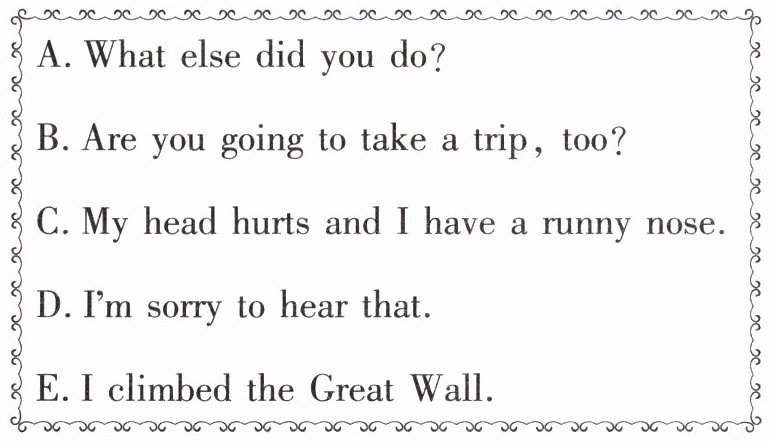
Amy: Hi, Bob! How was your autumn vacation(秋假)?
Bob: It was great! 1.
Amy: I went to Xi'an with my family—we saw the Terracotta Warriors! 2.
Bob: Oh, I watched a marathon on Sunday with my mom. I really liked watching the runners. By the way, What are you going to do during the Mid-Autumn Festival?
Amy: We're going to take a night boat tour in Xuan'en. 3.
Bob: No, we aren't. Actually, I feel ill. 4.
Amy: Oh no. 5.
Bob: You're right. Thanks for the tips!
Amy: Hi, Bob! How was your autumn vacation(秋假)?
Bob: It was great! 1.
E
What about you?Amy: I went to Xi'an with my family—we saw the Terracotta Warriors! 2.
A
Bob: Oh, I watched a marathon on Sunday with my mom. I really liked watching the runners. By the way, What are you going to do during the Mid-Autumn Festival?
Amy: We're going to take a night boat tour in Xuan'en. 3.
B
Bob: No, we aren't. Actually, I feel ill. 4.
C
Amy: Oh no. 5.
D
Maybe you should see a doctor. To stay healthy, we need to eat healthy food, exercise regularly, and avoid staying up late.Bob: You're right. Thanks for the tips!
答案
1. E 2. A 3. B 4. C 5. D
解析
【分析】
解答本题需先通读对话,明确对话围绕“秋假活动、中秋计划、身体状况”展开,再结合每个空前后句的逻辑关系匹配选项:1. 空1前Bob夸赞秋假很棒,后询问对方情况,需填Bob的秋假活动;2. 空2前Amy说自己的秋假经历,后Bob补充其他活动,需填询问对方还做了什么的句子;3. 空3前Amy说中秋计划,后Bob用No回答,需填一般疑问句;4. 空4前Bob说自己生病,需填生病的症状;5. 空5前Amy听到对方生病,需填表达同情的用语。
【解析】
1. 空1:Bob分享自己的秋假活动,对应选项E(I climbed the Great Wall.),故选E;
2. 空2:Amy询问Bob除了兵马俑之外还做了什么,对应选项A(What else did you do?),故选A;
3. 空3:Bob用No回答,说明空3是一般疑问句,询问对方是否也去旅行,对应选项B(Are you going to take a trip, too?),故选B;
4. 空4:Bob说明自己生病的症状,对应选项C(My head hurts and I have a runny nose.),故选C;
5. 空5:Amy听到对方生病,表达同情,对应选项D(I'm sorry to hear that.),故选D。
【答案】
1. E 2. A 3. B 4. C 5. D
【知识点】
情境交际,日常对话用语
【点评】
本题考查英语日常情境交际用语的运用,要求学生结合上下文语境分析对话逻辑,选择符合语境的句子,贴近生活实际,属于基础交际类题目。
【难度系数】
0.4
九、阅读理解。从古至今,货币发生了很大变化。让我们完成以下任务,一同了解货币的演变历程吧!
Long long ago, there was no money at all. People traded goods(交易物品) with each other directly. They exchanged(交换) fruits, animals or clothes to get what they needed. But this way was not always easy. Sometimes people could not find the right things for exchange.
Later, people started to use special things as money. They used shells(贝壳), knife-shaped money and copper coins(铜钱) for shopping. However, metal(金属) coins were very heavy. For example, fifty kilos of coins could only buy one roll of silk. It was tiring to take lots of coins outside.
Then paper money appeared. It was light(轻的) and convenient(方便的) to carry. From then on, paper money became popular. People also used bankbooks and bank cards(银行卡) for payment.
Now, great changes take place. We don’t always take cash(现金) when we go shopping. Most people pay by mobile phones. Mobile payment(手机支付) is quick(快捷) and easy in daily life.
What will money be like in the future? Maybe we will use new magic ways to pay for everything!
任务一:阅读文章,根据货币的发展历程,按照时间发展顺序,用1—4 将以下图片排序。
 (
任务二:单项选择。
(
A. Metal coins were too heavy to carry.
B. Paper looked more beautiful.
C. Shells became expensive.
(
A. Only metal coins.
B. Mobile phones.
C. Shells.
(
A. Metal coins were light.
B. Mobile payment is quick and easy today.
C. People never use paper money in modern life.
Long long ago, there was no money at all. People traded goods(交易物品) with each other directly. They exchanged(交换) fruits, animals or clothes to get what they needed. But this way was not always easy. Sometimes people could not find the right things for exchange.
Later, people started to use special things as money. They used shells(贝壳), knife-shaped money and copper coins(铜钱) for shopping. However, metal(金属) coins were very heavy. For example, fifty kilos of coins could only buy one roll of silk. It was tiring to take lots of coins outside.
Then paper money appeared. It was light(轻的) and convenient(方便的) to carry. From then on, paper money became popular. People also used bankbooks and bank cards(银行卡) for payment.
Now, great changes take place. We don’t always take cash(现金) when we go shopping. Most people pay by mobile phones. Mobile payment(手机支付) is quick(快捷) and easy in daily life.
What will money be like in the future? Maybe we will use new magic ways to pay for everything!
任务一:阅读文章,根据货币的发展历程,按照时间发展顺序,用1—4 将以下图片排序。
(4
) (2
) (1
) (3
)任务二:单项选择。
(
A
)1. Why did people invent(发明) paper money?A. Metal coins were too heavy to carry.
B. Paper looked more beautiful.
C. Shells became expensive.
(
B
)2. Now, what do people mainly(主要) use to pay?A. Only metal coins.
B. Mobile phones.
C. Shells.
(
B
)3. Which sentence is TRUE(正确)?A. Metal coins were light.
B. Mobile payment is quick and easy today.
C. People never use paper money in modern life.
答案
任务一:4213
任务二:1. A 2. B 3. B
解析
【分析】首先梳理货币发展的时间脉络:最早是物物交换(对应第三幅原始人交换物品的图),之后使用金属货币(对应第二幅背铜钱的图),接着出现纸币、银行卡等支付方式(对应第四幅钱包、银行卡的图),现在是手机支付(对应第一幅用手机支付的图)。再针对选择题,需定位原文对应细节:第1题找纸币发明的原因,第2题找当前主要支付方式,第3题判断句子正误,均需从原文提取关键信息。
【解析】任务一:根据原文时间顺序,四幅图对应的阶段依次为:手机支付(现代,第4阶段)、金属货币(古代,第2阶段)、物物交换(最早,第1阶段)、银行卡/现金支付(第3阶段),因此排序为4、2、1、3。任务二:1. 原文提到“metal coins were very heavy”,说明金属硬币太重是发明纸币的原因,选A;2. 原文明确“Most people pay by mobile phones”,选B;3. A选项“金属硬币轻”与原文“metal coins were very heavy”矛盾,B选项“Mobile payment is quick and easy today”与原文一致,C选项“现代不用纸币”错误,故选B。
【答案】任务一:4213;任务二:1.A 2.B 3.B
【知识点】英语阅读理解、细节理解、信息排序
【点评】本题以货币演变为主题,考查学生对英语阅读中时间顺序的梳理和细节信息的提取能力,贴近生活,难度适中。
【难度系数】0.5
