

 登录
Ⅵ. 中考趋势 短文还原
从方框中选出能填入空白处的最佳选项。选项中有两项多余。
新素材 “盛有声”火锅店 In the city of Zhengzhou, there is a special local hot pot restaurant called Shengyousheng. Unlike ordinary hot pot shops, it is doing something warm and meaningful for special groups.
1.
The restaurant's name means “more sound”. 2.
Shengyousheng runs as a self-service hot pot restaurant, which is perfect for its special workers. 3.
To solve possible communication problems between hearing disabled workers and customers, the restaurant has prepared many practical and thoughtful methods. 4.
This special restaurant is more than a common place to enjoy delicious hot pot. 5.
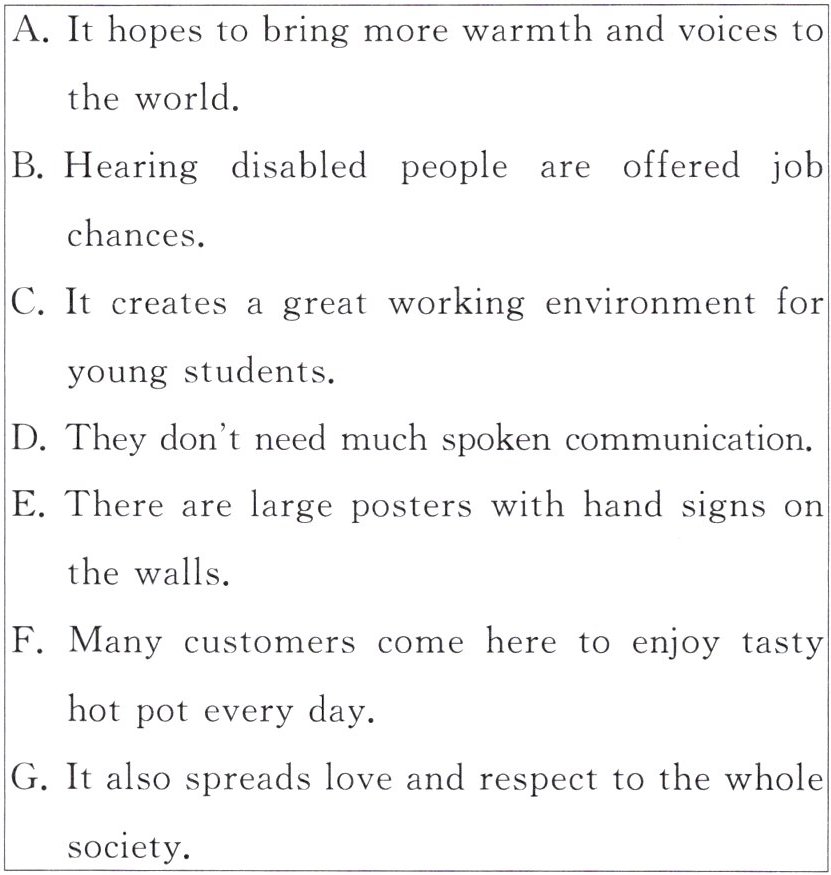
A. It hopes to bring more warmth and voices to the world.
B. Hearing disabled people are offered job chances.
C. It creates a great working environment for young students.
D. They don't need muspoken communication.
E. There are large posters with hand signs on the walls.
F. Many customers come here to enjoy tasty hot pot every day.
G. It also spreads love and respect to the whole society.
Ⅶ.首字母填空
根据短文内容及首字母提示,在空格处填入一个适当的词使短文完整。
跨学科 语文(南京二模改编)Classical Chinese is a written form of the Chinese language used in ancient China, mainly based on the language form before the Qin period. Before 1918, all articles were written in Classical Chinese. Today, we generally call it “wenyanwen”.
Classical Chinese is now an important 1. c
Ancient Chinese is a famous series with 4 books and 14 units. Each unit has three parts: the anthology(选集), common words, and archaic Chinese(古汉语). The anthology 4. p
These parts are 7. c
从方框中选出能填入空白处的最佳选项。选项中有两项多余。
新素材 “盛有声”火锅店 In the city of Zhengzhou, there is a special local hot pot restaurant called Shengyousheng. Unlike ordinary hot pot shops, it is doing something warm and meaningful for special groups.
1.
B
The restaurant's name means “more sound”. 2.
A
Nearly half of its full-time workers are hearing disabled. Thirty-one-year-old Deng Wei works as a kitchen manager here. He earns about 4,000 yuan every month and feels very satisfied with this quiet, warm and friendly workplace.Shengyousheng runs as a self-service hot pot restaurant, which is perfect for its special workers. 3.
D
The customers can freely pick their favourite food and mix different kinds of sauces on their own. This makes it much easier for hearing disabled workers to finish their daily work.To solve possible communication problems between hearing disabled workers and customers, the restaurant has prepared many practical and thoughtful methods. 4.
E
These posters show simple hand signs for daily expressions, with clear pictures and words for customers to understand easily. Besides, every table is prepared with message cards for convenient written communication.This special restaurant is more than a common place to enjoy delicious hot pot. 5.
G
It tells people that true kindness, patience and respect can bridge the gap between people, even without spoken words. It is truly a warm-hearted restaurant full of love and positive energy.A. It hopes to bring more warmth and voices to the world.
B. Hearing disabled people are offered job chances.
C. It creates a great working environment for young students.
D. They don't need muspoken communication.
E. There are large posters with hand signs on the walls.
F. Many customers come here to enjoy tasty hot pot every day.
G. It also spreads love and respect to the whole society.
Ⅶ.首字母填空
根据短文内容及首字母提示,在空格处填入一个适当的词使短文完整。
跨学科 语文(南京二模改编)Classical Chinese is a written form of the Chinese language used in ancient China, mainly based on the language form before the Qin period. Before 1918, all articles were written in Classical Chinese. Today, we generally call it “wenyanwen”.
Classical Chinese is now an important 1. c
course
for every middle school student. Learning it helps us understand 2. hhow
ancient Chinese spoke and thought. I would like to recommend a book for students who are deeply 3. iinterested
in Classical Chinese.Ancient Chinese is a famous series with 4 books and 14 units. Each unit has three parts: the anthology(选集), common words, and archaic Chinese(古汉语). The anthology 4. p
picks
many famous articles from The Analects, Stratagems of the Warring States, The Commentary of Zuo and The Works of Mencius. These works have made great contributions to Chinese literary history. After reading the anthology, you will learn how to tell the 5. ddifference/differences
between ancient and modern words. For example, in spoken language, we say “你吃饭了吗?”, 6. bbut
in Classical Chinese, it becomes “饭否?”. Archaic Chinese tells the background of the anthology, helping you better understand the stories behind the Chinese words.These parts are 7. c
closely
connected. If you only read the anthology, you will only understand what the teacher 8. eexplains
in class. If you only study common words but don't read the anthology, you will only get some knowledge about words. Without learning archaic Chinese, you cannot truly master classical Chinese as a 9. wwhole
. So, you must study all three parts together. If you enjoy Classical Chinese, we hope this book will help deepen your interest in Classical Chinese, history, and literature and improve your 10. aability
to read Classical Chinese.答案
Ⅵ. 1.B 2.A 3.D 4.E 5.G
【语篇解读】本文是一篇说明文,主要介绍了郑州一家为听障人士提供就业机会的自助火锅店,以及它用暖心设计促进平等沟通、传递尊重的做法。
Ⅶ.【语篇解读】本文是一篇说明文,介绍了文言文的历史、作为中学生重要课程的意义,推荐了《古代汉语》系列书籍,阐述其文选、常用词和古汉语三部分内容及紧密联系,强调需综合学习以掌握文言文。
1. course 解析:句意:文言文现在是每个中学生的一门重要课程。根据“an important ... for every middle school student”及首字母提示可知,此处指“课程”,“course”表示“课程”,符合语境。
2. how 解析:句意:学习它有助于我们理解古代中国人如何说话和思考。根据“understand ... ancient Chinese spoke and thought”及首字母提示可知,此处表示“如何”,用“how”引导宾语从句,符合语境。
3. interested 解析:句意:我想给对文言文深感兴趣的学生推荐一本书。根据“are deeply ... in Classical Chinese”及首字母提示可知,此处为固定搭配“be interested in”,表示“对……感兴趣”,符合语境。
4. picks 解析:句意:文选选取了《论语》《战国策》《左传》和《孟子》中的许多著名文章。根据下文出现的书籍及首字母提示可知,此处表示“挑选,选取”,主语“The anthology”为单数,谓语动词用第三人称单数形式“picks”,符合语境。
5. difference/differences 解析:根据“tell the ... between ancient and modern words”及首字母提示可知,此处为固定搭配“tell the difference(s) between ...”,表示“区分……之间的差异”,“difference”可用单数或复数形式,符合语境。
6. but 解析:根据前后句语义对比可知,此处表示转折关系,用“but”连接,符合语境。
7. closely 解析:根据下文及首字母提示可知,这本书的三个部分紧密相连,此处表示“紧密地”,用副词“closely”修饰动词“connected”,符合语境。
8. explains 解析:结合学习场景,老师在课堂上的核心动作是“讲解、阐释”,结合首字母,“explain”符合语境。主语“the teacher”为第三人称单数,谓语动词用“explains”。
9. whole 解析:上文分别说明“只学文选”“只学常用字词”的不足,此句进一步补充“不学习古汉语知识”的问题。结合首字母提示可知,此处为固定搭配“as a whole”,表示“作为一个整体,整体上”,符合语境。故填 whole。
10. ability 解析:根据上下文可知,此处总结学习这本书的作用,根据 improve 以及首字母可知,ability“能力”符合语境。
