

 登录
登录
Passage E
实际用时: minutes
Read the passage and then fill in the blanks.
Once upon a time there were three little pigs. One day their mother said to them. "You are too big to live here. You need to build your own houses. But make sure that the wolf can't catch you."
The first little pig built his house with grass. It was the easiest thing to do. The second little pig built his house with sticks, which was a little bit stronger than the grass house. The third little pig built his house with bricks (砖), which was the strongest but took him a lot of time.
One day the wolf came and saw the first little pig in his grass house. The wolf pushed down the house and ate the first little pig. Then the wolf came to the stick house and pushed down that house, too. Then he ate the second little pig. The wolf then came to the house of bricks, but he could not push down that brick house. The wolf climbed up to the roof and tried to get in through the chimney (烟囱). The smart little pig fired and boiled water on it. When the wolf fell down, he fell into the hot water and died.
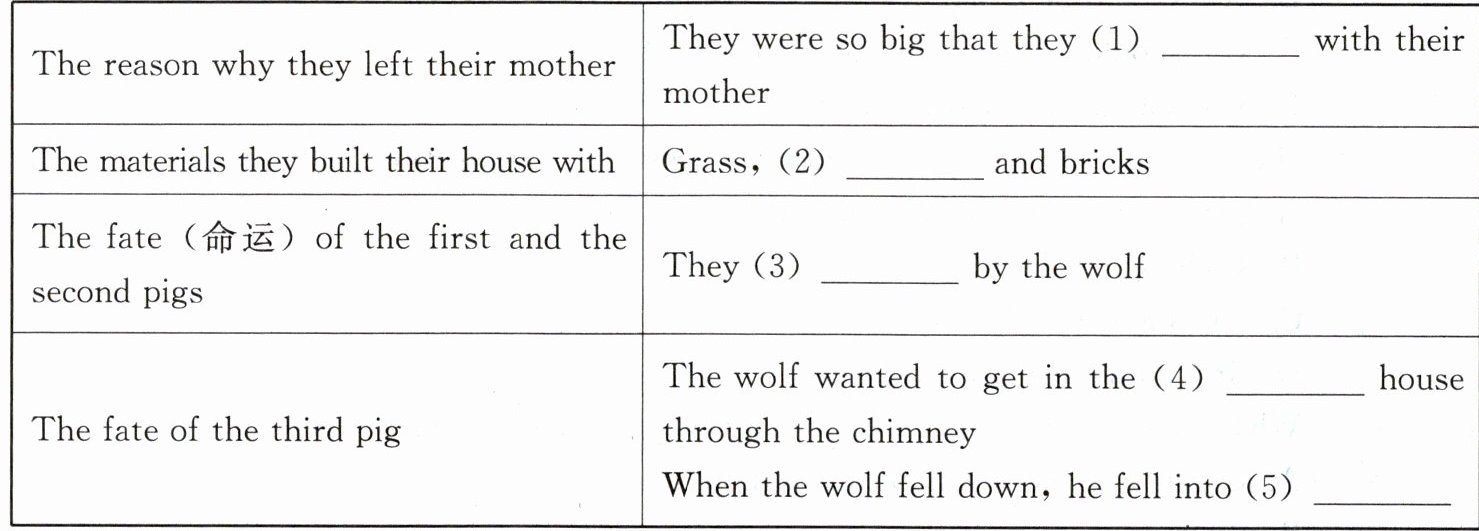
实际用时: minutes
Read the passage and then fill in the blanks.
Once upon a time there were three little pigs. One day their mother said to them. "You are too big to live here. You need to build your own houses. But make sure that the wolf can't catch you."
The first little pig built his house with grass. It was the easiest thing to do. The second little pig built his house with sticks, which was a little bit stronger than the grass house. The third little pig built his house with bricks (砖), which was the strongest but took him a lot of time.
One day the wolf came and saw the first little pig in his grass house. The wolf pushed down the house and ate the first little pig. Then the wolf came to the stick house and pushed down that house, too. Then he ate the second little pig. The wolf then came to the house of bricks, but he could not push down that brick house. The wolf climbed up to the roof and tried to get in through the chimney (烟囱). The smart little pig fired and boiled water on it. When the wolf fell down, he fell into the hot water and died.
答案
Passage E
(1) couldn't live (2) sticks (3) were eaten (4) brick (5) the hot water and died
(1) couldn't live (2) sticks (3) were eaten (4) brick (5) the hot water and died
解析
【分析】
本题是基于《三只小猪》的故事内容进行的阅读理解填空题,解题思路为:先通读短文理解故事整体大意,再针对每个空,定位原文对应段落的细节描述,结合语境和语法规则确定正确答案,最后核对答案是否与故事内容匹配。
【解析】
1. 第(1)空:根据原文第一段妈妈的话“You are too big to live here.”可知,三只猪太大了,无法和妈妈一起居住,故填couldn't live。
2. 第(2)空:根据原文第二段对三只猪建房子材料的描述:第一只用草,第二只用木棍,第三只用砖,故此处填sticks。
3. 第(3)空:根据原文第三段,狼推倒了第一只猪的草房并吃掉它,推倒第二只猪的木棍房也吃掉它,此处表示“被狼吃掉”,用一般过去时的被动语态,主语是复数,故填were eaten。
4. 第(4)空:第三只猪用砖建的房子,此处用名词brick作定语修饰house,故填brick。
5. 第(5)空:根据原文最后一句“When the wolf fell down, he fell into the hot water and died.”可知,狼掉进热水里死亡,故填the hot water and died。
【答案】
(1) couldn't live (2) sticks (3) were eaten (4) brick (5) the hot water and died
【知识点】
一般过去时被动语态;名词辨析;阅读理解
【点评】
本题依托经典童话考查阅读理解细节提取和基础语法运用,内容简单易懂,只要读懂短文就能完成填空,适合基础阶段学生练习。
【难度系数】
0.3
本题是基于《三只小猪》的故事内容进行的阅读理解填空题,解题思路为:先通读短文理解故事整体大意,再针对每个空,定位原文对应段落的细节描述,结合语境和语法规则确定正确答案,最后核对答案是否与故事内容匹配。
【解析】
1. 第(1)空:根据原文第一段妈妈的话“You are too big to live here.”可知,三只猪太大了,无法和妈妈一起居住,故填couldn't live。
2. 第(2)空:根据原文第二段对三只猪建房子材料的描述:第一只用草,第二只用木棍,第三只用砖,故此处填sticks。
3. 第(3)空:根据原文第三段,狼推倒了第一只猪的草房并吃掉它,推倒第二只猪的木棍房也吃掉它,此处表示“被狼吃掉”,用一般过去时的被动语态,主语是复数,故填were eaten。
4. 第(4)空:第三只猪用砖建的房子,此处用名词brick作定语修饰house,故填brick。
5. 第(5)空:根据原文最后一句“When the wolf fell down, he fell into the hot water and died.”可知,狼掉进热水里死亡,故填the hot water and died。
【答案】
(1) couldn't live (2) sticks (3) were eaten (4) brick (5) the hot water and died
【知识点】
一般过去时被动语态;名词辨析;阅读理解
【点评】
本题依托经典童话考查阅读理解细节提取和基础语法运用,内容简单易懂,只要读懂短文就能完成填空,适合基础阶段学生练习。
【难度系数】
0.3
Passage F
实际用时: _______ minutes
Cloze.
Jane was a young girl. She loved to see the negative side of life.
Once, her father took her to the kitchen. He asked Jane to take a potato, an egg _______1_______ two spoons of tea leaves. Jane was _______2_______, and asked her father, "Do you want me to cook?"
"No," her father said.
He then took three pots and _______3_______ some water into each pot. The pots were placed on the stove. Once the water started to boil, he dropped the potato in a pot, egg in _______4_______ one and the tea leaves in the third one.
"Why are you doing all these things?" Jane felt puzzled and asked.
"You'll get the answer in fifteen minutes," said her father.
The impatient daughter tried her best _______5_______ for around 15 minutes.
Now, he placed the two plates, one with the potato and _______6_______ with the egg, and the cup of tea in front of Jane.
Jane asked, "What does it mean, father? I don't understand!"
"Each object faced similar adversities (不幸), but reacted (反应) _______7_______. After we put the potato into boiling water, it became very weak. The soft egg became very hard _______8_______ we put it in boiling water. And the tea leaves changed the water itself, giving it a nice smell. _______9_______ fantastic it is!"
Jane understood that we could create _______10_______ new even when we experienced adversities.
So, what are you? A potato, an egg or tea leaves?
1. A. and
B. but
C. or
D. while
2. A. disappointing
B. disappointed
C. surprised
D. surprising
3. A. poured
B. emptied
C. pulled
D. threw
4. A. second
B. the second
C. a second
D. secondly
5. A. to leave
B. to look
C. to pay
D. to wait
6. A. other
B. the other
C. another
D. others
7. A. hardly
B. regularly
C. possibly
D. differently
8. A. before
B. when
C. though
D. until
9. A. How
B. What
C. What a
D. How much
10. A. nothing
B. anything
C. something
D. everything
实际用时: _______ minutes
Cloze.
Jane was a young girl. She loved to see the negative side of life.
Once, her father took her to the kitchen. He asked Jane to take a potato, an egg _______1_______ two spoons of tea leaves. Jane was _______2_______, and asked her father, "Do you want me to cook?"
"No," her father said.
He then took three pots and _______3_______ some water into each pot. The pots were placed on the stove. Once the water started to boil, he dropped the potato in a pot, egg in _______4_______ one and the tea leaves in the third one.
"Why are you doing all these things?" Jane felt puzzled and asked.
"You'll get the answer in fifteen minutes," said her father.
The impatient daughter tried her best _______5_______ for around 15 minutes.
Now, he placed the two plates, one with the potato and _______6_______ with the egg, and the cup of tea in front of Jane.
Jane asked, "What does it mean, father? I don't understand!"
"Each object faced similar adversities (不幸), but reacted (反应) _______7_______. After we put the potato into boiling water, it became very weak. The soft egg became very hard _______8_______ we put it in boiling water. And the tea leaves changed the water itself, giving it a nice smell. _______9_______ fantastic it is!"
Jane understood that we could create _______10_______ new even when we experienced adversities.
So, what are you? A potato, an egg or tea leaves?
1. A. and
B. but
C. or
D. while
2. A. disappointing
B. disappointed
C. surprised
D. surprising
3. A. poured
B. emptied
C. pulled
D. threw
4. A. second
B. the second
C. a second
D. secondly
5. A. to leave
B. to look
C. to pay
D. to wait
6. A. other
B. the other
C. another
D. others
7. A. hardly
B. regularly
C. possibly
D. differently
8. A. before
B. when
C. though
D. until
9. A. How
B. What
C. What a
D. How much
10. A. nothing
B. anything
C. something
D. everything
答案
Passage F
1.A 2.C 3.A 4.B 5.D 6.B 7.D 8.B 9.A 10.C
1.A 2.C 3.A 4.B 5.D 6.B 7.D 8.B 9.A 10.C
解析
【分析】
先通读全文,理解父亲用土豆、鸡蛋、茶叶在沸水中的不同反应教育女儿面对逆境的主旨。逐题结合语境、词汇含义、语法规则及固定搭配分析:1题需选并列连词连接三个物品;2题修饰人用-ed形容词表感受;3题选表示“倒水”的动词;4题特指三者中的第二个用定冠词加序数词;5题考查固定搭配try one's best to do sth及wait for短语;6题考查两者间的“另一个”代词;7题根据后文不同反应选副词;8题选表时间的连词;9题考查感叹句结构;10题肯定句中选表“某物”的不定代词。
【解析】
1. 考查连词:potato、egg、tea leaves是并列的三个物品,需用并列连词and连接,故选A。
2. 考查形容词:主语Jane是人,修饰人的感受用-ed形式;结合语境女儿问父亲是否要做饭,表现出惊讶,故选C。
3. 考查动词:pour意为“倒(液体)”,pour water是固定搭配,符合“往每个锅里倒水”的语境,故选A。
4. 考查冠词:前文提到三个锅,第一个放土豆,此处特指“第二个锅”,需用定冠词the加序数词second,故选B。
5. 考查固定搭配:try one's best to do sth是固定结构,wait for意为“等待”,符合“女儿等待15分钟”的语境,故选D。
6. 考查代词:one...the other是固定结构,指两者中的“一个...另一个”,此处指两个盘子,一个放土豆,另一个放鸡蛋,故选B。
7. 考查副词:根据后文土豆变弱、鸡蛋变硬、茶叶改变水,可知三者反应不同,differently意为“不同地”,符合语境,故选D。
8. 考查连词:此处表示“当把鸡蛋放入沸水时”,需用表时间的连词when,故选B。
9. 考查感叹句:感叹句结构“How + 形容词 + 主语 + 谓语!”,fantastic是形容词,故选A。
10. 考查不定代词:肯定句中表“某物”用something,此处指“创造一些新的东西”,故选C。
【答案】
1.A 2.C 3.A 4.B 5.D 6.B 7.D 8.B 9.A 10.C
【知识点】
英语完形填空、词汇辨析、语法运用
【点评】
本文通过生活化的事例传递面对逆境的不同态度,贴近学生生活,考查基础词汇与语法知识,是难度适中的完形填空题型。
【难度系数】
0.6
先通读全文,理解父亲用土豆、鸡蛋、茶叶在沸水中的不同反应教育女儿面对逆境的主旨。逐题结合语境、词汇含义、语法规则及固定搭配分析:1题需选并列连词连接三个物品;2题修饰人用-ed形容词表感受;3题选表示“倒水”的动词;4题特指三者中的第二个用定冠词加序数词;5题考查固定搭配try one's best to do sth及wait for短语;6题考查两者间的“另一个”代词;7题根据后文不同反应选副词;8题选表时间的连词;9题考查感叹句结构;10题肯定句中选表“某物”的不定代词。
【解析】
1. 考查连词:potato、egg、tea leaves是并列的三个物品,需用并列连词and连接,故选A。
2. 考查形容词:主语Jane是人,修饰人的感受用-ed形式;结合语境女儿问父亲是否要做饭,表现出惊讶,故选C。
3. 考查动词:pour意为“倒(液体)”,pour water是固定搭配,符合“往每个锅里倒水”的语境,故选A。
4. 考查冠词:前文提到三个锅,第一个放土豆,此处特指“第二个锅”,需用定冠词the加序数词second,故选B。
5. 考查固定搭配:try one's best to do sth是固定结构,wait for意为“等待”,符合“女儿等待15分钟”的语境,故选D。
6. 考查代词:one...the other是固定结构,指两者中的“一个...另一个”,此处指两个盘子,一个放土豆,另一个放鸡蛋,故选B。
7. 考查副词:根据后文土豆变弱、鸡蛋变硬、茶叶改变水,可知三者反应不同,differently意为“不同地”,符合语境,故选D。
8. 考查连词:此处表示“当把鸡蛋放入沸水时”,需用表时间的连词when,故选B。
9. 考查感叹句:感叹句结构“How + 形容词 + 主语 + 谓语!”,fantastic是形容词,故选A。
10. 考查不定代词:肯定句中表“某物”用something,此处指“创造一些新的东西”,故选C。
【答案】
1.A 2.C 3.A 4.B 5.D 6.B 7.D 8.B 9.A 10.C
【知识点】
英语完形填空、词汇辨析、语法运用
【点评】
本文通过生活化的事例传递面对逆境的不同态度,贴近学生生活,考查基础词汇与语法知识,是难度适中的完形填空题型。
【难度系数】
0.6
